CM Yogi: UP Controlled Encephalitis in Just 2 Years
Synopsis
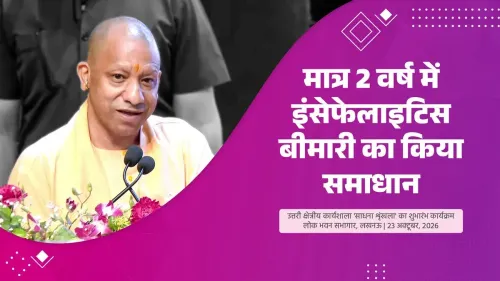
Chief Minister Yogi Adityanath declared on 23 October 2026 that Uttar Pradesh has fully controlled encephalitis — a disease haunting eastern UP for 40 years — citing two years of systematic training of ASHA workers, paramedics, pediatricians and the full primary-healthcare chain.
Key Takeaways
The Chief Minister's Office of Uttar Pradesh announced on 23 October 2026 that the state has 'completely controlled' encephalitis.
CM Yogi Adityanath attributed the achievement to systematic capacity building and training across every level of the health system.
Workers covered include ASHA workers, Anganwadi workers, paramedics, pediatricians, PHC/CHC staff , and medical college teams.
The CM claimed a 40-year-old disease burden was brought under control in just two years — though independent verification of exact timelines is pending.
Eastern Uttar Pradesh , particularly the Gorakhpur belt, suffered annual encephalitis outbreaks that primarily killed children for decades.
Surveillance data on post-intervention encephalitis incidence will be the key metric to watch for independent validation.
A disease that stalked Uttar Pradesh's eastern districts for four decades has been brought to heel — and Chief Minister Yogi Adityanath says the turnaround took just two years. The Chief Minister's Office of Uttar Pradesh shared the claim on Friday, 23 October 2026, with CM Yogi attributing the breakthrough to a systematic overhaul of grassroots health infrastructure rather than any single intervention.
How the State's Ground Army Broke the Encephalitis Cycle
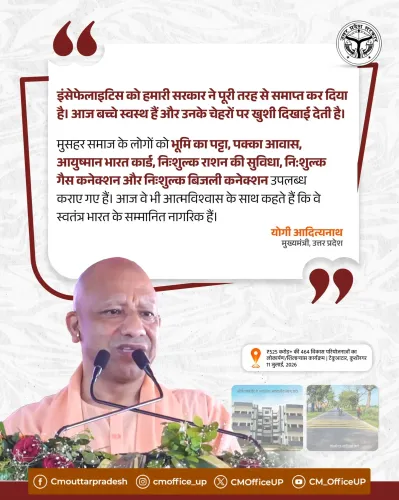
The CM's statement, quoted verbatim from the post, reads: 'इंसेफेलाइटिस को उत्तर प्रदेश ने पूरी तरह नियंत्रित कर लिया है' — 'Uttar Pradesh has completely controlled encephalitis.' The credit, he said, belongs to a coordinated chain of workers: ASHA workers, Anganwadi workers, paramedics, pediatricians, and facilities from Primary Health Centres (PHCs) and Community Health Centres (CHCs) right up to District Hospitals and Medical Colleges.
The logic is straightforward: define every link in the chain, train each one, and the results follow. That is precisely what the state claims happened. By locking down roles at each level of the health pyramid — from the village-level ASHA worker who spots early symptoms to the pediatrician at a medical college who manages critical cases — the government says it engineered a near-complete containment.
Forty Years of Suffering in Eastern UP — and What Changed
Encephalitis, particularly Japanese Encephalitis (JE) and Acute Encephalitis Syndrome (AES), carved a grim path through UP's eastern districts for generations. Children were its primary victims. Districts such as Gorakhpur — CM Yogi's own parliamentary constituency — became synonymous with the disease, with annual outbreaks claiming hundreds of young lives each season.
The National Vector Borne Disease Control Programme had extended JE vaccination to endemic districts from the mid-2000s onward, laying an early foundation. But vaccination alone was never enough. What the state argues it added — and what the CM's statement underlines — is capacity building: systematic training that turned a patchy response into a coordinated, tiered system capable of catching cases early and managing them locally.
What 'Completely Controlled' Means — and What Comes Next
The phrase 'completely controlled' is a strong claim, and annual health surveillance data will be the measure that either cements or complicates it. The next critical test will be the release of post-2024 encephalitis incidence figures from the state's endemic districts — numbers that independent public-health researchers will scrutinise closely.
If the model holds up under that scrutiny, the bigger question becomes replication: can the same tiered, training-first approach be exported to other states where vector-borne and neurological diseases still extract a heavy toll on children? UP's playbook — clear role assignment, aggressive field-worker capacity building, and a connected referral chain — is already being watched as a potential template.
Four decades of a seasonal nightmare ended, the state says, in two years of disciplined execution. The data will have the final word — but the political momentum behind this claim is unmistakable.
Point of View
It would represent one of independent India's more consequential district-level health turnarounds, giving the BJP a durable social-sector narrative ahead of future electoral cycles. The real test is whether the tiered capacity-building model survives institutional inertia and budget cycles once the political spotlight moves on.
NationPress
23 Oct 2026
Frequently Asked Questions
Has Uttar Pradesh really controlled encephalitis completely?
The Chief Minister's Office of Uttar Pradesh claimed on 23 October 2026 that encephalitis has been 'completely controlled,' crediting two years of systematic training across ASHA workers, paramedics, pediatricians and the full health-facility chain. Independent verification through annual surveillance data is still awaited.
What is encephalitis and why was it a big problem in UP?
Encephalitis — inflammation of the brain, often caused by Japanese Encephalitis (JE) virus or Acute Encephalitis Syndrome (AES) — devastated eastern Uttar Pradesh's districts, particularly Gorakhpur, for roughly four decades, killing hundreds of children annually during peak outbreak seasons.
What did UP do to control encephalitis?
According to CM Yogi Adityanath, the state focused on capacity building: assigning clear roles to ASHA workers, Anganwadi workers, paramedics, pediatricians, PHCs, CHCs, District Hospitals and Medical Colleges, and training each link in the chain to detect and manage cases early.
What is the role of ASHA workers in UP's encephalitis control?
ASHA (Accredited Social Health Activists) are community-level frontline workers who serve as the first point of contact in villages. In UP's encephalitis strategy, they were trained to identify early symptoms and ensure prompt referrals, helping catch cases before they became critical.
When did UP start the Japanese Encephalitis vaccination drive?
The National Vector Borne Disease Control Programme expanded Japanese Encephalitis vaccination to endemic UP districts from the mid-2000s onward, providing a foundation on which later capacity-building efforts under the Yogi Adityanath government were layered.