CM Bhagwant Mann: Punjab lays 14,000 km pipelines, passes anti-central-law resolution
Synopsis
Punjab CM Bhagwant Mann told the 16th Vidhan Sabha that 14,000 km of pipelines have pushed paddy yields to ~90 maunds per acre. The House also passed what he called India's first state-level resolution against anti-democratic central laws — a move that has not yet reached Parliament.
Key Takeaways
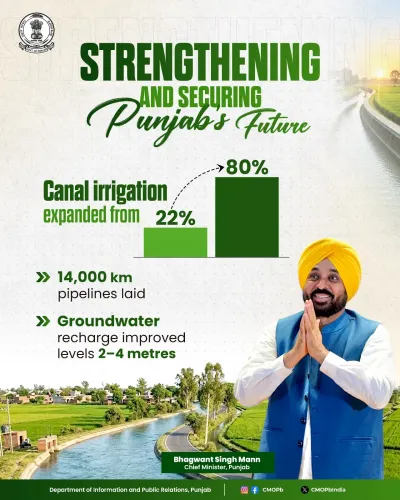
14,000 km of canal-water pipelines laid across Punjab, according to CM Bhagwant Mann's address to the 16th Vidhan Sabha.
Paddy yields have reportedly reached approximately 90 maunds per acre this kharif season due to mineral-rich canal water.
The 13th Session of the 16th Punjab Vidhan Sabha passed a resolution against laws described as 'anti-democracy and oppressive.' Punjab is claimed to be the first state legislature in India to pass such a resolution — ahead of Lok Sabha and Rajya Sabha.
The dual announcement combines agrarian infrastructure outcomes with an explicitly political federal challenge, consistent with AAP Punjab's legislative strategy since 2022.
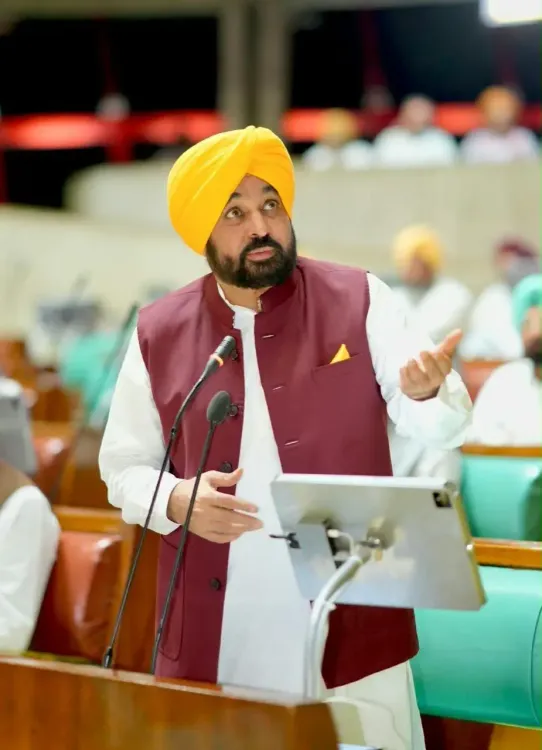
Two moves in a single assembly session — one rooted in the soil, one aimed at New Delhi. On Friday, 23 October 2026, Punjab Chief Minister Bhagwant Mann told the 16th Punjab Vidhan Sabha that the state's canal-water push has driven paddy yields to nearly 90 maunds per acre this season, while the House simultaneously became the first state legislature in the country to pass a resolution against what he called 'anti-democracy and oppressive' central laws — a move that has not yet reached either the Lok Sabha or the Rajya Sabha.
14,000 km of pipe and a paddy-yield turnaround
Bhagwant Mann announced that the Aam Aadmi Party government has laid 14,000 kilometres of pipelines to carry canal water directly to fields — a figure he presented as the backbone of a measurable agricultural turnaround. The result, he said, is a paddy yield of approximately 90 maunds per acre this kharif season, attributed to mineral-rich canal water replacing the brackish, depleted groundwater that Punjab's farmers had long depended on.
Punjab has battled one of the most severe groundwater crises in South Asia. Decades of paddy cultivation powered by tube-wells drew down aquifers to critical levels, making canal-water expansion a policy priority for successive governments. The AAP administration's claim of a large-scale pipeline rollout, if borne out by official data, would mark a structural shift in how the state's 23 lakh-plus farming families access irrigation.
A resolution no Parliament chamber has seen yet
The second move was explicitly political — and deliberately precedent-setting. During the 13th Session of the 16th assembly, Punjab legislators passed a resolution opposing central laws that the CM described as 'anti-democratic and oppressive.' Mann underlined that no such resolution has yet been moved in either house of Parliament, casting Punjab as the first institutional voice to formally put it on record.
The assembly move echoes the state's deep memory of the 2020-21 farmer protests, when Punjab became the epicentre of a year-long agitation against three central agricultural laws before their repeal in December 2021. The AAP government, which swept to power in March 2022 on the back of that charged atmosphere, has consistently used the state legislature as a platform to assert regional pushback against perceived over-centralisation. 'Punjab hamesha zulam khilaf datt ke khada hai' — 'Punjab has always stood firm against oppression' — Mann wrote, closing with the rallying cry Inquilab Zindabad.
The federal fault-line this session exposed
Taken together, the two announcements frame a deliberate dual narrative: a state government delivering on agrarian welfare while simultaneously positioning itself as a constitutional counterweight to the Centre. That pairing — ground-level irrigation numbers alongside a Parliament-first resolution — is a calculated message to Punjab's farming communities ahead of what will be a closely watched crop-season assessment.
Whether the groundwater tables reflect the pipeline investments, and whether the resolution triggers any response from Parliament's winter session, will be the tests that give these announcements their real weight.
One assembly session, two strikes — and Punjab is watching to see which one lands harder.
Point of View
Then use that credibility to amplify a political challenge to the Centre. The resolution strategy is significant because state assemblies bypassing the parliamentary route to put federal grievances on record can build normative pressure over time, especially if other non-BJP states follow suit. Punjab's deep agrarian identity and its 2020-21 protest legacy make it the highest-resonance venue for this kind of symbolic federalism. The real test is whether the groundwater data and yield figures hold up under independent scrutiny — because the political argument rests entirely on the developmental credibility underneath it.
NationPress
23 Oct 2026
Frequently Asked Questions
What did Punjab CM Bhagwant Mann announce about canal water and paddy yield?
Mann announced that the AAP government has laid 14,000 kilometres of pipelines to deliver canal water to fields, resulting in paddy yields of approximately 90 maunds per acre this kharif season — up significantly from earlier averages linked to groundwater-dependent irrigation.
What resolution did the Punjab Vidhan Sabha pass on 23 October 2026?
The Punjab Vidhan Sabha passed a resolution opposing central laws that CM Mann described as 'anti-democracy and oppressive.' He stated it is the first such resolution from any state legislature, noting it has not yet been introduced in the Lok Sabha or Rajya Sabha.
Why is Punjab's groundwater crisis a major issue?
Decades of paddy cultivation dependent on tube-wells have severely depleted Punjab's aquifers, making it one of India's most water-stressed agricultural states. Shifting irrigation to canal water is a long-standing policy priority aimed at conserving underground water reserves.
What is the connection between the Punjab assembly resolution and the 2020-21 farmer protests?
The 2020-21 farmer protests, largely centred in Punjab, opposed three central agricultural laws that were ultimately repealed in December 2021. The AAP government's assembly resolution against 'oppressive' central laws continues that tradition of institutional opposition to policies seen as harmful to farmers.
Which session of the Punjab Vidhan Sabha passed the resolution?
It was passed during the 13th Session of the 16th Punjab Vidhan Sabha, on 23 October 2026.