CM Yogi calls on UP residents to be curious conservationists
Synopsis
UP Chief Minister Yogi Adityanath has called on residents to visit natural sites as 'curious students' rather than tourists, share experiences through vlogs and articles, and become active guardians of the state's biodiversity — linking the appeal to Sanatan cultural values and public participation.
Key Takeaways
CM Yogi Adityanath posted the appeal on 8 June 2026 , urging Uttar Pradesh residents to engage with nature as inquisitive learners, not passive tourists.
He called on citizens to document and share nature experiences through vlogs and written articles to spread conservation awareness.
The message is rooted in Sanatan Sanskriti , framing every living being as an inseparable part of creation.
Uttar Pradesh has run large-scale tree plantation drives since 2017 and is a key state under the Namami Gange programme launched in 2014 .
No new scheme or statistic was announced; the post is a public awareness appeal ahead of potential follow-up action by the UP Forest Department .
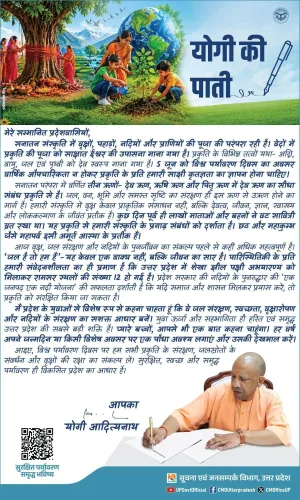
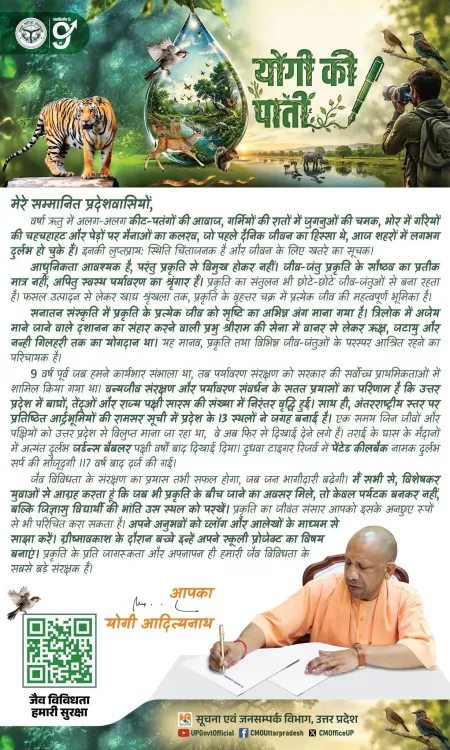
Uttar Pradesh Chief Minister Yogi Adityanath on Monday, 8 June 2026 urged the state's residents to approach nature not merely as tourists but as inquisitive learners, calling public participation the cornerstone of biodiversity conservation. Invoking the principles of Sanatan Sanskriti (Sanatan culture), he asked citizens to document and share their experiences in nature through vlogs and written pieces.
Context
In his post, CM Yogi wrote: 'In Sanatan culture, every living being in nature is considered an inseparable part of creation. The effort to conserve biodiversity will succeed only when public participation increases.' He urged residents that whenever they get an opportunity to visit natural surroundings, they should explore those places 'not as a tourist, but like a curious student' — and share their experiences through vlogs and articles.
The message comes around the time of internationally observed environment days, when conservation discourse peaks in policy and public circles. Uttar Pradesh, India's most populous state, hosts diverse ecosystems ranging from the Terai forests to the Gangetic plains, including protected areas such as Dudhwa National Park.
Policy Backdrop
The call for public participation echoes the framework of the Convention on Biological Diversity (CBD), the 1992 international treaty ratified by India, which explicitly recognises that community awareness and engagement are essential to sustainable conservation. India's obligations under the CBD include promoting biodiversity education and citizen involvement at the grassroots level.
In Uttar Pradesh, state-led conservation efforts have included large-scale annual tree plantation drives since 2017, setting records for saplings planted in a single day. The Namami Gange programme, launched in 2014, has also embedded public awareness as a key pillar of river rejuvenation and riparian biodiversity work along the Ganga in the state.
The framing of conservation through a Sanatan cultural lens is consistent with the approach of the Gorakhnath Math in Gorakhpur, the historic monastery headed by CM Yogi, which has long promoted harmony with nature as a traditional value.
Stakeholders and Impact
The appeal is directed at UP's roughly 24 crore residents, with a particular nudge towards eco-tourists and young digital creators. By encouraging vlogs and written accounts, the Chief Minister is effectively calling for a citizen-science and eco-documentation movement that could amplify awareness beyond formal government campaigns.
Forest department officials, wildlife conservationists, and community-based tourism operators in ecologically sensitive zones such as the Terai stand to benefit if the message translates into measurable public engagement. Environmental educators have long argued that first-hand nature experiences, when shared widely, build lasting conservation constituencies.
What's Next
The post does not announce a specific scheme or deadline, but it signals the state government's intent to deepen citizen involvement in conservation ahead of any follow-up policy action by the Uttar Pradesh Forest Department. Observers will watch whether the appeal is backed by structured platforms — such as citizen-reporting portals or state-sponsored eco-tourism guidelines — that can channel public enthusiasm into verifiable conservation outcomes.
If the messaging is followed by institutional support, it could mark a shift from top-down plantation drives to a more participatory model of biodiversity stewardship in India's most populous state.
Point of View
Biodiversity conservation — within a Sanatan cultural vocabulary to maximise resonance with a broad Hindu majority electorate. By framing citizens as 'curious students' of nature rather than passive recipients of government schemes, CM Yogi is attempting to build a grassroots conservation constituency that could lend political legitimacy to future forest and eco-tourism policy. The emphasis on vlogs and digital content also signals an awareness that conservation messaging must compete in the attention economy. Whether the appeal translates into institutional mechanisms or remains rhetorical will be the real test of its policy weight.
NationPress
24 Oct 2026
Frequently Asked Questions
What did CM Yogi Adityanath say about biodiversity conservation?
CM Yogi Adityanath urged Uttar Pradesh residents on 8 June 2026 to visit natural sites as curious learners rather than tourists, and to share their experiences through vlogs and articles to promote biodiversity awareness.
What is Uttar Pradesh doing for biodiversity conservation?
Uttar Pradesh has conducted annual large-scale tree plantation drives since 2017 and is a major implementation state under the central government's Namami Gange programme, which includes biodiversity conservation along the Ganga river banks.
What is the connection between Sanatan culture and nature conservation?
Sanatan cultural philosophy holds every living being to be an inseparable part of creation, a principle CM Yogi cited as the philosophical basis for his call to protect biodiversity through public participation.
What is Dudhwa National Park and why is it significant for UP?
Dudhwa National Park, located in the Terai region of Uttar Pradesh, is one of the state's most ecologically rich protected areas, home to tigers, rhinos, and diverse flora, making it a key site for biodiversity conservation efforts.
Did CM Yogi announce a new scheme for environment conservation in June 2026?
No new scheme or specific statistic was announced in the post. The message was a public awareness appeal encouraging citizen participation and digital documentation of nature experiences.