CM Bhajanlal reaffirms Modi's Viksit Bharat vision for four key groups
Synopsis
The Chief Minister's Office of Rajasthan on 18 July 2026 reiterated PM Narendra Modi's commitment to empowering women, youth, farmers and labourers as the foundation of the Viksit Bharat 2047 vision, tagging CM Bhajanlal Sharma and branding the state as a leading partner in national development.
Key Takeaways
The Rajasthan CMO on 18 July 2026 publicly reaffirmed PM Modi's resolve to empower women, youth, farmers and labourers as the four core pillars of national development.
The post is anchored to the Viksit Bharat 2047 framework, the central government's vision for a fully developed India by the centenary of independence.
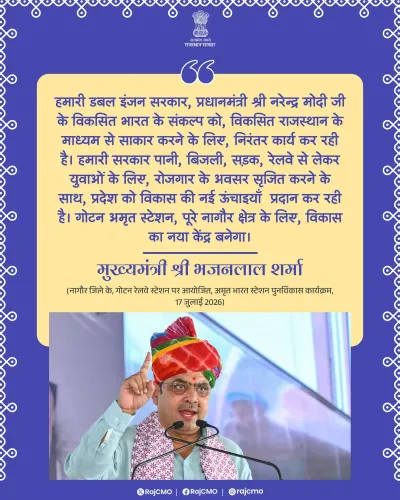
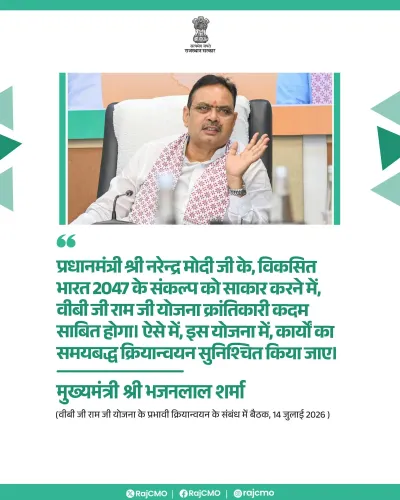
Chief Minister Bhajanlal Sharma was tagged, signalling the state government's alignment with the central narrative.
The hashtag #AapnoAgrani_Rajasthan positions Rajasthan as a proactive, leading partner in the Viksit Bharat agenda.
Key central schemes underpinning the four-pillar approach include PM-KISAN (2019) , Mudra Yojana and Stand-Up India (2015) .
State budget allocations for 2026-27 will be a key indicator of how concretely the stated resolve is being translated into policy.
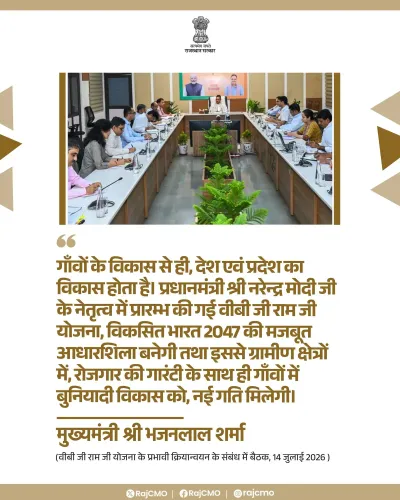
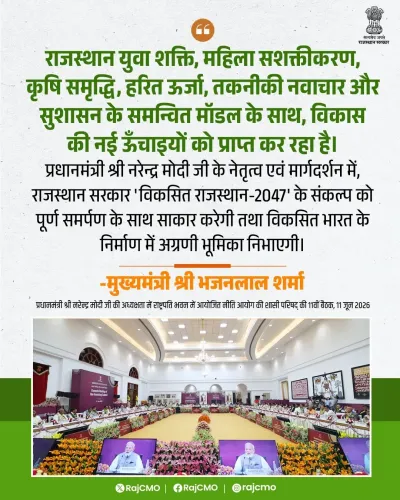
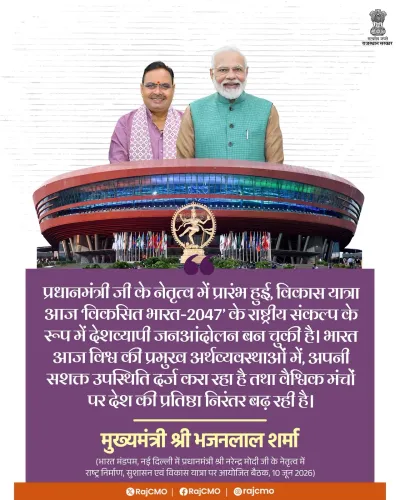
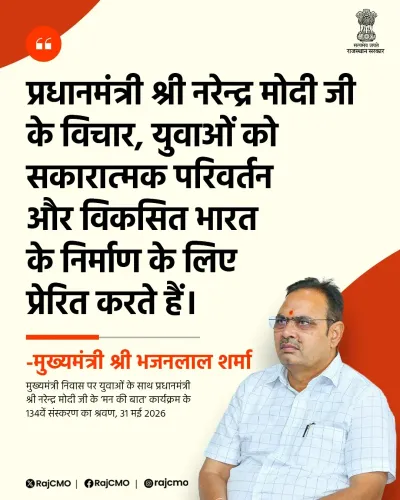
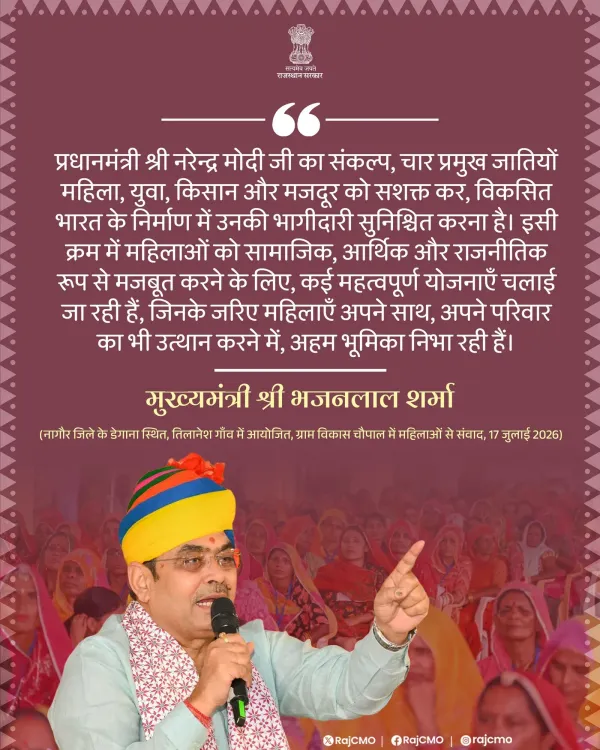
The Chief Minister's Office of Rajasthan on Saturday, 18 July 2026, reaffirmed Prime Minister Narendra Modi's resolve to build a developed India by empowering four core constituencies — women, youth, farmers and labourers — and ensuring their active participation in national development.
The post, shared on the official CMO account and tagging Chief Minister Bhajanlal Sharma (@BhajanlalBjp), stated in Hindi: 'Pradhan Mantri Shri Narendra Modi ji ka sankalp, chaar pramukh jatiyon mahila, yuva, kisan aur mazdoor ko sashakt kar, Viksit Bharat ke nirmaan mein unki bhaagidaari sunishchit karna hai' — meaning, 'Prime Minister Narendra Modi's resolve is to empower the four major sections — women, youth, farmers and labourers — and ensure their participation in building a Developed India.' The post was accompanied by the hashtag #AapnoAgrani_Rajasthan, a branding phrase the state government uses to position Rajasthan as a leading, forward-looking state.
Context
The message aligns squarely with the Viksit Bharat 2047 framework, the central government's overarching vision to transform India into a fully developed nation by the centenary of its independence. Prime Minister Modi has consistently articulated this vision around the empowerment of women, youth, farmers and informal-sector workers, grouping them as the four pillars on which national progress must rest. The framing has appeared in successive budget speeches, election manifestos and the landmark Viksit Bharat Sankalp Yatra launched in late 2023 to saturate welfare scheme delivery at the grassroots.
Policy Backdrop
Several flagship central schemes underpin this four-pillar narrative. The PM-KISAN scheme, launched in 2019, delivers direct income support to farmers, while Mudra Yojana and Stand-Up India — both launched in 2015 — have extended credit access to youth, women and micro-entrepreneurs among labourers and small businesses. Rajasthan's BJP government, which took office in December 2023 under Chief Minister Bhajanlal Sharma, has framed state-level programme delivery as an extension of these central priorities, a pattern consistent with BJP-ruled states across the country.
The hashtag #AapnoAgrani_Rajasthan — roughly translating to 'Our Leading Rajasthan' — reflects the state administration's effort to brand itself as a proactive partner in the national development agenda, rather than a passive recipient of central transfers.
Stakeholders and Impact
The four groups named — women, youth, farmers and labourers — together constitute the overwhelming majority of Rajasthan's population. The state has a large agrarian base, a significant informal labour force and one of the country's notable youth bulges, making the four-pillar framing politically and administratively significant. Women-led self-help groups, farmer producer organisations and skill-development programmes for youth have all been cited by the state government as delivery mechanisms for the broader Viksit Bharat agenda.
Observers note that the consistent reiteration of this framing by state CMOs across BJP-governed states serves both a governance and a communication purpose — reinforcing the central government's narrative while anchoring local administration to measurable scheme targets.
What's Next
Attention will turn to Rajasthan's state budget for 2026-27 and whether new or expanded allocations for women, youth, farmers and labourers translate the stated resolve into concrete fiscal commitments. Any specific Rajasthan variants of central welfare schemes announced in the coming months will be watched as a test of how deeply the Viksit Bharat framework is being operationalised at the state level. Prime Minister Modi's forthcoming Independence Day address on 15 August 2026 is also expected to revisit the four-pillar narrative, potentially providing fresh policy direction that state governments like Rajasthan will be expected to mirror.
Point of View
Youth, farmers and labourers as a unified constituency has become a signature rhetorical device for the BJP, serving simultaneously as a welfare frame and an electoral coalition map. For CM Bhajanlal Sharma, whose government is still relatively young, such visible alignment with central priorities reinforces his administration's credibility within the party hierarchy. The broader pattern — state CMOs amplifying central messaging via official handles — reflects a centralisation of political communication that has become standard practice across BJP-governed states since 2014.
NationPress
16 Oct 2026
Frequently Asked Questions
What is the Viksit Bharat 2047 vision?
Viksit Bharat 2047 is the Indian government's official framework to make India a fully developed nation by 2047, the centenary of independence. PM Modi has repeatedly emphasised empowering women, youth, farmers and labourers as the foundation of this vision.
Who is Bhajanlal Sharma and what is his role in Rajasthan?
Bhajanlal Sharma is the BJP Chief Minister of Rajasthan, in office since December 2023 . His government has aligned state-level programmes with the central government's Viksit Bharat priorities.
What schemes support women, youth, farmers and labourers under Modi's government?
Key schemes include PM-KISAN (launched 2019) for direct farmer income support, and Mudra Yojana and Stand-Up India (both from 2015) for credit access to youth, women and micro-entrepreneurs.
What does 'Aapno Agrani Rajasthan' mean?
Aapno Agrani Rajasthan translates roughly to 'Our Leading Rajasthan.' It is a branding phrase used by the Rajasthan state government to position the state as a forward-looking, proactive partner in national development.
Why does the Rajasthan CMO post about PM Modi's vision?
State governments led by the BJP routinely use official handles to reinforce the central government's policy narrative, signalling administrative alignment and political cohesion with the national leadership's agenda.