Uttarakhand CMO flags ₹3 lakh kiwi project in Dungri

Synopsis
The Chief Minister's Office of Uttarakhand said Sundar Singh of Dungri, Pithoragarh, received a ₹3 lakh kiwi project under the Chief Minister's Border Area Development Scheme. The 28 November 2026 announcement frames horticulture as self-employment on the China-Nepal frontier to thicken hill incomes.
Key Takeaways
The Chief Minister's Office of Uttarakhand on 28 November 2026 announced a kiwi self-employment project in Dungri , Pithoragarh .
It said Sundar Singh received a ₹3 lakh project under the Chief Minister's Border Area Development Scheme .
Pithoragarh is a Uttarakhand border district adjoining China and Nepal.
Kiwi is promoted because it suits the state's mid- and high-altitude climate.
Such grants sit inside a wider hill effort to boost local farm incomes and reduce out-migration.
The Chief Minister's Office of Uttarakhand on 28 November 2026 turned a kiwi orchard in a Himalayan frontier village into a livelihood story, announcing a ₹3 lakh self-employment project for Sundar Singh in Dungri, Pithoragarh. The grant, the office said, comes under the Chief Minister's Border Area Development Scheme.
In the post, the office called it a स्वरोजगार की पहल (self-employment initiative) through kiwi production in Dungri, and said Sundar Singh had received the benefit of a ₹3 lakh project. The district sits on India's border with China and Nepal. That geography is the point: remote hill hamlets are being asked to grow cash, not just grain.
Why kiwi is the crop in Dungri
Kiwi is promoted in Uttarakhand because it matches the state's mid- and high-altitude agro-climatic zones. For a small farmer in Dungri, a perennial orchard is meant to be income across seasons, not a single-harvest gamble. Horticulture-linked self-employment programmes have become a staple of the state's work in international border districts.
Pithoragarh has long drawn targeted development attention precisely because it is a frontier. Thin markets and seasonal work have pushed many young people out of the hills. A fruit crop that can travel to plains markets is the state's answer to that squeeze.
Border grants and the fight against hill out-migration
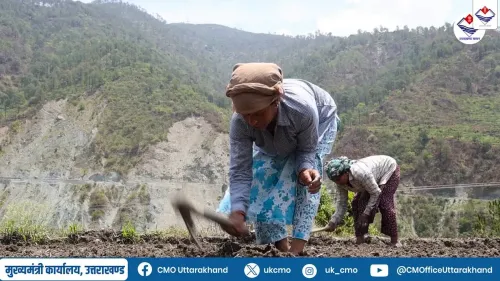
The Chief Minister's Border Area Development Scheme is the vehicle named in the announcement — a state scheme for livelihood projects in border districts. The people in the frame are border-area residents and small farmers, not distant contractors.
One ₹3 lakh project will not rewrite the hill economy. The larger pattern will: more such grants in other Pithoragarh villages, and any real movement in local kiwi acreage or farm incomes. That is the scoreboard after the announcement.
Dungri's vines will be judged not by the press note, but by whether they pay a family to stay.
Point of View
A fruit that suits altitude, and a border-area scheme rather than a generic farm subsidy. The political signal is that frontier villages should be treated as livelihood theatres, not only as security maps. The policy test is replication — whether Dungri is a one-off note or the start of measurable kiwi acreage and incomes across Pithoragarh.
NationPress
28 Nov 2026
Frequently Asked Questions
What did the Uttarakhand CMO announce about kiwi in Pithoragarh?
The Chief Minister's Office of Uttarakhand said a kiwi-production self-employment project worth ₹3 lakh had been given to Sundar Singh in Dungri under the Chief Minister's Border Area Development Scheme. The post was issued on 28 November 2026.
What is the Chief Minister's Border Area Development Scheme?
It is a Uttarakhand state scheme that supports livelihood projects in international border districts. The Dungri kiwi grant was announced as a benefit under this scheme.
Why is kiwi farming encouraged in the Uttarakhand hills?
Kiwi suits the state's mid- and high-altitude climate, and horticulture is used as a self-employment tool in border districts. The aim is to thicken local farm incomes and reduce pressure to migrate out of remote villages.
Where is Dungri village?
Dungri is a village in Pithoragarh district of Uttarakhand, a frontier district bordering China and Nepal. The CMO named it as the site of the kiwi self-employment project.
How does this fit Uttarakhand's hill livelihood policy?
The state has run horticulture-linked self-employment programmes in border districts to strengthen local economies. Watchpoints include further roll-out in other Pithoragarh villages and any change in kiwi acreage or incomes.