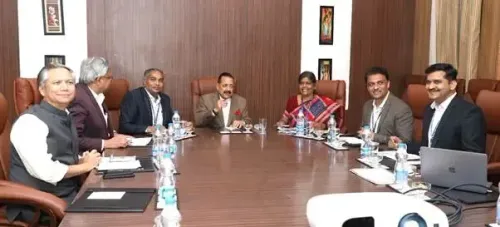
Dr. Jitendra Singh: CSIR-NAL Completes Saras MkII Design
Synopsis
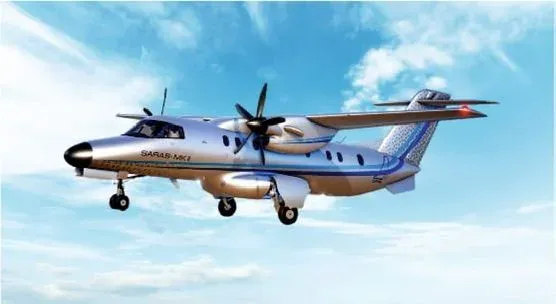
CSIR-National Aerospace Laboratories in Bengaluru has completed the design phase of the Saras MkII, a 19-seater indigenous aircraft, Union Minister Dr. Jitendra Singh announced on 8 July 2026. The milestone advances India's Atmanirbhar Bharat mission and supports the UDAN regional connectivity scheme.
Key Takeaways
CSIR-NAL, Bengaluru has completed the design phase of the 19-seater Saras MkII indigenous light transport aircraft.
The announcement was made by Union Science and Technology Minister Dr.
Jitendra Singh on 8 July 2026 .
The Saras MkII is intended to serve remote and high-altitude regions under the UDAN regional air connectivity scheme, launched in 2016 .
The programme supports the Atmanirbhar Bharat Abhiyan , which designated aerospace a priority sector for indigenisation in 2020 .
Next steps include prototype fabrication, ground testing, and DGCA airworthiness certification before commercial operations can begin.
The original Saras PT-1 prototype achieved its first flight in 2004 , making this the latest chapter in over two decades of indigenous civil aircraft development.
Union Science and Technology Minister Dr. Jitendra Singh announced on Wednesday, 8 July 2026 that CSIR-National Aerospace Laboratories (NAL), Bengaluru has completed the design phase of the Saras MkII, a 19-seater indigenous light transport aircraft, marking a significant milestone in India's civil aviation self-reliance drive.
Context
The minister described the development as a 'milestone breakthrough in the aviation sector,' stating that CSIR-NAL has 'wrapped up the design phase of the 19-seater Saras MkII, a testament to India's growing prowess in indigenous aircraft development.' The announcement positions the achievement within Prime Minister Narendra Modi's Atmanirbhar Bharat mission and the UDAN regional connectivity scheme.
CSIR-NAL, headquartered in Bengaluru, is India's premier aerospace research laboratory under the Council of Scientific and Industrial Research (CSIR). The lab has been the nodal agency for India's indigenous civil aircraft programme since its inception, making the Saras MkII a direct continuation of that institutional mandate.
Policy Backdrop
The Saras programme traces its roots to 2004, when CSIR-NAL achieved the first flight of the original Saras PT-1 prototype — India's first indigenous civil aircraft effort. The current Saras MkII variant is designed specifically to serve the operational requirements of the UDAN (Ude Desh ka Aam Naagrik) scheme, which was launched in 2016 with explicit provisions for 19-seater category aircraft to connect underserved and remote airports.
The Atmanirbhar Bharat Abhiyan, announced in 2020, identified aerospace as a key sector for reducing India's import dependence. Completion of the design phase for a domestically engineered regional aircraft directly advances that policy objective, moving the programme closer to prototype fabrication and eventual certification.
Stakeholders and Impact
The Saras MkII's 19-seat capacity makes it particularly suited for high-altitude and short-runway operations where larger commercial jets are uneconomical or operationally infeasible. Remote regions — including parts of Himachal Pradesh, Uttarakhand, Jammu and Kashmir, and the Northeast — stand to benefit most directly if the aircraft enters UDAN-linked service.
Regional airlines bidding under the UDAN framework would gain access to a domestically produced aircraft, potentially reducing dependence on imported turboprops and lowering fleet acquisition costs. For CSIR-NAL, successful commercialisation of the Saras MkII would validate decades of institutional investment in civil aerospace design capability.
What's Next
The completion of the design phase moves the Saras MkII programme into the next critical stages: prototype fabrication, ground testing, and eventual airworthiness certification by the Directorate General of Civil Aviation (DGCA). Each stage will require sustained funding, inter-agency coordination, and regulatory clearances before the aircraft can be inducted into commercial regional operations.
The government's ability to sustain momentum through these technically demanding phases — and to integrate the Saras MkII into UDAN bidding rounds for specific routes — will determine whether this design milestone translates into operational impact for underserved communities across India.
Point of View
But the harder test lies ahead: India's indigenous civil aircraft efforts have historically struggled to bridge the gap between design and certified, commercially viable operation. Minister Dr. Jitendra Singh's framing of the development within both Atmanirbhar Bharat and UDAN is politically deliberate — it ties a technical achievement to two of the Modi government's most visible policy brands simultaneously. For the government, sustained momentum through prototype and certification phases will be the real measure of whether this announcement signals a turning point or remains one in a series of incremental progress updates. The international regional aviation market is watching whether India can produce a certified, cost-competitive 19-seater, which would have strategic implications well beyond domestic connectivity.
NationPress
7 Oct 2026
Frequently Asked Questions
What is the Saras MkII aircraft?
The Saras MkII is a 19-seater indigenous light transport aircraft designed by CSIR-National Aerospace Laboratories (NAL) in Bengaluru. It is intended for regional connectivity, particularly to remote and high-altitude destinations where larger commercial jets cannot operate economically.
What is the current status of the Saras MkII project?
As of 8 July 2026, CSIR-NAL has completed the design phase of the Saras MkII, according to an announcement by Union Minister Dr. Jitendra Singh. The programme must now proceed to prototype fabrication, ground testing, and DGCA certification before the aircraft can enter service.
How does Saras MkII relate to the UDAN scheme?
The UDAN regional air connectivity scheme, launched in 2016, includes specific provisions for 19-seater category aircraft to serve underserved airports. The Saras MkII, with its 19-seat capacity, is designed to fulfil exactly this operational niche, potentially giving regional airlines a domestically produced aircraft for UDAN routes.
What is CSIR-NAL and where is it located?
CSIR-National Aerospace Laboratories (NAL) is a premier aerospace research and development laboratory under the Council of Scientific and Industrial Research (CSIR), headquartered in Bengaluru. It has led India's indigenous civil aircraft programme since the early 2000s, including the original Saras prototype that first flew in 2004.
How does Saras MkII support Atmanirbhar Bharat?
Atmanirbhar Bharat Abhiyan, announced in 2020, identified aerospace as a key sector for reducing India's dependence on imports. Developing a domestically designed and manufactured regional aircraft like the Saras MkII directly advances this goal by building indigenous capability in civil aviation design and production.