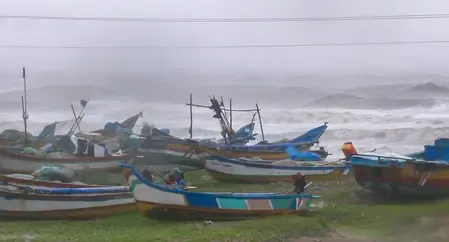
Cyclone Akvan crosses Andhra-Odisha coasts near Gopalpur, third in a month

Synopsis
Cyclone Akvan has made landfall near Gopalpur — the third storm to hit Andhra Pradesh in under a month. It weakened before crossing, sparing the coast from major damage, but the rapid-fire sequence of Arnab, Murasu, and now Akvan within 30 days is an extraordinary meteorological event that has pushed Andhra's disaster infrastructure to its limits.
Key Takeaways
Cyclonic Storm Akvan crossed the north Andhra Pradesh–south Odisha coast near Gopalpur on 20 November 2026 between 07:30 and 08:30 IST .
Landfall wind speeds were 70–80 kmph , gusting to 90 kmph ; the storm had weakened from severe cyclonic storm intensity before crossing.
IMD expects the system to weaken into a depression within nine hours of landfall as it tracks north-northeast across Odisha .
Residents of Srikakulam district were urged to stay alert by APSDMA chief Prakhar Jain ; no damage reports had emerged as of Friday morning.
This is the third cyclone to hit Andhra Pradesh in under a month; predecessors Arnab (27 October) and Murasu (3 November) together killed 15 people and damaged roads, power networks, and crops.
Cyclonic Storm Akvan made landfall along the north Andhra Pradesh and south Odisha coasts near Gopalpur on Friday, 20 November 2026, the India Meteorological Department (IMD) confirmed. The storm, which had earlier been classified as a severe cyclonic storm, weakened by one grade before crossing the coast — bringing some relief to disaster managers who had been bracing for a more destructive impact.
Landfall Details and Storm Track
According to an IMD bulletin, Akvan moved north-northwestwards at 26 kmph over the west-central Bay of Bengal in the six hours leading up to landfall. It crossed the coast between 07:30 and 08:30 IST with sustained wind speeds of 70–80 kmph, gusting up to 90 kmph.
At the time of landfall, the storm was centred over south coastal Odisha and adjoining north coastal Andhra Pradesh, close to Gopalpur (Odisha) — approximately 120 km northeast of Kalingapatnam, 130 km west-southwest of Puri, and 230 km northeast of Visakhapatnam.
Forecast: Rapid Weakening Expected
The IMD projected that the system would move nearly north-northeastwards across Odisha, weakening into a deep depression within three hours of landfall and further into a depression within the subsequent six hours. Light to moderate rainfall is likely to continue across North Andhra Pradesh, according to the Andhra Pradesh State Disaster Management Authority (APSDMA).
Authorities Urge Caution Despite Weakening
Prakhar Jain, Managing Director of APSDMA and Chief Executive Officer of the Real Time Governance Society (RTGS), cautioned that residents of Srikakulam district must remain on alert even as the system moves inland. Officials said there were no reports of damage from any location as of Friday morning — a marked contrast to the destruction wrought by the two preceding cyclones.
Third Cyclone to Hit Andhra in Under a Month
Notably, Akvan is the third cyclone to strike the Andhra Pradesh coast in less than 30 days — an unusually compressed sequence that has strained state emergency infrastructure. Very severe cyclonic storm Arnab struck the Andhra Pradesh coast on 27 October, followed by severe cyclonic storm Murasu, which crossed the coast between Nellore and Narasapur on 3 November. Those two storms together claimed 15 lives and caused widespread damage to electricity networks, roads, and standing crops across the coastal districts. This comes amid growing concern among meteorologists about the increasing frequency of late-season Bay of Bengal cyclones, a pattern linked to above-normal sea surface temperatures.
What Comes Next
With Akvan expected to dissipate rapidly over land, the immediate threat appears to be heavy rainfall in interior Odisha and residual strong winds in coastal Andhra Pradesh. Disaster response teams remain deployed across vulnerable districts, and authorities are monitoring the situation as the system weakens. The state government is expected to undertake a damage assessment once conditions normalise.
Point of View
The cumulative toll of Arnab and Murasu — 15 dead, crippled power networks, damaged crops — means communities on this coast are entering Akvan's aftermath already depleted. The IMD's forecasting has been creditable, but the harder question is whether the state's pre-positioning, compensation pipelines, and infrastructure repair cycles can keep pace with what increasingly looks like a new normal for Bay of Bengal cyclone frequency in the post-monsoon window.
NationPress
20 Nov 2026
Frequently Asked Questions
Where did Cyclone Akvan make landfall?
Cyclone Akvan crossed the north Andhra Pradesh and south Odisha coasts near Gopalpur, Odisha, on 20 November 2026 between 07:30 and 08:30 IST. At landfall it was about 120 km northeast of Kalingapatnam and 230 km northeast of Visakhapatnam.
How strong was Cyclone Akvan at landfall?
Akvan crossed the coast with sustained wind speeds of 70–80 kmph gusting to 90 kmph. The storm had weakened from a severe cyclonic storm to a cyclonic storm before making landfall, reducing the risk of major damage.
Is Cyclone Akvan the third cyclone to hit Andhra Pradesh this year?
Yes, Akvan is the third cyclone to cross the Andhra Pradesh coast in under a month. Very severe cyclonic storm Arnab struck on 27 October and severe cyclonic storm Murasu crossed between Nellore and Narasapur on 3 November; those two storms killed 15 people and caused widespread infrastructure damage.
What is the forecast for Cyclone Akvan after landfall?
The IMD expects Akvan to move north-northeastwards across Odisha and weaken into a deep depression within three hours of landfall, then further into a depression within six more hours. Light to moderate rainfall is expected to continue in North Andhra Pradesh.
Which areas remain on alert after Akvan's landfall?
APSDMA chief Prakhar Jain has specifically asked residents of Srikakulam district in Andhra Pradesh to remain alert even after the system crossed the coast. Disaster response teams remain deployed across vulnerable coastal districts in both Andhra Pradesh and Odisha.