Dang district strawberry farming grows 65% in 3 years on natural farming push
Synopsis
Dang — a tribal district in Gujarat — has quietly become a strawberry powerhouse, with output set to hit 233 metric tonnes in 2025-26 and farmers earning up to ₹8 lakh per hectare. Declared India's first natural farming district, Dang's transformation from subsistence crops to high-value horticulture is one of the more concrete payoffs of the state's chemical-free farming push.
Key Takeaways
Dang district strawberry cultivation area grew from 20 hectares in 2022-23 to nearly 33 hectares in 2025-26 .
Production is projected at 233 metric tonnes in 2025-26 , up from 140 metric tonnes in 2022-23 .
Farmers earn between ₹7 lakh and ₹8 lakh per hectare annually — far above returns from traditional crops like paddy and nagli.
Dang was declared India's first natural farming district under Chief Minister Bhupendra Patel .
State subsidies of 55–75% cover saplings, equipment, and packaging; produce now reaches Ahmedabad , Surat , and Bharuch .
Nine strawberry varieties are cultivated, with Winter Dawn the most widely preferred for its high yield.
Gujarat's Dang district has become the state's foremost strawberry-producing region, with cultivated area expanding from 20 hectares in 2022-23 to nearly 33 hectares in 2025-26 — a 65% increase in three years — driven by the state government's natural farming initiative and favourable agro-climatic conditions. Farmers in the tribal district are now earning between ₹7 lakh and ₹8 lakh per hectare annually, a sharp improvement over returns from traditional crops.
Production Numbers and Growth Trajectory
According to official data, strawberry output in Dang rose from 140 metric tonnes in 2022-23 to 196 metric tonnes in 2024-25, and is projected to reach 233 metric tonnes in 2025-26. Officials attributed the sustained growth to rising market demand, chemical-free cultivation, and the district's natural advantages — a cool climate, sandy-loam soil rich in organic matter, and a soil pH between 5.5 and 7.0 that suits strawberry crops. Optimal growing conditions include day temperatures of 22–25°C and night temperatures of 7–13°C, along with 8 to 12 hours of daily sunlight.
Dang as India's First Natural Farming District
Under Chief Minister Bhupendra Patel, Dang was declared the country's first natural farming district, catalysing large-scale adoption of sustainable agriculture among local tribal farmers. The shift has been significant: many residents who previously depended on labour work in industrial units and farms in Maharashtra have returned to farm their own land, drawn by the higher profitability of strawberry cultivation. Traditional crops such as paddy, nagli, urad, and varai had generated limited returns by comparison.
Varieties, Villages, and Expanding Footprint
Farmers across Dang are cultivating nine strawberry varieties — Winter Dawn, Early Winter, Camarosa, Sweet Charlie, Nabila, Nabati, Selva, Belrubi, and Pajero. Among these, Winter Dawn has emerged as the most preferred, owing to its high yield potential during the December to February-March harvest window. Cultivation has spread across multiple villages in Ahwa taluka — including Bhurapani, Borigavtha, Galkund, Kotamdar, Malegaon, Sonuniya, and Vanar — and in Waghai taluka across Kanchanpada, Ghodwahal, Murambi, and adjoining areas.
Government Support and Market Reach
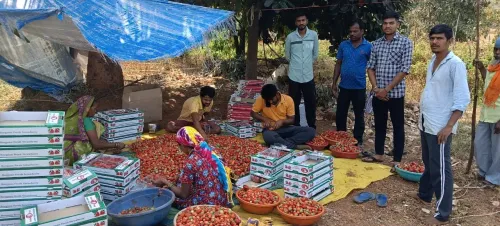
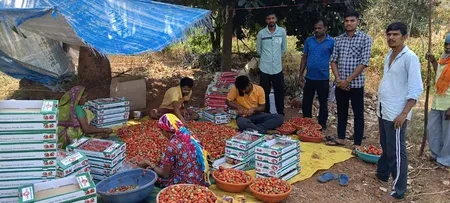
The state horticulture department has been conducting training camps and educational tours on natural farming and modern cultivation practices. Subsidies of 55 to 75 per cent are being extended on strawberry saplings and cultivation-related expenses, covering mulching sheets, plastic covers, crates, packaging material, and farm equipment including mini tractors, rotavators, cultivators, and trolleys. Strawberries from Dang, once sold only in local markets at Saputara and Ahwa, are now reaching Ahmedabad, Surat, and Bharuch. The expansion has also generated seasonal employment for local residents, officials added.
Point of View
Helping Dang command premium pricing in urban centres. The real question is scalability: subsidies covering up to 75% of input costs are generous, but long-term viability depends on whether farmers can sustain margins once support tapers. The migration reversal — labourers returning from Maharashtra to farm their own land — is a social dividend that rarely shows up in headline crop-output numbers, but may be the district's most durable gain.
NationPress
10 Oct 2026
Frequently Asked Questions
How much has strawberry cultivation grown in Gujarat's Dang district?
Cultivated area in Dang has grown from 20 hectares in 2022-23 to nearly 33 hectares in 2025-26, a rise of about 65% in three years, according to official data. Production is projected to reach 233 metric tonnes in 2025-26, up from 140 metric tonnes in 2022-23.
How much do Dang farmers earn from strawberry cultivation?
Farmers in Dang are earning between ₹7 lakh and ₹8 lakh per hectare annually from strawberry cultivation. This is significantly higher than returns from traditional crops such as paddy, nagli, urad, and varai.
Why is Dang district ideal for strawberry farming?
Dang's cool climate, sandy-loam soil rich in organic matter, and a soil pH of 5.5 to 7.0 create near-ideal conditions for strawberries. Day temperatures of 22–25°C, night temperatures of 7–13°C, and 8 to 12 hours of daily sunlight support strong flowering and fruit development.
What government support is available for strawberry farmers in Dang?
The state horticulture department provides subsidies of 55 to 75 per cent on strawberry saplings and cultivation expenses, including mulching sheets, packaging material, and farm equipment such as mini tractors and rotavators. Training camps and educational tours on natural farming are also organised regularly.
What is the significance of Dang being India's first natural farming district?
Dang was declared India's first natural farming district under Chief Minister Bhupendra Patel, making it a model for chemical-free, sustainable agriculture. The designation has encouraged large-scale farmer participation and helped Dang-grown strawberries access premium urban markets in Ahmedabad, Surat, and Bharuch.