Delhi court reserves order on Umar Khalid, Sharjeel Imam bail pleas in 2020 riots case

Synopsis
Nearly six years after the 2020 northeast Delhi riots, a Delhi court has reserved its order on bail pleas by Umar Khalid and Sharjeel Imam — two of the most high-profile accused in the UAPA conspiracy case. The ruling arrives as the Supreme Court itself grapples with a fundamental split on whether prolonged trial delay can override UAPA's strict bail bar.
Key Takeaways
Karkardooma Court reserved its order on bail pleas of Umar Khalid and Sharjeel Imam on 4 July .
Both accused have been in custody for nearly six years in the 2020 northeast Delhi riots larger conspiracy case.
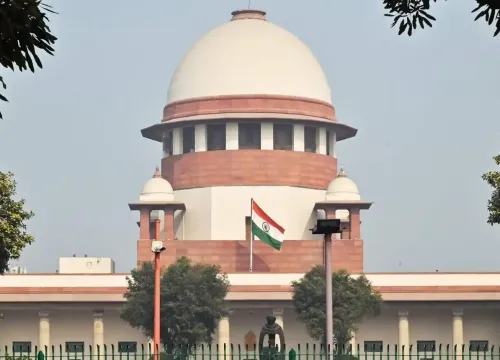
The Supreme Court earlier this year dismissed their bail pleas, citing prima facie UAPA grounds under Section 43D(5) .
The apex court granted bail to five co-accused and extended six months' interim bail to Tasleem Ahmed and Khalid Saifi .
A larger Bench referral is pending before the CJI on whether trial delay can justify bail under UAPA's stringent provisions.
A Delhi court on Saturday, 4 July reserved its order on the regular bail applications filed by Umar Khalid and Sharjeel Imam in the larger conspiracy case stemming from the 2020 northeast Delhi riots. The Karkardooma Court concluded hearing arguments on both pleas before reserving its verdict.
Background of the Bail Pleas
Khalid and Imam have sought regular bail in a case registered under the Unlawful Activities (Prevention) Act (UAPA) and other penal provisions. Last month, the court had issued notice on their applications and directed the Delhi Police to file its response.
In his plea, Imam argued that despite more than six months having elapsed since the Supreme Court rejected his bail application in January, there has been no meaningful progress in the trial. He further submitted that arguments on the framing of charges are yet to conclude and that he has been behind bars for nearly six years in connection with this case.
Supreme Court's Earlier Rulings
Earlier this year, the Supreme Court dismissed bail pleas filed by both Khalid and Imam, holding that prosecution material disclosed prima facie grounds attracting the statutory bar on bail under Section 43D(5) of the UAPA. At the same time, the apex court granted bail to five other accused in the case — Gulfisha Fatima, Meeran Haider, Shifa Ur Rehman, Mohd Saleem Khan, and Shadab Ahmed.
Interim Relief and a Larger Constitutional Question
More recently, the Supreme Court granted six months' interim bail to Tasleem Ahmed and Khalid Saifi, while simultaneously referring to a larger Bench the question of whether prolonged incarceration and trial delay can justify bail even under the restrictions of Section 43D(5) of the UAPA.
A Bench of Justices Aravind Kumar and Prasanna B. Varale directed the registry to place the matter before the Chief Justice of India (CJI) for constituting an appropriate Bench. The referral followed arguments by Additional Solicitor General S.V. Raju, appearing for the Delhi Police, who flagged apparent divergence among coordinate Benches in applying the K.A. Najeeb judgment to bail pleas under stringent statutes such as the UAPA and the NIA Act.
The Bench also took note of the subsequent ruling in Syed Iftikhar Andrabi vs National Investigation Agency (NIA), where another coordinate Bench expressed reservations over aspects of the earlier order that had denied bail to Khalid and Imam while granting relief to five co-accused.
What Happens Next
The Karkardooma Court's reserved order will be closely watched as a signal of how trial courts interpret UAPA bail provisions amid ongoing uncertainty at the Supreme Court level. With the apex court yet to constitute a larger Bench on the Section 43D(5) question, the broader legal framework governing bail in terror-related cases remains unsettled.
Point of View
Which itself raises serious questions about the pace of UAPA trials. The differential treatment — bail for five co-accused, rejection for two others — has already prompted one coordinate Bench to flag inconsistency. Until the larger Bench rules, trial courts are effectively navigating without a stable legal compass.
NationPress
4 Jul 2026
Frequently Asked Questions
What is the 2020 northeast Delhi riots larger conspiracy case?
It is a case registered under the UAPA and other penal provisions alleging a larger criminal conspiracy behind the communal violence that erupted in northeast Delhi in February 2020. Several activists, students, and community leaders were arrested, with Umar Khalid and Sharjeel Imam among the most prominent accused.
Why did the Supreme Court reject bail for Umar Khalid and Sharjeel Imam?
The Supreme Court dismissed their bail pleas earlier in 2025, holding that prosecution material disclosed prima facie grounds that attracted the statutory embargo on bail under Section 43D(5) of the UAPA. The provision sets a high threshold, requiring courts to be satisfied that there are reasonable grounds to believe the accused is not guilty before granting bail.
Why has the Supreme Court referred the UAPA bail question to a larger Bench?
Different Benches of the Supreme Court had expressed divergent views on applying the K.A. Najeeb judgment, which dealt with whether prolonged incarceration and trial delay can justify bail despite UAPA restrictions. A Bench of Justices Aravind Kumar and Prasanna B. Varale directed the matter be placed before the CJI to constitute an appropriate Bench to resolve the conflict.
Which co-accused were granted bail in the same case?
The Supreme Court granted bail to five co-accused — Gulfisha Fatima, Meeran Haider, Shifa Ur Rehman, Mohd Saleem Khan, and Shadab Ahmed — while rejecting the pleas of Khalid and Imam. More recently, Tasleem Ahmed and Khalid Saifi received six months' interim bail.
How long have Umar Khalid and Sharjeel Imam been in custody?
Sharjeel Imam submitted before the court that he has been behind bars for nearly six years in connection with this case. Umar Khalid has similarly been in custody for a comparable period, with arguments on the framing of charges still ongoing at the trial court stage.