Giriraj Singh Highlights UP's Rooftop Solar Record Under PM Surya Ghar
Synopsis
Union Textiles Minister Giriraj Singh on 4 July 2026 highlighted that Uttar Pradesh has set a new record in rooftop solar installations under the PM Surya Ghar Muft Bijli Yojana, a Rs 75,021 crore central scheme targeting 1 crore households with up to 300 units of free monthly electricity.
Key Takeaways
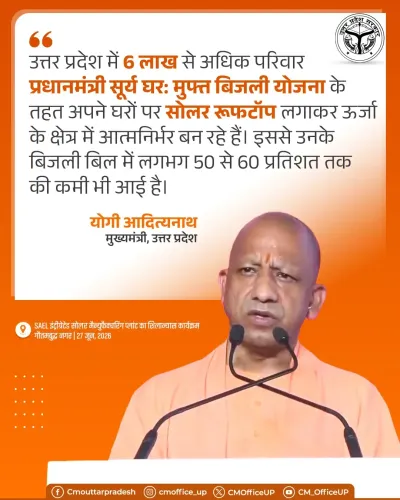
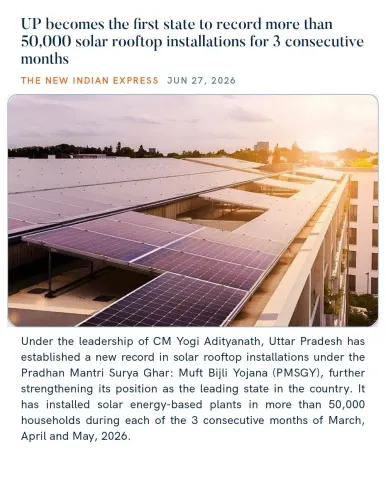
Uttar Pradesh has reportedly set a new record in rooftop solar installations under the PM Surya Ghar Muft Bijli Yojana as of 4 July 2026 .
The scheme was launched in February 2024 with a total outlay of Rs 75,021 crore targeting 1 crore households nationally.
Beneficiary households receive up to 300 units of free electricity per month after rooftop solar installation.
Union Textiles Minister Giriraj Singh amplified the achievement via X and the NaMo App .
The scheme is part of India's goal to achieve 500 GW of non-fossil fuel power by 2030 .
Central financial assistance under the scheme is directly linked to verified installation numbers, incentivising state-level competition.
Union Textiles Minister Giriraj Singh on Saturday, 4 July 2026 shared that Uttar Pradesh has set a new record in rooftop solar installations under the PM Surya Ghar Muft Bijli Yojana, amplifying the achievement via his official X account and the NaMo App. The post, shared in Hindi, highlights the northern state's emerging lead in a flagship central scheme aimed at bringing solar power to ordinary households.
Context
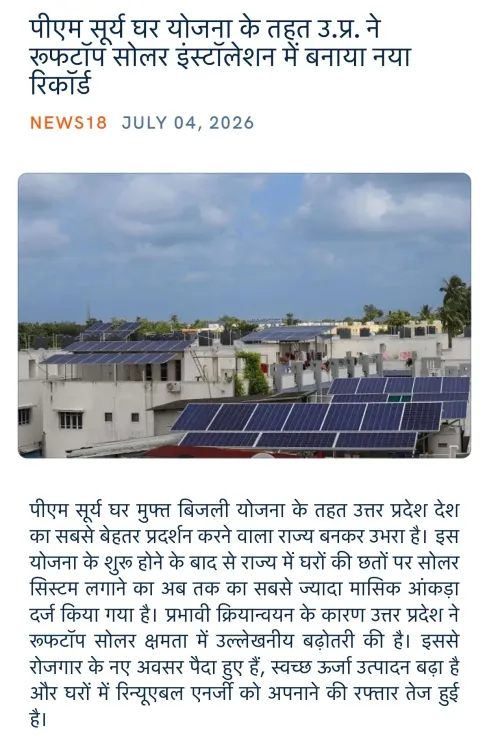
Singh's post reads: 'पीएम सूर्य घर योजना के तहत उ.प्र. ने रूफटॉप सोलर इंस्टॉलेशन में बनाया नया रिकॉर्ड' — translated: 'Under the PM Surya Ghar scheme, Uttar Pradesh has set a new record in rooftop solar installations.' While Singh serves as Union Textiles Minister, senior BJP leaders routinely amplify achievements across government schemes, particularly those tied to Prime Minister Narendra Modi's development agenda. The reference to the NaMo App underlines the BJP's practice of channelling policy communication through its own digital ecosystem.
Uttar Pradesh, India's most populous state, has historically lagged in per-capita electricity access. A record performance in rooftop solar under a central subsidy scheme would mark a significant shift in the state's energy profile and signals aggressive implementation by the state administration.
Policy Backdrop
The PM Surya Ghar Muft Bijli Yojana was launched in February 2024 with a total government outlay of Rs 75,021 crore, targeting 1 crore households across India. The scheme promises up to 300 units of free electricity per month to beneficiary households that install rooftop solar panels, with the central government providing direct subsidy support linked to installation numbers.
The programme falls under the Ministry of New and Renewable Energy and builds on the lineage of India's National Solar Mission. It forms a key pillar of India's broader ambition to achieve 500 GW of non-fossil fuel power capacity by 2030. States are assessed on implementation metrics, and central financial assistance is directly tied to verified installation counts, creating strong incentives for competitive state-level performance.
Stakeholders and Impact
The primary beneficiaries are residential households, particularly in semi-urban and rural pockets of Uttar Pradesh, who gain access to subsidised clean energy and reduced electricity bills. The solar installation industry — including panel manufacturers, distributors, and local installers — also stands to benefit from a surge in state-level demand driven by central subsidy flows.
For the broader renewable energy ecosystem, a large state like Uttar Pradesh setting installation records carries significant weight. It demonstrates that high-density, lower-income states can absorb and deploy rooftop solar at scale, a proof-of-concept that could inform rollout strategies in similarly structured states such as Bihar, Madhya Pradesh, and Rajasthan.
What's Next
The Ministry of New and Renewable Energy is expected to publish updated state-wise progress reports that will provide verified figures behind Uttar Pradesh's claimed record. A potential mid-term review of household coverage targets under the scheme could reshape subsidy allocations in favour of high-performing states.
As India approaches its 2030 renewable energy milestones, the pace of rooftop solar adoption in large states will be a critical variable. Sustained political attention from senior leaders across ministries suggests the scheme retains strong backing at the highest levels of the central government.
Point of View
The achievement will likely be cited in campaign messaging and could accelerate central subsidy flows toward UP, deepening the Centre-state alignment that has defined BJP governance since 2017.
NationPress
4 Jul 2026
Frequently Asked Questions
What is PM Surya Ghar Muft Bijli Yojana?
PM Surya Ghar Muft Bijli Yojana is a central government scheme launched in February 2024 with an outlay of Rs 75,021 crore to install rooftop solar panels for 1 crore Indian households, providing up to 300 units of free electricity per month to each beneficiary.
What record has Uttar Pradesh set under PM Surya Ghar scheme?
According to a post by Union Textiles Minister Giriraj Singh on 4 July 2026, Uttar Pradesh has set a new record in rooftop solar installations under the PM Surya Ghar Muft Bijli Yojana, though specific verified figures are awaited from the Ministry of New and Renewable Energy.
Why is Giriraj Singh, a Textiles Minister, posting about a solar scheme?
Senior BJP leaders routinely amplify achievements across government schemes as part of the party's coordinated communication strategy, even when the subject falls outside their own ministry's portfolio.
Which ministry runs the PM Surya Ghar scheme?
The PM Surya Ghar Muft Bijli Yojana is administered by the Ministry of New and Renewable Energy, not the Ministry of Textiles.
How does India's rooftop solar scheme connect to its 2030 energy targets?
The PM Surya Ghar scheme is a key component of India's plan to achieve 500 GW of non-fossil fuel power capacity by 2030, with rooftop solar in residential buildings forming a significant part of the distributed renewable energy push.