Delhi Government Collaborates with IIT Madras for Air Pollution Study
Synopsis
In a significant move, the Delhi government has partnered with IIT Madras to tackle air pollution through innovative photocatalytic surfaces. This pilot study aims to reduce harmful pollutants effectively.
Key Takeaways
MoU signed between Delhi government and IIT Madras for air pollution mitigation.
Focus on photocatalytic 'smog-eating' surfaces utilizing Titanium Dioxide.
Targets pollutants like Nitrogen Dioxide (NO₂) and Volatile Organic Compounds (VOCs).
Study to assess effective application methods over six months.
Potential installation of pollutant-removal panels on rooftops and streetlights.
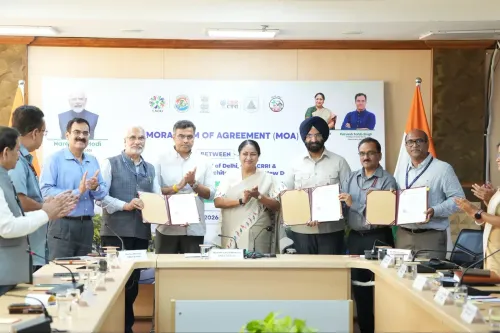
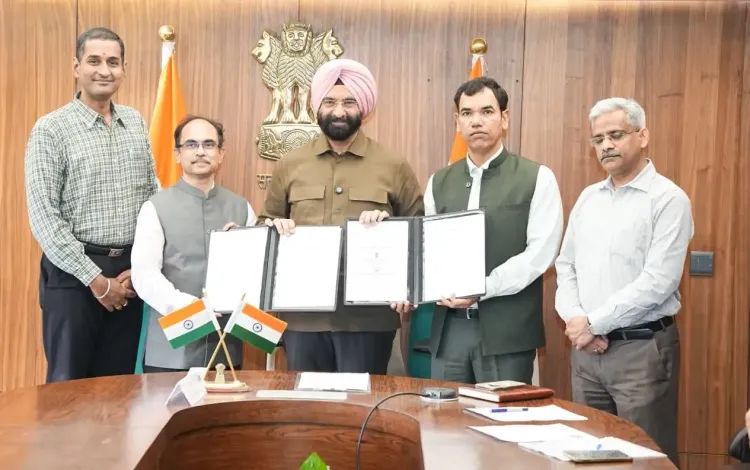
New Delhi, March 13 (NationPress) On Friday, the Delhi government formalized a Memorandum of Understanding (MoU) with the Indian Institute of Technology Madras (IIT Madras) to initiate a pilot project focusing on photocatalytic "smog-eating" surfaces, as reported by officials.
Entitled "Comprehensive Study on the Effectiveness of Photocatalytic Smog-Eating Surfaces, Specifically Utilizing Titanium Dioxide (TiO₂) or Comparable Safe Photocatalysts for Air Pollution Mitigation in Delhi," this initiative aims to address critical pollutants such as Nitrogen Dioxide (NO₂) and Volatile Organic Compounds (VOCs) that contribute to urban smog.
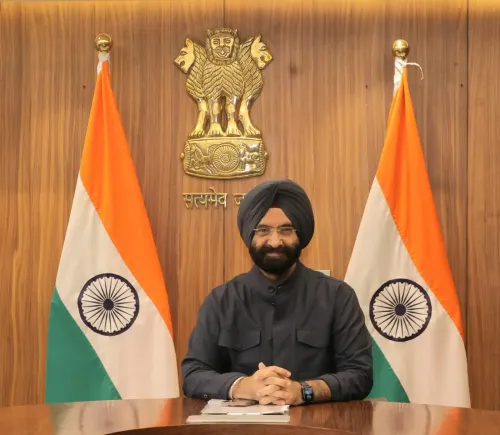
The MoU signing was witnessed by Manjinder Singh Sirsa and Prof. Somnath C. Roy from IIT Madras’s Department of Physics, who is the Principal Investigator.
Senior representatives from the Department of Environment and the Delhi Pollution Control Committee (DPCC) were also in attendance.
“With this IIT Madras research, our goal is to discover the most effective, enduring, and cost-efficient ways to apply 'smog-eating' coatings on roads, buildings, and various city surfaces. If the study yields evidence-based results indicating that such coatings can reduce Nitrogen Dioxide and other pollutants, it will greatly benefit us,” remarked Sirsa.
Sirsa further noted, “As Delhi’s population continues to grow due to urbanization from surrounding areas, our infrastructure is expanding rapidly. Under CM Rekha Gupta's leadership, our focus is on ensuring cleaner air for residents without implementing blanket bans. We must leverage scientific solutions to safeguard our air quality while supporting this essential growth.”
Photocatalytic materials such as TiO₂ are activated by sunlight, initiating reactions that transform harmful pollutants into harmless compounds.
The six-month study will evaluate optimal incorporation methods, including mixing with concrete and asphalt, surface coatings for infrastructure, and innovative panels on rooftops or streetlights.
The research will also explore the creation and use of photocatalytic pollutant-removal panels based on Titanium Dioxide, which could be installed on rooftops similar to solar panels or mounted on streetlight poles to facilitate direct pollutant removal from the air.
“We are committed to fostering innovation, as evidenced by our innovation challenge that has progressed to its trial phase. This study is a testament to that commitment,” emphasized Sirsa.
Prof. Somnath C. Roy stressed the meticulous nature of the approach: “The study will commence with laboratory tests in a smog chamber at IIT Madras to accurately measure pollutant reduction effectiveness.”
Subsequently, our team will undertake real-time field evaluations in Delhi’s urban settings on surfaces like concrete, asphalt, metal panels, glass, and roadways to assess durability and performance under real conditions.
Point of View
Focusing on scientific solutions rather than restrictive measures. This initiative could pave the way for innovative urban planning and health-conscious infrastructure.
NationPress
19 Sept 2026
Frequently Asked Questions
What is the purpose of the MoU between Delhi government and IIT Madras?
The MoU aims to initiate a pilot study on photocatalytic 'smog-eating' surfaces to mitigate air pollution in Delhi.
How does photocatalytic technology work?
Photocatalytic materials like Titanium Dioxide (TiO₂) activate under sunlight to convert harmful pollutants into harmless substances.
What pollutants are being targeted in the study?
The study focuses on reducing Nitrogen Dioxide (NO₂) and Volatile Organic Compounds (VOCs) that contribute to urban smog.
What will the study assess?
The study will evaluate various integration methods for photocatalytic surfaces, including their durability and effectiveness in real conditions.
Who is leading the research at IIT Madras?
Prof. Somnath C. Roy from the Department of Physics at IIT Madras is the Principal Investigator of the study.