Delhi Metro beats Hong Kong, Paris, New York in punctuality: DMRC
Synopsis
Delhi Metro has outpaced Hong Kong, Paris, and New York in punctuality — and it does so under a tougher standard than most: any train more than 59 seconds late counts as delayed. With a 99.95% punctuality rate in 2026 and an MDBF of 2.72 million car-kilometres, the network that started with 6 stations in 2002 now holds a top-five global reliability ranking among 45 metro systems.
Key Takeaways
Delhi Metro has ranked ahead of metro systems in Hong Kong , Paris , and New York in train punctuality and reliability, according to DMRC .
Punctuality stands at 99.95 per cent in 2026 , measured against a strict 59-second delay threshold.
The network has consistently placed in the top five globally for reliability through COMET benchmarking across 45 metro systems.
Mean Distance Between Failures (MDBF) has reached 2.72 million car-kilometres .
Line 7 ( 71.55 km , 45 stations ) is the world's longest driverless metro line ; about 29 per cent of the network runs under Unattended Train Operation.
Daily ridership has grown from 82,000 in 2002–03 to a record 81 lakh journeys on 8 August 2025 , with an average of 64.06 lakh daily journeys.
The Delhi Metro Rail Corporation (DMRC) has surpassed several of the world's most celebrated urban rail networks — including those in Hong Kong, Paris, and New York — in train punctuality and reliability, the corporation announced on 9 August 2026. The claim is backed by international benchmarking data and rests on one of the strictest delay-measurement standards in the industry.
A Stricter Benchmark Than Most
What makes the comparison particularly notable is the threshold the DMRC uses. While many global metro systems classify a train as delayed only after several minutes past its scheduled arrival, the Delhi Metro counts any train reaching its destination station more than 59 seconds behind schedule as delayed. Under this demanding standard, the network has still achieved a punctuality rate of 99.95 per cent in 2026 — up from 98.27 per cent when operations began in 2003, and above 99 per cent by as early as 2005.
'Since then, DMRC has constantly achieved 99.9 per cent train punctuality, year after year,' the corporation said in its statement.
Global Rankings and Reliability Record
Through international benchmarking conducted by the Community of Metros (COMET) — a consortium of 45 leading metro systems worldwide — the Delhi Metro has consistently ranked among the top five metro systems globally on reliability, measured using the 2-minute delay criterion. The network has also recorded a Mean Distance Between Failures (MDBF) of 2.72 million car-kilometres, a metric that captures the average distance trains travel before a service-affecting failure occurs.
Notably, this performance has been sustained even as the network expanded significantly in size and fleet — conditions that typically erode operational standards in large transit systems over time.
Operational Milestones and Network Scale
Train headway on the busiest corridors has been cut from seven minutes in the network's early years to just 2 minutes 18 seconds today. The DMRC also operates India's largest driverless metro network, with approximately 29 per cent of its network running under Unattended Train Operation (UTO).
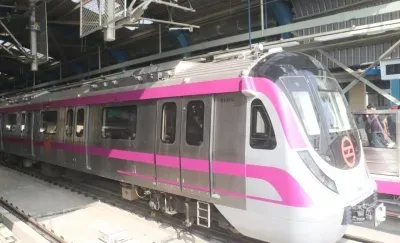
Line 7, stretching 71.55 km across 45 stations, is recognised as the world's longest driverless metro line and among the longest circular metro lines globally, according to the corporation. It connects with nearly every Delhi Metro corridor — barring a small section of the Grey Line — and has helped ease interchange congestion, cut travel times, and provide alternative routing during disruptions.
From 8.4 km to 416.5 km in 23 Years
The Delhi Metro began operations on 25 December 2002 with an 8.4-km corridor between Shahdara and Tis Hazari, comprising just six stations. It now spans 416.5 km across 303 stations on 12 lines, with 31 interchange stations connecting Delhi and the National Capital Region.
Daily ridership has grown from roughly 82,000 passengers in its first year of operations to a record single-day high of more than 81 lakh passenger journeys on 8 August 2025. Average daily ridership currently stands at 64.06 lakh journeys. The DMRC added that its operational innovations have earned it several prestigious international awards in recent years.
With ridership still rising and further network expansions on the horizon, the Delhi Metro's operational benchmarks will face their stiffest test yet in the years ahead.
Point of View
But the methodology matters as much as the metric: a 59-second delay threshold is genuinely stricter than what most peer systems apply, which means the comparison with Hong Kong or Paris is not an apples-to-apples one — it is arguably harder. What the DMRC data does confirm is sustained operational discipline across a network that has grown more than fifty-fold in route length since 2002, a period during which most expanding metro systems see performance dip. The more telling figure may be the MDBF of 2.72 million car-kilometres: reliability at that scale, on ageing rolling stock alongside new additions, is where execution usually frays. Whether the DMRC can hold these numbers as Phase IV corridors come online will be the real test of its engineering and maintenance culture.
NationPress
9 Aug 2026
Frequently Asked Questions
How does Delhi Metro compare to Hong Kong, Paris, and New York metro systems in punctuality?
According to the DMRC, Delhi Metro has ranked ahead of metro systems in Hong Kong, Paris, and New York in train punctuality, achieving 99.95 per cent punctuality in 2026. The comparison is made under a stricter standard — the DMRC counts any train more than 59 seconds late as delayed, whereas many global peers use a longer threshold.
What is the DMRC's punctuality standard and how is it measured?
The DMRC classifies a train as delayed if it arrives at its destination station more than 59 seconds behind its scheduled time. This is stricter than the standard used by several international metro systems, which typically allow a few minutes before logging a delay.
What is Mean Distance Between Failures (MDBF) and what is Delhi Metro's record?
MDBF measures the average distance metro trains travel before a service-affecting failure occurs — a key reliability indicator. Delhi Metro has achieved an MDBF of 2.72 million car-kilometres, placing it consistently among the top five metro systems globally in COMET benchmarking.
What is special about Delhi Metro Line 7?
Line 7 spans 71.55 km across 45 stations and is recognised as the world's longest driverless metro line and among the longest circular metro lines globally. It connects with nearly every Delhi Metro corridor and has helped reduce interchange congestion and shorten passenger travel times.
How large is the Delhi Metro network today compared to when it started?
The Delhi Metro launched on 25 December 2002 with a single 8.4-km corridor of six stations between Shahdara and Tis Hazari. It now covers 416.5 km across 303 stations on 12 lines, with daily ridership rising from around 82,000 in its first year to a record 81 lakh journeys on 8 August 2025.