Are There Deliberate Efforts to Vilify and Erase Nehru?
Click to start listening
Synopsis
Sonia Gandhi highlights the ongoing efforts to distort Jawaharlal Nehru's legacy, calling for a nationwide defense of his contributions to India's democratic fabric. Discover how these initiatives aim to preserve history against political agendas.
Key Takeaways
- Sonia Gandhi warns of efforts to distort Nehru's legacy.
- The current regime is accused of systematic vilification.
- Defending Nehru is crucial for preserving India's constitutional vision.
- New digital archives aim to provide access to Nehru's works.
- Nehru's principles remain relevant in today’s political landscape.
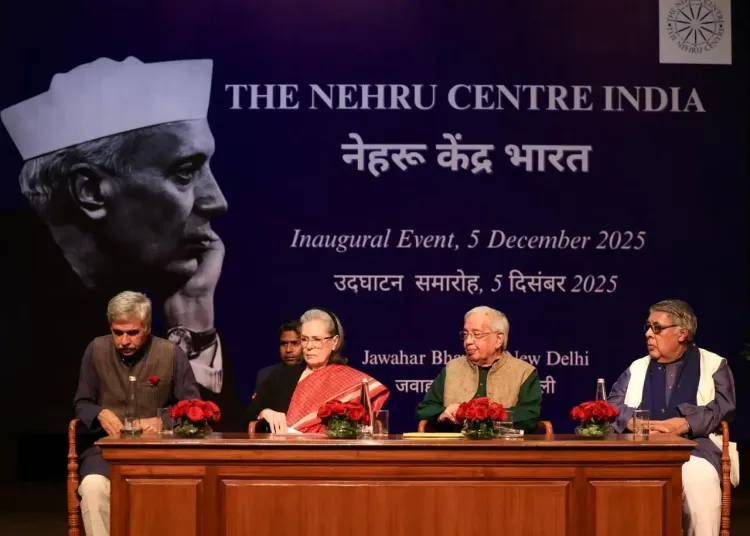
New Delhi, Dec 5 (NationPress) Congress Parliamentary Party Chairperson Sonia Gandhi expressed concern on Friday regarding what she described as a deliberate initiative to “vilify and erase” Jawaharlal Nehru. She asserted that this effort is part of a broader scheme aimed at undermining the foundational principles of the Indian republic.
During the inauguration of the Nehru Centre India at Jawahar Bhavan, she pointed out that the entities targeting Nehru adhere to an ideology that “played no part in the freedom struggle or in constructing the Constitution” and one that “incited animosity leading to Mahatma Gandhi’s assassination”.
She accused the current administration of leading a systematic campaign to distort, belittle, and tarnish Nehru’s legacy, attempting to rewrite history for political advantage.
Sonia Gandhi called upon citizens to resist what she termed “intentional historical misrepresentation and propaganda”, emphasizing that defending Nehru’s legacy is not merely a nostalgic endeavor but a reaffirmation of India’s constitutional vision, rationality, and inclusive identity.
She noted that the shrinking tolerance for dissent, increasing hostility towards differing opinions, and the politicization of history make Nehru’s example particularly significant in contemporary times.
Nehru, she remarked, embodied a democratic spirit that welcomed disagreement and regarded India’s diversity as its greatest asset.
In reference to the newly launched digital archive of Nehru’s Selected Works by the Jawaharlal Nehru Memorial Fund, Sonia Gandhi highlighted that the platform provides open access to 100 published volumes, encompassing his writings from 1903 until the day before his passing, with additional documents forthcoming.
She commended Sandeep Dikshit for spearheading the initiative, labeling it a vital effort to “liberate Nehru from a web of deception” and promote a fact-based public understanding.
Such initiatives, she stated, should proliferate across the nation.
In her address, she reminisced about Nehru’s pivotal role in shaping the modern Indian state and underscored his commitment to parliamentary democracy, secularism, scientific thinking, and planned economic growth.
These tenets, she affirmed, continue to steer India today and are crucial for preserving the nation’s pluralistic and democratic essence.
Point of View
It is imperative to recognize that the discourse surrounding historical figures like Nehru often reflects deeper societal divisions. While some may view these discussions as politically charged, it's essential to approach the narrative with an objective lens, ensuring that the historical contributions of influential leaders are accurately represented.
NationPress
05/12/2025
Frequently Asked Questions
What was Sonia Gandhi's main message regarding Nehru?
Sonia Gandhi emphasized the need to defend Jawaharlal Nehru's legacy against deliberate attempts to vilify and erase his contributions to India's democratic framework.
Why is Nehru's legacy important today?
Nehru's legacy embodies principles of democracy, secularism, and inclusivity, which are crucial for maintaining the pluralistic character of India in contemporary society.