Sonia Gandhi Raises Alarm Over Delimitation, Not Women's Reservation
Synopsis
In a recent statement, Sonia Gandhi expressed concerns about the Centre's focus on delimitation over women's reservation during the upcoming Parliament session. She warns of the dangers this poses to the Constitution and criticizes the government's political motivations.
Key Takeaways
Delimitation is prioritized over women's reservation , according to Sonia Gandhi.
The timing of the legislative session is questioned, suggesting political motives.
The Nari Shakti Vandan Adhiniyam, 2023 provides for women's reservations in legislative bodies.
Concerns are raised about delays in the Census and its impact on social justice.
Gandhi calls for a collaborative approach in governance and decision-making.
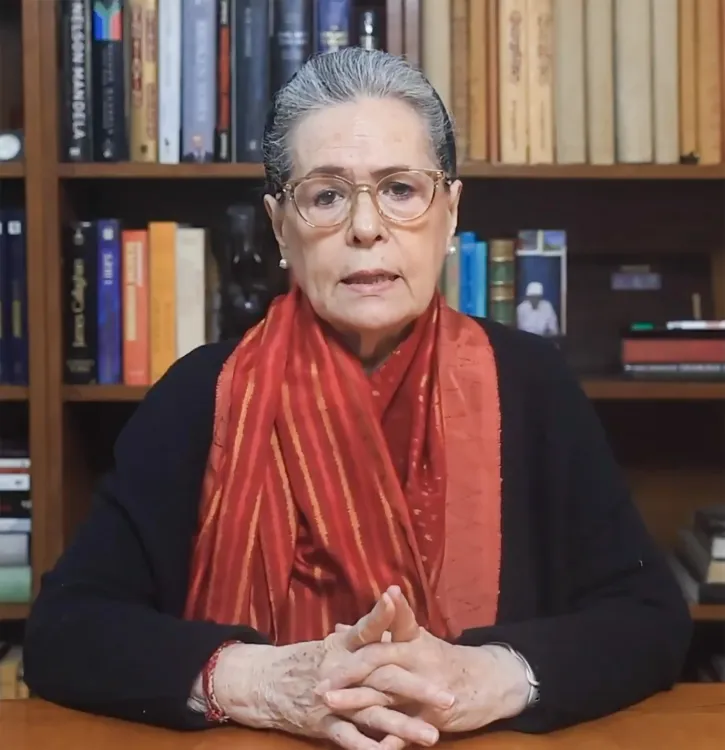
New Delhi, April 13 (NationPress) Sonia Gandhi, Chairperson of the Congress Parliamentary Party and member of the Rajya Sabha, emphasized on Monday that the primary issue with the Centre's decision to present Bills during a special session of Parliament on April 16 revolves around delimitation, rather than women's reservation. She characterized the process as "extremely dangerous" and referred to it as an "assault on the Constitution".
Gandhi accused Prime Minister Narendra Modi of attempting to "delay and derail" the caste census, arguing that the timing and approach of the legislative proposal suggest underlying political agendas.
Additionally, she criticized the government for ignoring numerous requests from opposition parties to hold an all-party meeting following the Assembly elections in Tamil Nadu and West Bengal, which conclude on April 29.
In an article published in The Hindu, Gandhi remarked, "The Prime Minister is urging Opposition parties to back Bills that the government wishes to push through during a special parliamentary session, coinciding with the peak of the election campaign in Tamil Nadu and West Bengal. The rush is clearly aimed at gaining political leverage and placing the Opposition in a defensive position."
She further asserted that the Prime Minister is "being less than truthful", noting that the opposition has been advocating for the implementation of women's reservation starting with the 2024 Lok Sabha elections, rather than tying it to the completion of the Census.
Referring to the Nari Shakti Vandan Adhiniyam, 2023, she stated, "In September 2023, Parliament unanimously passed the Nari Shakti Vandan Adhiniyam, 2023, during a special session, introducing Article 334-A in the Constitution, which stipulates one-third reservation for women in the Lok Sabha and Vidhan Sabhas. This is set to take effect post the next Census and the Census-based delimitation process."
"The Opposition did not request this stipulation. In fact, Rajya Sabha's Leader of the Opposition, Shri Mallikarjun Kharge, strongly demanded that the reservation be applied from the 2024 Lok Sabha elections. The government declined the request for reasons unknown," she added.
Gandhi continued to express that the opposition has learned that Article 334-A may be modified to implement women's reservation from 2029. She questioned why the Prime Minister took 30 months to reverse his stance and why he cannot postpone the special session by a few weeks.
She mentioned that several opposition leaders had reached out to the Centre three times, requesting an all-party meeting after the final phase of elections in West Bengal on April 29 to discuss governmental proposals.
"However, this entirely reasonable request has been rejected. Instead, the Prime Minister has turned to writing opinion pieces, appealing to political parties, and organizing sammelans. This indicates a manipulative tactic that showcases the Prime Minister's ego and his 'my way or the highway' approach to governance," she expressed.
Advocating for a more collaborative approach, Gandhi referenced the passage of the 73rd and 74th Constitutional Amendment Bills in 1993, which followed nearly five years of discussion before implementing reservations for women in panchayats and municipalities.
She acknowledged late Prime Minister Rajiv Gandhi for this initiative, stating, "Today, there are approximately 1.5 million elected women representatives in rural and urban local bodies, making up over 40 percent of the total. The Nari Shakti Vandan Adhiniyam, 2023, builds upon this achievement."
Gandhi also raised alarms about delays in the Census, highlighting that the decadal exercise scheduled for 2021 was postponed by the government. She pointed out, "Over 100 million individuals have been deprived of their legal rights under the National Food Security Act, 2013, which underpins the Pradhan Mantri Garib Kalyan Anna Yojana. Census operations have only commenced after an inexplicable five-year delay."
Questioning the urgency surrounding the proposed Census 2027, she commented, "It is being proudly claimed that this will be a digital Census. Senior officials have indicated that due to its digital nature, most population enumeration figures won't be available until 2027. The government's justifications for hastily convening this session and conducting delimitation are clearly unconvincing."
She also recalled the Centre's previous position on the caste census, stating, "Almost a year ago, the Prime Minister claimed that the 2027 Census would also encompass a caste census. This followed filings in the Supreme Court and responses in Parliament, where he dismissed the notion of conducting a caste census. He also labeled Congress leaders calling for a caste census as having an 'urban naxal mindset'. Regardless, Census 2027 is expected to categorize the population by caste to enhance social justice and empowerment."
Pointing to state-level examples, she noted that Bihar and Telangana successfully executed caste-based surveys within six months, contending that concerns regarding delays are unfounded.
"It is evident that the narrative claiming a caste census will postpone the publication of Census 2027 is unfounded. The Prime Minister's true intention appears to be to further delay and obstruct the caste census," she stated.
Regarding the upcoming special session commencing April 16, Gandhi remarked that "no formal proposal has been communicated to MPs regarding what the government intends to address during the session."
"It seems that a delimitation formula is being suggested. Any delimitation should follow a Census exercise, as seen in the past. Moreover, it is clear that any increase in Lok Sabha strength must be equitable politically, not just mathematically. States that have led in family planning, as well as smaller states, must not face absolute or relative disadvantages. A proportional increase could potentially diminish their influence because the difference in absolute numbers gets amplified," she elaborated.
She also highlighted that the Nari Shakti Vandan Adhiniyam, 2023, "ensures reservation within reservation," guaranteeing that "one-third of seats reserved for Scheduled Castes and Scheduled Tribes are also reserved for women."
"During the September 2023 debate, the Leader of the Opposition in the Rajya Sabha insisted on similar reservations for women from the Other Backward Classes (OBCs). Reservations for OBCs have already been established in higher education and government employment," she noted.
Gandhi concluded by mentioning that the monsoon session of Parliament is set to begin in mid-July, providing ample time for broader consultations.
"There is no harm if the government were to convene an all-party meeting post-April 29 to discuss its proposals with the Opposition, allowing for public debate before considering the Constitution Amendment Bills in the monsoon session," she said.
"This urgency to hastily push through significant changes to our political framework lacks justification, except for narrative management during challenging times. The process is fundamentally flawed and undemocratic. The focus is not on women's reservation, which has already been determined, but rather on delimitation, which, based on unofficial information, poses significant risks and represents an assault on the Constitution itself," she concluded.
Point of View
Sonia Gandhi's statements highlight significant concerns regarding the government's legislative priorities and the implications for democratic processes. Her calls for consultation and transparency reflect a broader yearning for accountability in governance.
NationPress
20 Sept 2026
Frequently Asked Questions
What is the main concern raised by Sonia Gandhi?
Sonia Gandhi emphasizes that delimitation is the primary issue at hand, rather than women's reservation, describing the delimitation process as a potential threat to the Constitution.
What does Sonia Gandhi say about the government's timing for the special session?
She suggests that the government's rush to introduce Bills coincides with election campaigns in Tamil Nadu and West Bengal, implying political motivations behind the timing.
What is the Nari Shakti Vandan Adhiniyam, 2023?
The Nari Shakti Vandan Adhiniyam, 2023, is a legislation that mandates one-third reservation for women in the Lok Sabha and Vidhan Sabhas, which is set to take effect post the next Census.
How does Sonia Gandhi view the government's handling of the caste census?
Gandhi accuses the Prime Minister of attempting to delay and derail the caste census, raising concerns over the urgency presented by the government.
What does Sonia Gandhi propose regarding all-party meetings?
She advocates for an all-party meeting to discuss the government's proposals after the conclusion of the elections, emphasizing the need for collaboration and consultation.