Congress Challenges Central Government on Women's Reservation and Delimitation
Synopsis
In a bold move, the Congress party claims the Central government is using women's reservation as a smokescreen for a flawed delimitation process. With the next census still delayed, the party questions the government's urgency and commitment to equitable representation.
Key Takeaways
Central Government's Alleged Strategy: Accusations of using women's reservation as a cover for flawed delimitation.
Call for Updated Census: Emphasis on the need for current census data before proceeding with delimitation.
Political Maneuvering: Concerns over timing of special parliamentary sessions amid elections.
Historical Context: Congress's role in establishing women's reservation in local governance.
Demand for Dialogue: Request for an all-party meeting to address these critical issues.
New Delhi, April 13 (NationPress) The Congress party has accused the Central government of engaging in a 'Machiavellian strategy' (similar to Shakuni's tactics) by concealing its true intentions regarding women's reservation. The party insists that the government's aim is to execute a flawed delimitation process while sidestepping the essential requirement of a caste census.
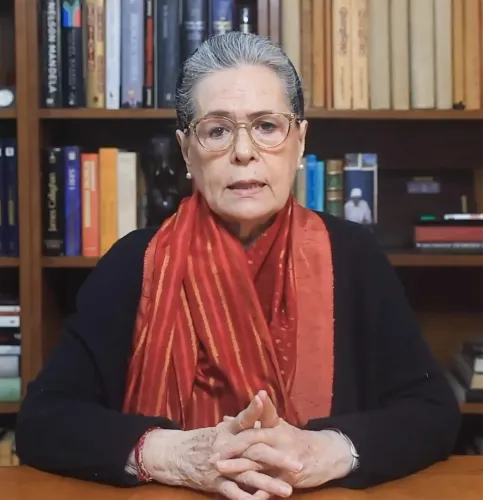
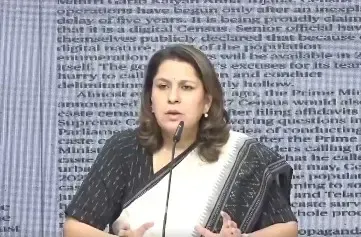
At a press conference held at the Congress headquarters, Supriya Shrinate—who leads the party's social media and digital outreach—referenced an article by Sonia Gandhi, Chair of the Congress Parliamentary Party. She emphasized that the delimitation initiative should not lead to undue advantages or disadvantages for smaller states or those that have excelled in family planning initiatives.
However, the delimitation exercise proposed by the Central government—scheduled to proceed without appropriate census data—will be fundamentally flawed, she cautioned. Shrinate warned that this could worsen the existing disparities between northern and southern states.
She underscored that the primary purpose of delimitation is not just to augment the number of seats but to guarantee fair representation.
Noting that the last census occurred in 2011 and the next was slated for 2021, which is now five years overdue, she questioned how delimitation could be effectively executed without current census data. She raised concerns regarding the ongoing Socio-Economic and Caste Census (SECC), where millions have been removed from lists, indicating the government's acknowledgment of fluctuating population data across regions.
In this context, she queried, what criteria will be employed for delimitation? How will the government identify which seats should be allocated for Scheduled Castes (SCs) and Scheduled Tribes (STs)?
Furthermore, she asked why the government could not wait until 2027, when comprehensive census data is projected to be available.
The Congress spokesperson pointed out that caste surveys conducted in Bihar and Telangana highlight the substantial size of the Backward Classes population. Following the passage of the Women's Reservation Bill in 2023, the Congress had advocated for the inclusion of reservations for OBC women. However, to evade conducting a caste census and providing reservations for OBC women, the Modi government is hastily pushing for the delimitation process.
Expressing concerns about a special session of Parliament set to commence on April 16 amidst election campaigns in West Bengal and Tamil Nadu, Shrinate accused the government of attempting to gain political advantage during elections, thus depriving MPs of their right to connect with the electorate.
She mentioned that the Opposition had sent three letters to the Central government, requesting an all-party meeting after April 29 to discuss the constitutional amendment. However, this request was ignored by the government, revealing questionable intentions and a lack of genuine commitment towards women's empowerment.
Shrinate reminded everyone that the Nari Shakti Vandan Adhiniyam (Women's Reservation Act) was introduced 30 months ago in September 2023. The legislation required a census and delimitation exercise to be completed before implementing the women's reservation quota. At that time, Congress President Mallikarjun Kharge and Sonia Gandhi had called for immediate implementation of the Act starting in 2024, without any preconditions, a request that the government has not honored.
The Congress spokesperson reiterated that Sonia Gandhi has made it clear in her writings that the real issue lies not in women's reservation—which has already received unanimous parliamentary support—but in the delimitation process itself.
Supriya Shrinate concluded by emphasizing that it was the Congress party that originally established the framework for women's reservation, having provided one-third reservation to women in the Panchayati Raj system through the 73rd and 74th Constitutional Amendments—an initiative initiated by Rajiv Gandhi. This groundwork has led to the rise of over 1.5 million elected women representatives in the Panchayati Raj system today.
She reaffirmed the party's demand for the Central government to convene an all-party meeting and reach a resolution only after thorough discussions.
Point of View
The Congress party's concerns about the delimitation process amid the ongoing census delay highlight significant issues in representation and governance. The call for an all-party meeting reflects the need for collaborative dialogue on women's empowerment in the political arena.
NationPress
24 Sept 2026
Frequently Asked Questions
What is the Women's Reservation Act?
The Women's Reservation Act, also known as the Nari Shakti Vandan Adhiniyam, aims to reserve a certain percentage of seats for women in legislative bodies to ensure their representation.
Why is delimitation important?
Delimitation is crucial as it involves redrawing boundaries of electoral constituencies to reflect changes in population and ensure fair representation.
What are the concerns regarding the current delimitation process?
Concerns include the lack of updated census data, which could lead to procedural inaccuracies and inequitable representation, particularly between northern and southern states.
What did the Congress party demand regarding the census?
The Congress party has demanded that the Central government postpone delimitation until after the next census to ensure accurate and fair representation.
How has the Congress party contributed to women's reservation?
The Congress party laid the groundwork for women's reservation through initiatives like the 73rd and 74th Constitutional Amendments, which provided one-third reservation in local governance.