CM Dhami Highlights Uttarakhand AYUSH Policy-2023 Progress
Synopsis
Uttarakhand Chief Minister Pushkar Singh Dhami has highlighted the state's AYUSH Policy-2023, crediting PM Modi's leadership for new benchmarks in traditional medicine, with the policy targeting stronger AYUSH institutions, wider healthcare access, employment generation, and investment in the sector.
Key Takeaways
CM Pushkar Singh Dhami announced on 9 June 2026 that Uttarakhand is setting new benchmarks in the AYUSH sector.
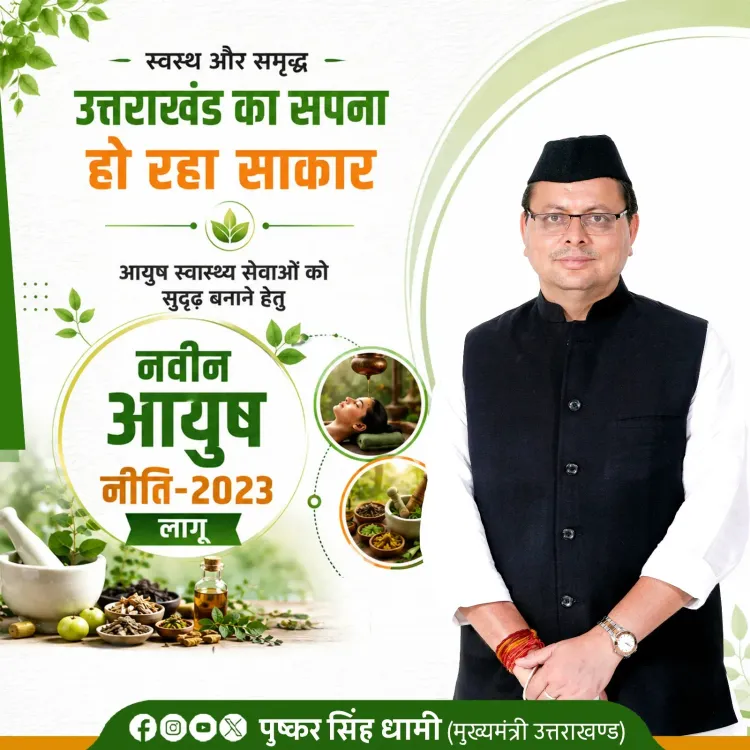
AYUSH Policy-2023 has been implemented to strengthen AYUSH health services and ensure quality treatment reaches every citizen in the state.
The policy aims to empower AYUSH institutions and health centres across Uttarakhand.
It also targets employment generation , investment attraction , and promotion of traditional medicine systems.
The initiative aligns with the National AYUSH Mission launched in 2014 and the Ministry of AYUSH established in November 2014 .
Key stakeholders include AYUSH practitioners , rural patients , and wellness investors .
Uttarakhand Chief Minister Pushkar Singh Dhami on Tuesday, 9 June 2026, credited Prime Minister Narendra Modi's leadership for the state setting new benchmarks in the AYUSH sector, pointing to the implementation of Uttarakhand AYUSH Policy-2023 as a key driver of strengthening traditional medicine services across the state.
Context
Posting in Hindi on X, CM Dhami stated: 'आदरणीय प्रधानमंत्री श्री नरेंद्र मोदी जी के कुशल नेतृत्व में उत्तराखंड आयुष के क्षेत्र में भी नए कीर्तिमान स्थापित कर रहा है' ['Under the able leadership of respected Prime Minister Narendra Modi, Uttarakhand is also setting new records in the field of AYUSH']. He added that AYUSH Policy-2023 was enacted with the objective of strengthening AYUSH health services in the state and delivering quality treatment to every citizen.
The Chief Minister further noted that the policy is simultaneously empowering AYUSH institutions and health centres while promoting employment, investment, and traditional systems of medicine.
Policy Backdrop
The Ministry of AYUSH was established in November 2014 to provide dedicated policy focus to Ayurveda, Yoga, Unani, Siddha, and Homoeopathy at the national level. This was accompanied by the launch of the National AYUSH Mission in 2014, which aimed to upgrade state-level AYUSH infrastructure and improve service delivery across India.
Uttarakhand, a Himalayan state with a natural advantage in medicinal herbs and wellness tourism, has positioned itself as a front-runner in translating central AYUSH policy into state-level action. The AYUSH Policy-2023 is the state's dedicated framework to consolidate this momentum, aligning with the broader national objective of integrating traditional medicine into mainstream public health.
Stakeholders and Impact
The policy's stated beneficiaries include AYUSH practitioners, rural patients, wellness investors, and state health officials. By linking AYUSH expansion to employment generation and investment attraction, the policy also carries an economic dimension beyond its health mandate.
Several Indian states have followed the central government's lead with their own AYUSH frameworks that combine infrastructure upgrades, practitioner training, and investment incentives. Uttarakhand's approach fits this broader national pattern of promoting medical pluralism and preventive care, including under the Ayushman Bharat framework.
What's Next
Official evaluation reports on AYUSH Policy-2023 outcomes — including the number of new centres opened and jobs created — will be key indicators of the policy's on-ground impact. Future central funding allocations and potential memoranda of understanding between Uttarakhand and the Ministry of AYUSH will determine the pace of further expansion.
As traditional medicine continues to be integrated into India's public health architecture, Uttarakhand's experience with its dedicated AYUSH policy could serve as a reference point for other states seeking to balance heritage health systems with modern delivery standards.
Point of View
The Chief Minister positions Uttarakhand as a model implementer of the Modi government's traditional-medicine mainstreaming agenda. The dual emphasis on healthcare access and economic outcomes (employment, investment) reflects a deliberate effort to broaden the policy's appeal beyond health alone. Whether the policy's on-ground outcomes match the political framing will depend on forthcoming official data on new centres, practitioners enrolled, and jobs created.
NationPress
23 Oct 2026
Frequently Asked Questions
What is Uttarakhand AYUSH Policy-2023?
Uttarakhand AYUSH Policy-2023 is a state government framework designed to strengthen AYUSH health institutions and health centres, expand access to quality traditional medicine, and promote employment and investment in Ayurveda, Yoga, Unani, Siddha, and Homoeopathy across the state.
What did CM Pushkar Singh Dhami say about AYUSH in Uttarakhand?
CM Dhami stated that under PM Modi's leadership, Uttarakhand is setting new benchmarks in the AYUSH sector, and credited AYUSH Policy-2023 with empowering institutions, improving healthcare access, generating employment, and attracting investment in traditional medicine.
When was the Ministry of AYUSH established?
The Ministry of AYUSH was established in November 2014 to provide dedicated policy focus to traditional and alternative medicine systems including Ayurveda, Yoga, Unani, Siddha, and Homoeopathy.
How does Uttarakhand AYUSH Policy-2023 help rural patients?
The policy aims to make quality AYUSH treatment accessible to every citizen by strengthening health centres and institutions across the state, with a particular focus on reaching underserved and rural populations.
What is the National AYUSH Mission?
The National AYUSH Mission was launched in 2014 to upgrade state-level AYUSH infrastructure and improve service delivery across India, providing states like Uttarakhand with a framework and funding support to expand traditional medicine services.