CM Dhami Announces Jamrani Dam Project Approval
Synopsis
Uttarakhand Chief Minister Pushkar Singh Dhami on 21 July 2026 announced government approval for the long-pending Jamrani Multipurpose Dam Project, saying it will boost irrigation, drinking water supply, and regional development — crediting the BJP's 'double engine' central-state coordination.
Key Takeaways
Uttarakhand Chief Minister Pushkar Singh Dhami announced on 21 July 2026 that the Jamrani Multipurpose Dam Project has received government approval.
The project had been pending for several years; its approval is attributed to the BJP's 'double engine government' — simultaneous BJP rule at the state and central level.
The dam is designed to strengthen irrigation, drinking water supply, and water management in the region.
Key beneficiaries include Kumaon region farmers and local households dependent on reliable water access.
Next steps include finalisation of the detailed project report, environmental and forest clearances , and budget allocation.
The announcement reflects a broader BJP pattern of fast-tracking long-delayed water infrastructure in Himalayan states .
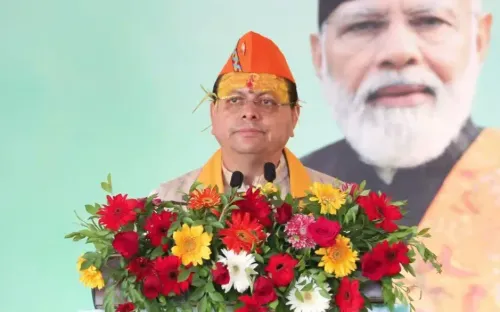
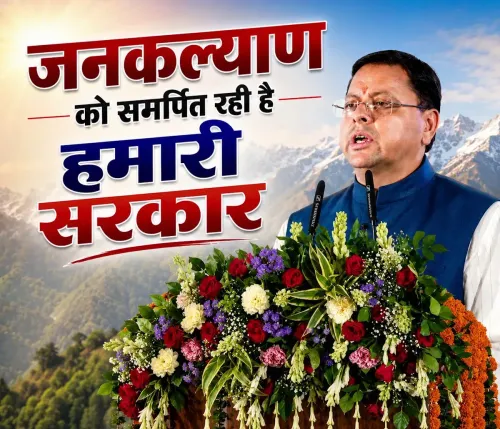
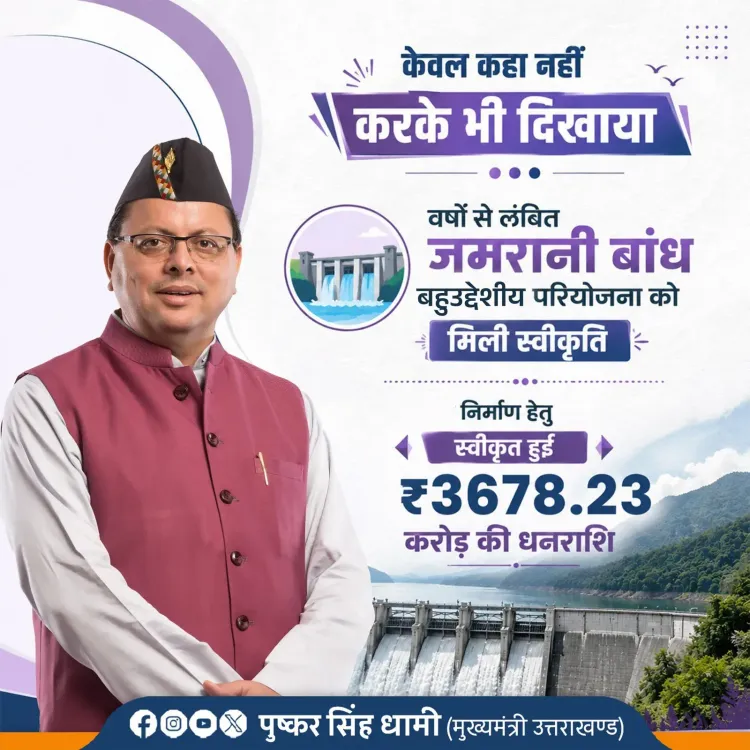
Uttarakhand Chief Minister Pushkar Singh Dhami announced on Tuesday, 21 July 2026 that the long-pending Jamrani Multipurpose Dam Project has been granted approval by the 'double engine' government — referring to the BJP's simultaneous hold on power in both Uttarakhand and at the Centre. Dhami said the project will strengthen irrigation, drinking water supply, and water management while giving fresh momentum to regional development.
Posting in Hindi on X, the Chief Minister stated: 'वर्षों से लंबित जमरानी बहुउद्देशीय बांध परियोजना को हमारी डबल इंजन सरकार द्वारा स्वीकृति प्रदान की गई है' — ('The long-pending Jamrani Multipurpose Dam Project has been approved by our double engine government'). He described the project's ground-level realisation as proof of firm resolve toward development and continuous efforts in public interest.
Context
The Jamrani Multipurpose Dam Project is a long-delayed water infrastructure initiative in Uttarakhand aimed at addressing the state's irrigation deficits, drinking water shortages, and flood moderation challenges. The project has been in the pipeline for years, with successive governments unable to push it to the approval stage. The announcement marks a significant administrative milestone for the Dhami-led state government.
Uttarakhand's terrain — largely Himalayan — makes water resource management both critical and complex. Communities in the Kumaon region, including farmers and local households, stand to be among the primary beneficiaries of improved water availability and regulated river flow that a multipurpose dam can provide.
Policy Backdrop
The approval fits squarely within the BJP's 'double engine government' framework — a political messaging strategy that highlights accelerated project delivery when the same party governs both the state and the Centre. Under this model, central-state coordination is presented as the key enabler for clearing bottlenecks that had stalled projects for years or even decades.
Across Uttarakhand and other BJP-governed Himalayan states, there has been a visible push to fast-track pending irrigation and drinking-water schemes. These announcements are routinely positioned as evidence of improved governance efficiency and a departure from earlier administrative delays.
Stakeholders and Impact
The project is expected to benefit Kumaon region farmers who depend on reliable irrigation for their agricultural cycles, as well as households in surrounding areas that face drinking water access challenges. Flood moderation — a key function of multipurpose dams — would also reduce seasonal vulnerability for communities along the affected river corridor.
Beyond immediate beneficiaries, the project carries economic implications for the broader region. Improved water infrastructure typically supports agricultural productivity, reduces crop loss from water stress, and can anchor ancillary development activity in previously underserved areas.
What's Next
Following the approval announcement, the project will need to advance through several procedural stages before construction can begin. These include finalisation of the detailed project report, environmental and forest clearances, and firm budget allocations under relevant state or central schemes.
The pace at which these clearances are secured will determine how quickly the Jamrani Dam moves from policy approval to ground-level implementation — the metric by which CM Dhami has himself chosen to measure the project's significance. The coming months will test whether the 'double engine' coordination advantage translates into tangible construction timelines.
Point of View
Designed to reinforce BJP's central campaign argument that single-party alignment between state and Centre delivers results that coalition or opposition-governed states cannot. For CM Dhami, clearing a project that languished for years is a credibility asset ahead of any electoral cycle. However, the real test will come not at approval but at execution: environmental clearances and forest diversion approvals in Himalayan states have historically been the stage where infrastructure ambitions stall. The announcement sets a benchmark that the government will be held against.
NationPress
20 Oct 2026
Frequently Asked Questions
What is the Jamrani Multipurpose Dam Project?
The Jamrani Multipurpose Dam Project is a long-pending water infrastructure initiative in Uttarakhand designed to improve irrigation, drinking water supply, and flood moderation, particularly for communities in the Kumaon region.
Who approved the Jamrani Dam Project?
Uttarakhand Chief Minister Pushkar Singh Dhami announced on 21 July 2026 that the project was approved by the 'double engine government,' referring to the BJP's coordinated authority at both the state and central levels.
What does 'double engine government' mean in this context?
'Double engine government' is a BJP political term describing simultaneous BJP rule in a state and at the Centre, which the party argues enables faster project approvals and smoother central-state coordination.
Who will benefit from the Jamrani Dam Project?
Farmers in the Kumaon region of Uttarakhand and local households facing water access challenges are among the primary expected beneficiaries, along with communities that stand to gain from improved flood moderation.
What are the next steps for the Jamrani Dam Project after approval?
Following the approval announcement, the project must progress through detailed project report finalisation, environmental and forest clearances, and budget allocations before construction can begin.