CM Uttarakhand: Jamrani Dam project gets PMKSY boost
Synopsis
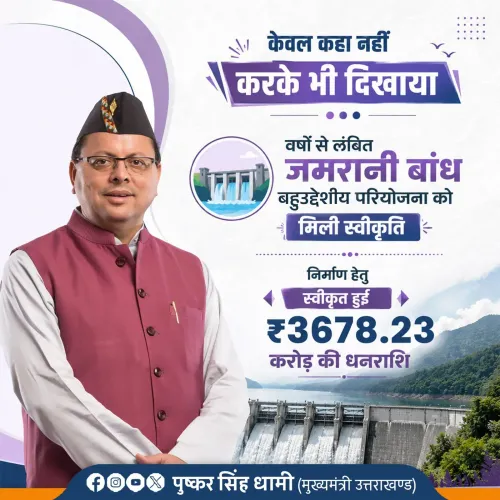
The Uttarakhand CMO announced on June 9, 2026 that the long-pending Jamrani Dam Multipurpose Project has been included under Pradhan Mantri Krishi Sinchayee Yojana under PM Modi's leadership, offering a new push for irrigation and drinking water supply in the Kumaon and Terai regions.
Key Takeaways
The Jamrani Dam Multipurpose Project has been included under Pradhan Mantri Krishi Sinchayee Yojana (PMKSY) , announced by the Uttarakhand CMO on June 9, 2026 .
The project is designed to provide irrigation, drinking water, and hydropower benefits to the Kumaon and Terai regions of Uttarakhand.
PMKSY , launched in 2015 , provides central viability-gap funding and technical support to fast-track stalled state irrigation projects.
Farmers and residents of Kumaon and the Terai belt have awaited reliable water infrastructure for several decades.
The inclusion follows a broader central government pattern of bringing long-pending Himalayan water projects under national funding umbrellas.
Key next steps include detailed project report approvals, central fund allocations, and environmental clearances.
The Chief Minister's Office of Uttarakhand announced on Tuesday, June 9, 2026, that the long-pending Jamrani Dam Multipurpose Project has been included under the Pradhan Mantri Krishi Sinchayee Yojana (PMKSY), describing the move as a new ray of hope for the Kumaon and Terai regions that have awaited reliable irrigation infrastructure for decades.
Context
The post, shared from the official CMO handle, states: 'Dashkon se intezaar kar rahe Kumaun aur Terai kshetra ke liye Jamrani Baandh Bahuddesheey Pariyojana ab umeed ki nayi kiran bankar ubhar rahi hai' ('For the Kumaon and Terai regions that have waited for decades, the Jamrani Dam Multipurpose Project is now emerging as a new ray of hope'). The announcement credits the central government under Prime Minister Narendra Modi with giving fresh momentum to the project by bringing it under PMKSY. The Jamrani Dam Multipurpose Project is designed to serve multiple purposes — irrigation for agricultural land, drinking water supply, and hydropower generation — for communities across both the hilly Kumaon division and the Terai plains belt of Uttarakhand.Policy Backdrop
Pradhan Mantri Krishi Sinchayee Yojana was launched in 2015 with the mandate to expand irrigation coverage across India, improve water-use efficiency, and fast-track stalled state-level irrigation projects through central viability-gap funding and technical support. Inclusion under PMKSY typically unlocks dedicated central allocations and provides a structured implementation timeline for projects that have otherwise languished in state budgets. Uttarakhand has long sought central support for storage dam projects to address acute seasonal water scarcity in both its mountain districts and the downstream plains. The Jamrani Dam project is among the most prominent of these long-delayed proposals, with stakeholders in Kumaon and the Terai belt having advocated for its completion over multiple decades.Stakeholders and Impact
Farmers in the Kumaon hills and the Terai agricultural belt stand to be the primary beneficiaries if the project reaches completion. Reliable upstream water storage is expected to stabilise irrigation supply across seasons, reducing dependence on rain-fed agriculture and improving crop yields in the region. Drinking water security for settlements in both zones is also cited as a key deliverable of the multipurpose design. The move mirrors a broader pattern in which the central government has folded long-pending Himalayan water infrastructure projects — including those in Himachal Pradesh and Jammu and Kashmir — into national schemes to provide the financial and administrative push needed to break implementation deadlocks.What's Next
The key milestones to watch will include the release of detailed project report approvals, formal central fund allocation orders, and environmental clearance timelines under the PMKSY framework. Progress on these administrative steps will determine how quickly the project transitions from announcement to active construction, and whether the decades-long wait for Kumaon and Terai communities finally nears its end.Point of View
The BJP-led government at the Centre reinforces its development narrative in a hill state where water scarcity is a lived grievance, not an abstract policy concern. The move also follows a well-worn playbook of using PMKSY as a mechanism to claim credit for legacy infrastructure projects that have accumulated political goodwill over years of delay. Whether the announcement translates into accelerated on-ground progress will depend on the speed of clearances and fund releases — the metrics by which voters in Kumaon and Terai will ultimately judge the promise.
NationPress
24 Oct 2026
Frequently Asked Questions
What is the Jamrani Dam Multipurpose Project?
The Jamrani Dam Multipurpose Project is a long-pending infrastructure scheme in Uttarakhand designed to provide irrigation water, drinking water supply, and hydropower generation to communities in the Kumaon hills and the Terai plains belt.
What is Pradhan Mantri Krishi Sinchayee Yojana (PMKSY)?
Pradhan Mantri Krishi Sinchayee Yojana is a central government scheme launched in 2015 to expand irrigation coverage across India, improve water-use efficiency, and provide funding support to fast-track stalled state irrigation projects.
How does PMKSY inclusion help the Jamrani Dam project?
Inclusion under PMKSY typically unlocks dedicated central government funding, technical assistance, and a structured implementation framework, helping break the financial and administrative deadlocks that have delayed such projects for decades.
Which regions benefit from the Jamrani Dam project?
The primary beneficiaries are farmers and residents of the Kumaon division in the hills and the Terai agricultural belt in the plains of Uttarakhand, who have faced seasonal water scarcity for decades.
What are the next steps after the Jamrani Dam project is included under PMKSY?
The key milestones ahead include approval of the detailed project report, formal central fund allocation orders, and obtaining environmental clearances — all of which will determine the pace of actual construction.