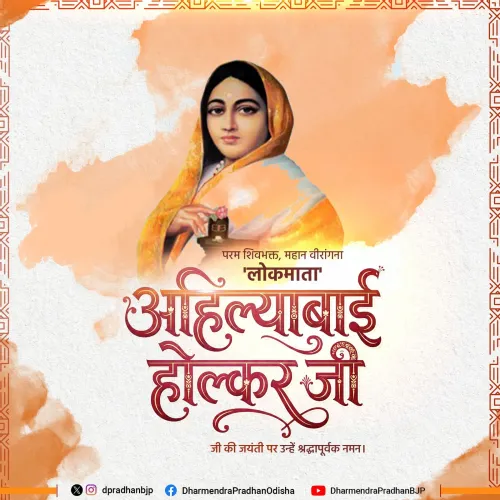
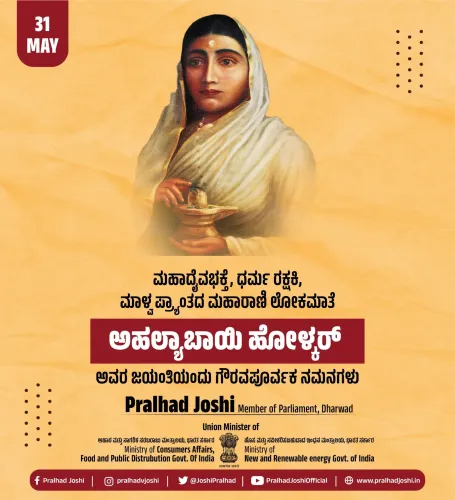
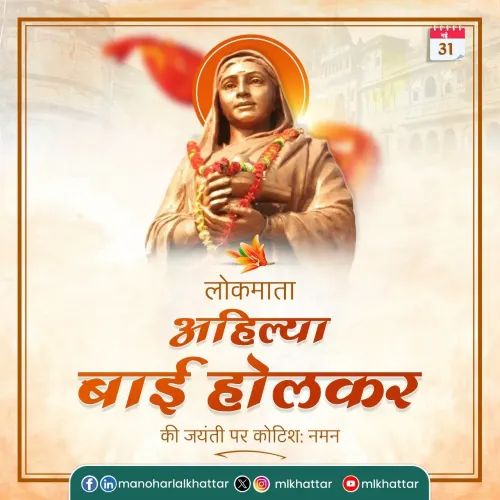
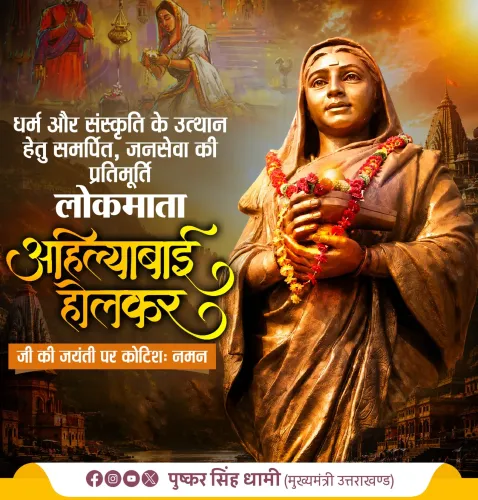
CM Dhami pays tribute to Ahilyabai Holkar on death anniversary
Synopsis
Uttarakhand CM Pushkar Singh Dhami on 13 August 2026 honoured Maharani Ahilyabai Holkar on her death anniversary, praising the 18th-century Malwa ruler's role in reviving temples including Kashi Vishwanath and Somnath, and her legacy of women's empowerment and public welfare.
Key Takeaways
CM Pushkar Singh Dhami posted a formal tribute to Maharani Ahilyabai Holkar on her death anniversary on 13 August 2026 .
Dhami described her as a symbol of 'dharma protection, women's empowerment, and public welfare.' Ahilyabai Holkar ruled the Malwa kingdom in the 18th century and rebuilt major temples including Kashi Vishwanath and Somnath .
The tribute fits a consistent BJP pattern of publicly honouring historical Hindu rulers on their death and birth anniversaries.
The themes of temple conservation and Sanatan tradition align closely with the stated cultural priorities of the Uttarakhand government.
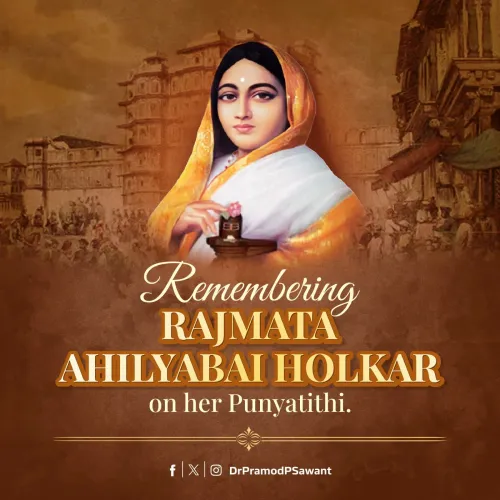
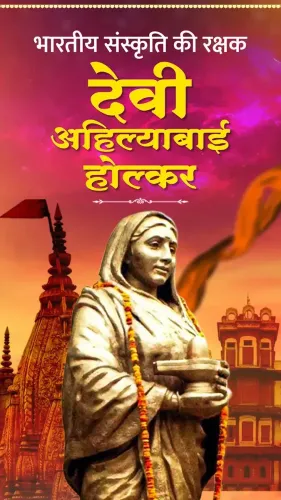
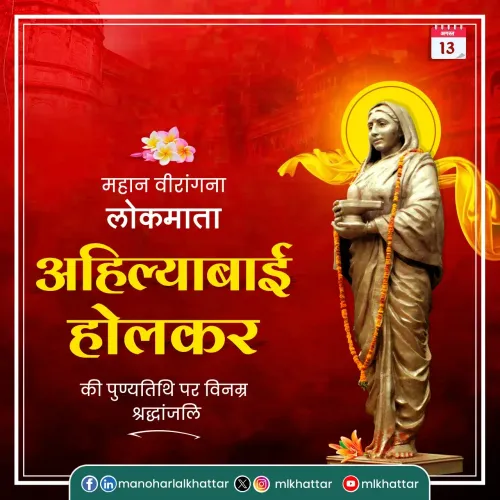
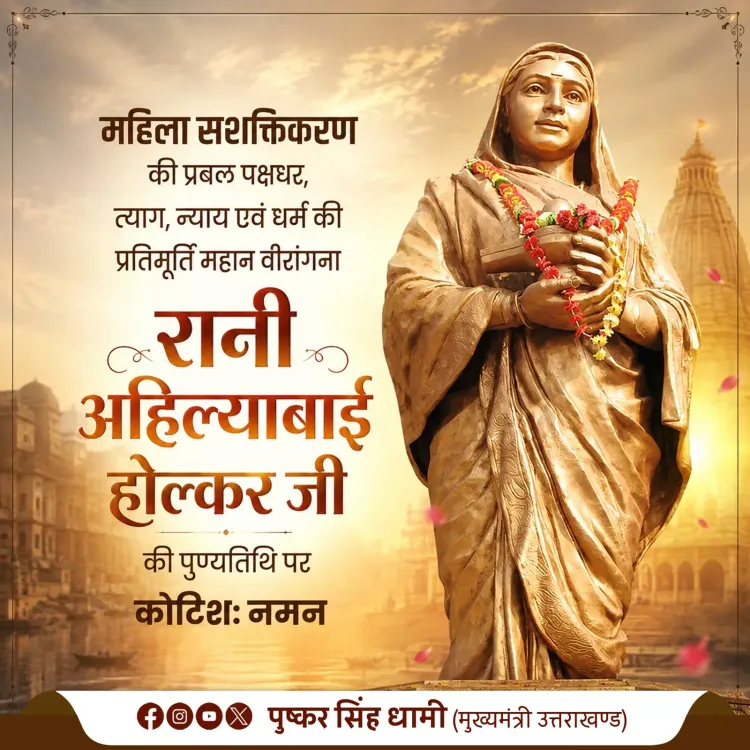
Three centuries after she rebuilt the Kashi Vishwanath and Somnath temples from ruin, Maharani Ahilyabai Holkar still commands reverence at the highest levels of Indian public life. On her death anniversary, Thursday, 13 August 2026, Uttarakhand Chief Minister Pushkar Singh Dhami offered a formal tribute, calling her an enduring symbol of dharma, women's empowerment, and public welfare.
In his post, CM Dhami wrote: 'Dharmaraksha, mahila sashaktikaran evam lokkalyan ki mahan pratik, virangana Maharani Ahilyabai Holkar ji ki punyatithi par kotishaha naman' — 'Countless salutations on the death anniversary of the great symbol of protection of dharma, women's empowerment, and public welfare, the brave Maharani Ahilyabai Holkar.' He credited her 'farsightedness' for an 'unparalleled contribution' to the preservation and revival of Indian culture, Sanatan traditions, temples, and monasteries.
The queen who rebuilt India's sacred geography
Ahilyabai Holkar ruled the Malwa kingdom in the latter half of the 18th century and became one of the most celebrated administrators of her era. She oversaw the reconstruction of several major Hindu pilgrimage sites that had been damaged or destroyed over preceding centuries, including the Kashi Vishwanath temple in Varanasi and the Somnath temple in Gujarat. Her reign is also noted for patronising public works — roads, rest houses, and wells — and for extending support to women's education, unusual for the period.
Her legacy sits at the intersection of statecraft and religious patronage, making her a recurring reference point in contemporary discussions about cultural heritage and temple conservation.
BJP's pattern of historical Hindu tributes
BJP leaders across states routinely mark the death and birth anniversaries of historical Hindu rulers with public statements, and Ahilyabai Holkar is among the most frequently honoured figures in that calendar. The tributes consistently foreground themes of temple restoration and traditional governance — the same themes CM Dhami highlighted on 13 August. For Dhami, whose state of Uttarakhand is home to some of India's most significant pilgrimage corridors including the Char Dham circuit, the alignment between Ahilyabai's legacy and his administration's stated priorities is pointed.
Her example — a woman ruler who governed with both administrative rigour and deep religious conviction — also gives the tribute a dual register: honouring a female historical leader while underscoring a commitment to cultural preservation.
Ahilyabai Holkar's story is not a chapter from a distant past. It is a blueprint that Indian politics still actively reads.
Point of View
The reference to temple restoration carries an implicit policy signal. These anniversary statements, individually ceremonial, collectively form a sustained narrative about who the party sees as India's authentic historical custodians.
NationPress
27 Sept 2026
Frequently Asked Questions
Who was Maharani Ahilyabai Holkar?
Maharani Ahilyabai Holkar was an 18th-century ruler of the Malwa kingdom, celebrated for rebuilding major Hindu temples including Kashi Vishwanath in Varanasi and Somnath in Gujarat, and for her public welfare works and support for women's education.
Why did CM Dhami pay tribute to Ahilyabai Holkar?
13 August 2026 marks Ahilyabai Holkar's death anniversary. CM Pushkar Singh Dhami posted a tribute honouring her contributions to dharma, women's empowerment, and the preservation of Indian culture and temples.
Which temples did Ahilyabai Holkar restore?
Among the most prominent temples she restored were the Kashi Vishwanath temple in Varanasi and the Somnath temple in Gujarat, both major Hindu pilgrimage sites.
What is the significance of BJP leaders honouring historical Hindu rulers?
BJP leaders across states routinely mark the anniversaries of historical Hindu rulers to reinforce themes of cultural heritage, temple restoration, and traditional governance as part of the party's broader ideological identity.
What did CM Dhami say about Ahilyabai Holkar?
Dhami called her an 'unparalleled' contributor to Indian culture and Sanatan traditions, and said her work in protecting dharma and culture would remain a source of inspiration.