CM Dhami: Uttarakhand draws 8 crore visitors yearly
Synopsis
On World Tourism Day 2026, CM Pushkar Singh Dhami cited annual footfall of nearly 8 crore visitors to Uttarakhand, highlighting the Char Dham Yatra's record growth and crediting PM Modi's PRASAD scheme and double-engine governance for the state's tourism surge.
Key Takeaways
CM Dhami marked World Tourism Day on 27 September 2026 with a message spotlighting Uttarakhand's tourism economy.
He cited an annual arrival figure of nearly 8 crore (80 million) pilgrims and tourists in the state.
The Char Dham Yatra — covering Yamunotri, Gangotri, Kedarnath and Badrinath — was highlighted as the driver of 'historic' growth in devotee numbers.
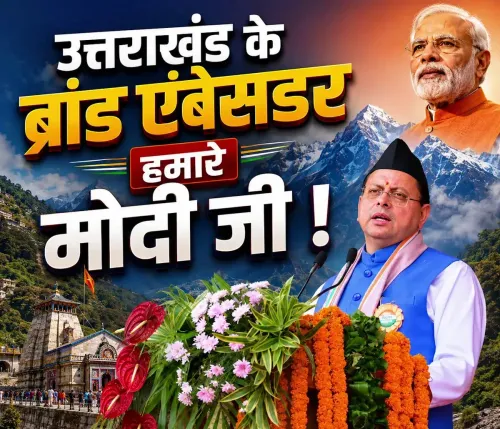
CM Dhami credited PM Narendra Modi's leadership and the 'double-engine government' for unprecedented tourism development in the state.
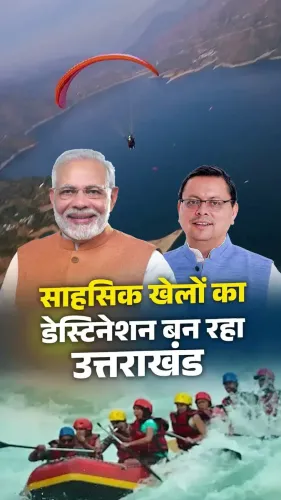
The state is now promoting adventure, eco and rural tourism alongside religious pilgrimage to diversify and extend visitor spread.
The central PRASAD scheme (launched 2014-15) has supported pilgrimage infrastructure investment across Uttarakhand's key sites.
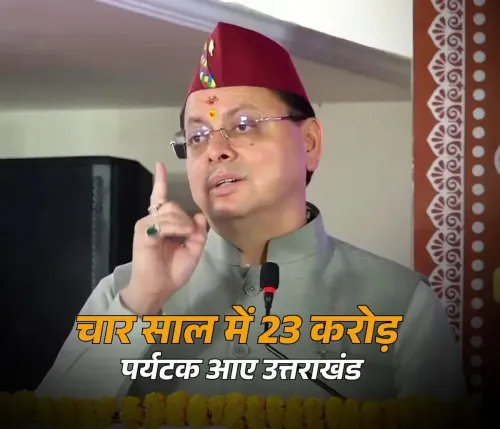
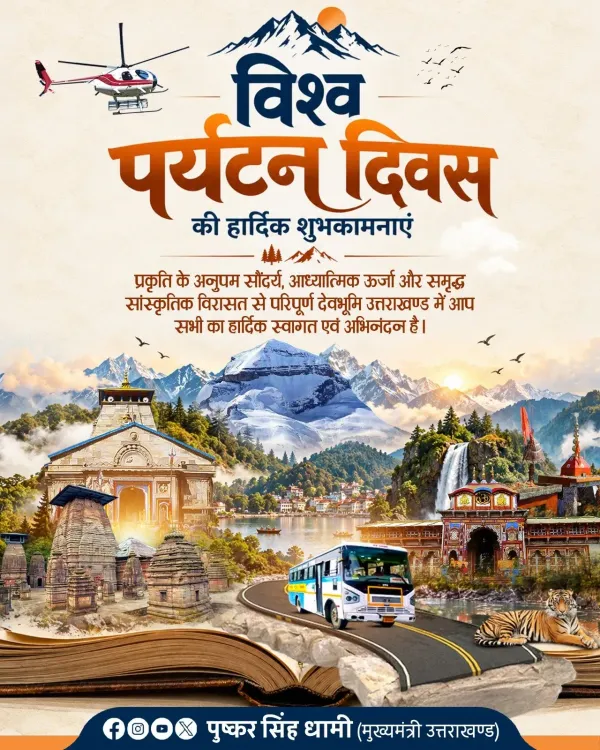
On World Tourism Day, 27 September 2026, Uttarakhand Chief Minister Pushkar Singh Dhami placed a striking number at the centre of his message to the state: nearly 8 crore pilgrims and tourists now arrive in Uttarakhand every year, a figure he called evidence of the state's rising global identity.
Writing in Hindi on the occasion of the annual global observance, CM Dhami declared: 'Paryatan Uttarakhand ki aarthiki ka mahatvapurna aadhar hai' — 'Tourism is an important pillar of Uttarakhand's economy' — while also describing it as the most powerful medium for carrying the state's 'rich culture, spiritual heritage and natural beauty to the country and the world.'
Char Dham at the heart of the footfall surge
The Char Dham Yatra — the annual Hindu pilgrimage circuit of Yamunotri, Gangotri, Kedarnath and Badrinath — sits at the core of this visitor story. CM Dhami described the growth in devotees at the state's religious and spiritual sites as 'historic', citing it as the clearest proof of Uttarakhand's expanding reach as a destination. The Char Dham circuit has long been Uttarakhand's single biggest tourism engine, drawing pilgrims from across India and increasingly from the Indian diaspora abroad.
The central government's PRASAD scheme, launched in 2014-15, has channelled infrastructure investment into pilgrimage and spiritual tourism sites across India, with Uttarakhand among its primary beneficiaries. All-weather road connectivity projects to the Char Dham shrines have been a visible part of that push — shortening journey times and opening the high-altitude circuit to a wider base of visitors.
Beyond the shrines: adventure, eco and rural tourism take shape
CM Dhami's message deliberately broadened the frame beyond pilgrimage. He described Devbhoomi Uttarakhand — the 'Land of the Gods' — as now drawing national and global attention across adventure, religious, eco and rural tourism as well. The four-category articulation reflects a state strategy to smooth out the seasonal concentration of visitors around the yatra months and spread economic benefit into lesser-known corners of the hills.
CM Dhami attributed the 'unprecedented development' in tourism directly to the 'skilled leadership' of Prime Minister Narendra Modi and the continuous efforts of the 'double-engine government' — the BJP shorthand for aligned ruling parties at both the state and central level. The framing is a recurring feature of BJP-governed Himalayan states, which use tourism milestones to demonstrate the dividend of coordinated Centre-state governance.
What the 8-crore figure means for a mountain economy
For a state of roughly 11 million people, an annual visitor flow of 8 crore — 80 million — represents a ratio that makes tourism not just a sector but a structural feature of the economy. Hotels, homestays, transport operators, local artisans, priests and the broader hospitality ecosystem all depend on sustaining and growing that footfall. The post-pandemic recovery of domestic pilgrimage and leisure travel has been sharper than most forecasts anticipated, and Uttarakhand has been one of the clearest beneficiaries of that rebound.
The state's challenge now is infrastructure that scales with ambition — managing crowd surges at high-altitude shrines, protecting fragile Himalayan ecosystems, and ensuring that the economic gains flow into mountain communities rather than pooling at gateway towns. World Tourism Day is the right moment to celebrate the numbers; the harder work is making them sustainable.
Point of View
Eco and rural categories, Dhami is also laying rhetorical groundwork for a broader state tourism policy push likely before the next yatra season. The invocation of PM Modi and the PRASAD scheme keeps Uttarakhand firmly within the Centre's developmental branding ecosystem, a pattern consistent across BJP-governed Himalayan states. The open question — whether infrastructure and ecological carrying capacity can keep pace with the ambition embedded in those numbers — is the subtext the post conspicuously leaves unaddressed.
NationPress
27 Sept 2026
Frequently Asked Questions
How many tourists visit Uttarakhand every year?
CM Pushkar Singh Dhami stated on World Tourism Day 2026 that nearly 8 crore (80 million) pilgrims and tourists visit Uttarakhand annually, driven significantly by the Char Dham Yatra circuit.
What is the Char Dham Yatra and why is it important for Uttarakhand tourism?
The Char Dham Yatra is an annual Hindu pilgrimage covering four high-altitude shrines — Yamunotri, Gangotri, Kedarnath and Badrinath — in Uttarakhand. It is the state's single largest tourism driver, attracting millions of devotees each season and generating significant economic activity for local communities.
What is the PRASAD scheme and how does it benefit Uttarakhand?
The PRASAD (Pilgrimage Rejuvenation and Spiritual Augmentation Drive) scheme was launched by the central government in 2014-15 to develop infrastructure at pilgrimage and spiritual tourism sites across India. Uttarakhand is a key beneficiary, with investments directed at all-weather road connectivity and facilities at Char Dham sites.
What types of tourism is Uttarakhand promoting beyond pilgrimage?
According to CM Dhami, Uttarakhand is actively promoting adventure, eco and rural tourism alongside its well-established religious and spiritual tourism, aiming to attract a broader domestic and international visitor base throughout the year.
What is 'double-engine government' and why does CM Dhami mention it for tourism?
'Double-engine government' is the BJP's term for aligned party governments at both the state and central levels . CM Dhami uses it to argue that having the same party in power in Lucknow and New Delhi enables faster infrastructure approvals and coordinated scheme implementation, which he credits for Uttarakhand's tourism growth.