What Key Suggestions Did Dharmendra Pradhan Offer to Enhance Education in Odisha?
Synopsis
Union Education Minister Dharmendra Pradhan recently introduced an impactful four-point action plan to reinforce Odisha's educational framework. This initiative is pivotal in implementing the National Education Policy 2020, focusing on curriculum reform and fostering engagement among students and parents.
Key Takeaways
Four-point action plan proposed by Dharmendra Pradhan.
Focus on Foundational Literacy and Numeracy (FLN) .
Promotion of mother-tongue-based education .
Strengthening of PM-POSHAN scheme .
Introduction of new textbooks by 2026–27.
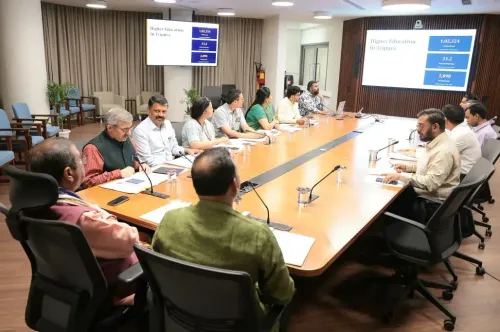
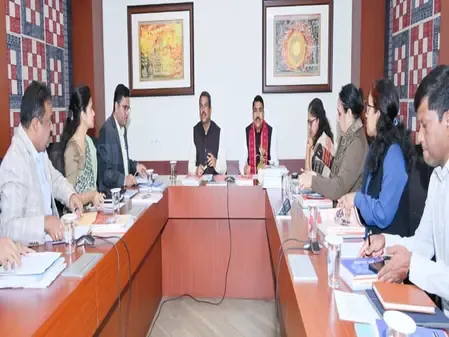
Bhubaneswar, Jan 16 (NationPress) Union Education Minister Dharmendra Pradhan proposed a four-point action plan aimed at enhancing the educational landscape in Odisha. These recommendations were made during a significant review meeting focused on curriculum reform and textbook development held in Bhubaneswar.
The discussions centered around the execution of the National Education Policy (NEP) 2020 and the state's readiness to roll out new textbooks that are in sync with the national curriculum framework.
An official statement revealed that the Union Education Minister assessed the progress of curriculum development and the capacity building of Master Resource Persons across various districts.
Pradhan urged district officials to actively involve students and parents in order to foster awareness and excitement regarding the new textbooks.
During the meeting, the minister shared four pivotal recommendations to fortify the educational framework in the state. He stressed the importance of prioritizing the National Initiative for Proficiency in Reading with Understanding and Numeracy (NIPUN) Bharat, which was launched by the Indian government in July 2021, and enhancing Foundational Literacy and Numeracy (FLN).
Additionally, he advised on promoting mother-tongue-based education at least until Class V, reinforcing the PM-POSHAN scheme with a focus on student nutrition, and expanding the implementation of 10 bagless school days annually for students in Classes VI to X, as envisioned in NEP 2020.
During the meeting, the state government announced that, in accordance with NEP 2020, Odisha is in the process of developing new textbooks and anticipates introducing 55 newly created textbooks for Classes I to VIII starting from the academic year 2026–27.
These textbooks have been adapted and translated from NCERT materials to cater to Odisha's unique local requirements, culture, and heritage.
Importantly, the State Council of Educational Research and Training (SCERT) has finalized the translation and contextualization of all 55 new textbooks, which will be deployed in all schools from the academic year 2026–27.
To facilitate a smooth implementation, 1,000 Master Resource Persons have been trained in four batches spread across four regions of the state.
These trained persons will subsequently educate over 1.66 lakh primary teachers from the School and Mass Education Department and the ST&SC Development, Minorities & Backward Classes Welfare Department at the district level.
Point of View
It is essential to recognize the proactive measures being taken to enhance education in Odisha. The suggestions put forth by Union Education Minister Dharmendra Pradhan reflect a comprehensive understanding of the current educational landscape, and they align with national goals to improve literacy and numeracy. It's vital for the nation to support these initiatives for a better future.
NationPress
2 Oct 2026
Frequently Asked Questions
What is the purpose of the action plan suggested by Dharmendra Pradhan?
The action plan aims to strengthen the education system in Odisha by focusing on foundational literacy and numeracy, promoting mother-tongue education, improving student nutrition, and enhancing curriculum alignment with the National Education Policy.
When will the new textbooks be introduced in Odisha?
The new textbooks for Classes I to VIII are expected to be introduced from the academic year 2026–27.
How many Master Resource Persons have been trained?
1,000 Master Resource Persons have been trained across four batches in different zones of the state.