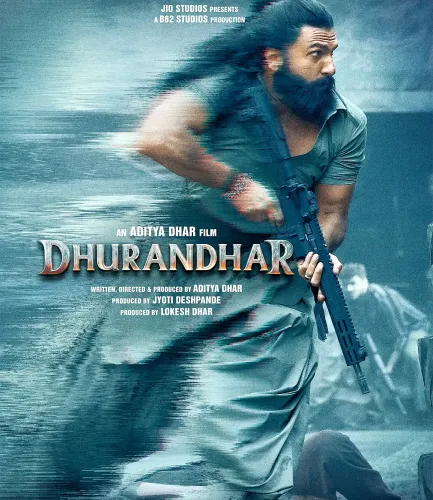
How 'Dhurandhar' Unleashes India's Long-Suppressed Anger

Synopsis
Explore how 'Dhurandhar' transcends traditional cinema, voicing sentiments that resonate deeply with many Indians. This film challenges longstanding narratives, addressing uncomfortable truths about terrorism and accountability in a bold narrative that refuses to be silenced.
Key Takeaways
'Dhurandhar' challenges mainstream narratives about terrorism.
The film articulates long-suppressed sentiments in India.
It highlights the need for accountability from Pakistan.
Aditya Dhar's personal background informs the storytelling.
The movie reflects a shift in societal attitudes among younger Indians.
New Delhi, March 22 (NationPress) 'Dhurandhar' is not a film you simply watch and forget; it resonates deeply. It challenges viewers and, more importantly, articulates sentiments that many Indians have harbored for years but have seldom felt free to express openly.
At its heart, the movie addresses a sentiment that has simmered for decades: Pakistan's persistent reliance on terrorism as a state strategy cannot be addressed with half-hearted measures, diplomatic niceties, or intellectual evasions. The demand for accountability from its institutions — like the ISI and military establishment — is not a fringe belief. It is a mainstream feeling, and 'Dhurandhar' gives voice to that.
Over time, a certain interpretation of "secularism" took hold, often resulting in silence regarding uncomfortable truths. Discussing terrorism, religious divisions, or historical grievances was frequently labeled as regressive. This led to a culture of self-censorship, where outrage had to be tempered and facts were carefully curated. This shift didn't happen overnight; it was the result of decades of societal conditioning.
Whether it was the hesitation to tackle long-standing issues like Ayodhya, Kashi, or Krishna Janmabhoomi, or the reluctance to confront targeted violence, the trend was evident. Even official statements — like former Prime Minister Manmohan Singh's 2006 comment about the Muslim minority having the "first claim on resources" — reinforced a notion of selective prioritization.
In this environment of hesitation, Pakistan found its confidence. From cross-border terrorism to covert destabilization, its tactics have been consistent. Likewise, India's responses have often been cautious — not just on the ground, but also in the narratives that surrounded these issues. There have always been voices willing to contextualize, downplay, or call for restraint, even when the provocations were clear.
This is where Dhurandhar steps in and disrupts the status quo.
The film does not strive for neutrality. It does not attempt to temper outrage with diplomatic sensitivity. Instead, it embraces a sentiment that has been quietly building over time.
Moreover, it directly critiques the ecosystem that has shaped public discourse for years — one that frequently found moral complexity where many saw none. This ecosystem mobilized outrage in selective instances, like those of Afzal Guru and Yakub Memon, yet remained conspicuously quiet about the victims of terrorism.
The film's strength lies in its refusal to sanitize reality. It does not shy away from acknowledging that anger is valid. It does not dilute the harshness of terrorism. Instead, it channels a sentiment that has lingered beneath the surface — a demand for accountability, for clarity, and for retribution.
Aditya Dhar's voice becomes crucial in this context. The discomfort some may feel arises because 'Dhurandhar' does not sidestep difficult subjects.
There’s also a personal dimension to this narrative.
Dhar's identity as a Kashmiri Pandit is pivotal to his storytelling. His community's traumatic experience since the late 1980s — characterized by violence, fear, and eventual displacement from the Valley — remains one of the most overlooked chapters in India's recent past. For years, this narrative has existed on the fringes, acknowledged but not fully engaged.
Dhar’s films — from 'Uri: The Surgical Strike' to 'Article 370' and now the 'Dhurandhar' series — appear to be an effort to reintegrate these narratives into mainstream discourse. Not subtly, not cautiously, but boldly. Critics have labeled this as propaganda.
This begs an important question: when one set of narratives prevails for decades, it is considered balance. When an alternative viewpoint arises — particularly one that is unvarnished and uncomfortable — it is quickly dismissed.
Perhaps the real issue isn't the film itself, but its refusal to conform to established norms.
'Dhurandhar' also serves as a reminder of R.N. Kao's legacy, the architect of India's external intelligence agency, the Research & Analysis Wing (RAW). Within a few years of its inception, it played a pivotal role in the events leading to Bangladesh's liberation in 1971 — a moment when India combined strategy with resolve. Dhaka may have forgotten the struggle, but they owe it to him. Pakistan harbored animosity towards Kao and blamed the Kashmiri Pandits for its setbacks in 1971.
It is said that Islamabad always sought vengeance on this community, which became evident in the late 1980s when its terrorists targeted Kashmiri Pandits, abducting, torturing, and killing numerous individuals, branding them as 'agents of the Indian Intelligence Bureau.'
While many critics assert that the film is propaganda, those who have experienced the aftermath of terrorism — directly or indirectly — understand its truth. 'Dhurandhar' unveils the reality that has been concealed for decades, especially following the turmoil in Punjab and Kashmir.
'Dhurandhar' does not claim to be subtle, and perhaps that is its strength. It signifies a shift — particularly among the younger generation of Indians — towards scrutinizing long-held narratives and confronting uncomfortable truths. Why have certain realities been minimized? Why have some tragedies been overlooked? And why has justified anger been regarded as unacceptable?
Anger, arising from persistent provocation and unresolved historical issues, does not simply vanish. It accumulates.
And at times, it finds its outlet — not through policy papers or discussions — but through cinema. 'Dhurandhar' embodies that expression. It illustrates what a government and its system can achieve when leadership is resolute and clear in thought and action.
(Deepika Bhan can be reached at deepika.b@ians.in)
Point of View
My perspective on 'Dhurandhar' is that it courageously addresses complex issues often avoided in mainstream discourse. By voicing suppressed sentiments, it prompts necessary conversations about accountability and the consequences of terrorism, reflecting a broader shift in societal attitudes.
NationPress
23 Sept 2026
Frequently Asked Questions
What is the main theme of 'Dhurandhar'?
The film primarily addresses India's long-suppressed anger regarding terrorism and the demand for accountability from Pakistan.
How does 'Dhurandhar' differ from typical films?
'Dhurandhar' does not shy away from uncomfortable truths and challenges mainstream narratives, making it a provocative viewing experience.
What impact does the film aim to have on its audience?
It seeks to resonate with viewers by articulating sentiments about terrorism and accountability that many have felt but rarely expressed.
Is 'Dhurandhar' considered propaganda?
Critics have labeled it as propaganda, but supporters argue it reflects a necessary truth about terrorism and its victims.
What historical context does 'Dhurandhar' address?
It confronts the historical experiences of the Kashmiri Pandit community and the broader implications of terrorism in India.