Gujarat raises DNT welfare budget to ₹170 crore for 2026-27, targets education and self-reliance
Synopsis
Gujarat quietly raised its NT-DNT welfare budget by ₹7 crore to ₹170 crore for 2026-27, while the Development Corporation's own allocation jumped 67% to ₹20 crore — a signal that the state is moving beyond symbolic Liberation Day commemorations toward structured economic inclusion for communities still carrying the colonial stigma of the Criminal Tribes Act.
Key Takeaways
Gujarat raised its NT-DNT welfare budget to ₹170 crore for 2026-27 , up from ₹163 crore the previous year.
The Nomadic and Denotified Tribes Development Corporation budget jumped from ₹12 crore to ₹20 crore for 2026-27 .
Self-employment loans of up to ₹15 lakh are available at 4–5% interest; women can access up to ₹2.5 lakh under Mahila Samriddhi Yojana .
Educational loans of up to ₹15 lakh are available under the New Aakanksha Yojana for higher education.
Homeless families receive plot allotments and ₹1.70 lakh via direct benefit transfer under the Pandit Deendayal Upadhyaya Awas Yojana .
The DNT Development Foundation aims to expand to 16 states , 300+ districts , and launch one lakh service projects.
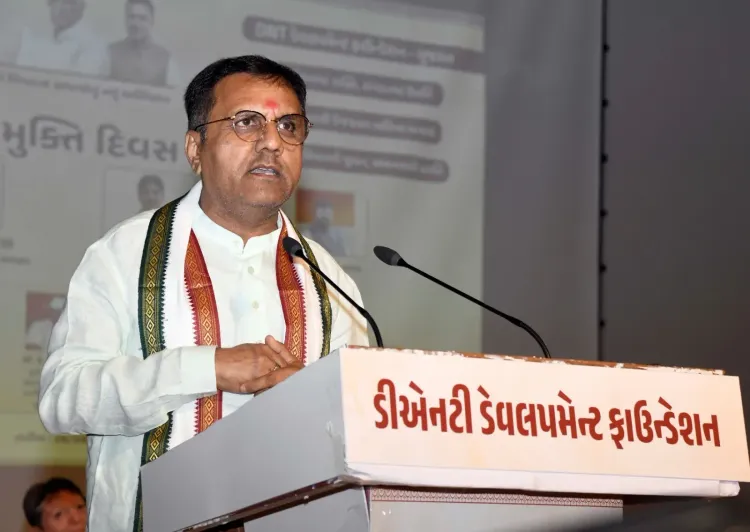
The Gujarat government has raised its budgetary allocation for the welfare of Nomadic and Denotified Tribes (NT-DNT) to ₹170 crore for 2026-27, up from ₹163 crore in the previous financial year, State Social Justice and Empowerment Minister Pradyuman Vaja announced at a DNT Liberation Day programme in Gandhinagar on 30 August 2026. The event, organised by the DNT Development Foundation at Town Hall, marked the commemoration of 31 August — observed as DNT Liberation Day — and sought to raise awareness about the identity, rights and challenges of Denotified, Nomadic and Semi-Nomadic communities.
Budget Boost and Loan Schemes
Minister Vaja said the state Nomadic and Denotified Tribes Development Corporation provides loans of up to ₹15 lakh at interest rates of four to five per cent for self-employment, with its budget allocation raised sharply from ₹12 crore last year to ₹20 crore for 2026-27. Under various schemes, term loans ranging from ₹3 lakh to ₹15 lakh and microfinance loans of up to ₹2.50 lakh are available for small businesses and self-employment.
The Mahila Samriddhi Yojana provides women loans of up to ₹2.5 lakh at four per cent interest, while the New Swarnima Yojana offers assistance of up to ₹5 lakh. The New Aakanksha Yojana extends educational loans of up to ₹15 lakh for higher education, the Minister said.
Education, Digital Skills and Scholarships
Vaja urged parents to prioritise their children's education and called on young people to use mobile phones and the internet to acquire skills in technology, artificial intelligence and digital tools, rather than restricting their use to entertainment. He also highlighted steps taken to ensure students were not denied scholarships, including reopening the Digital Gujarat portal three times for applications.
Invoking Prime Minister Narendra Modi's 'Sabka Saath, Sabka Vikas, Sabka Vishwas and Sabka Prayas' and Pandit Deendayal Upadhyaya's principle of 'Antyodaya', Vaja said: 'Ensuring development benefits reached the last person in society remained a priority.'
Housing, Caste Certificates and Five Pledges
Under the Pandit Deendayal Upadhyaya Awas Yojana, homeless families receive plot allotments and ₹1.70 lakh through direct benefit transfer for house construction. The Minister also said caste certificate procedures had been simplified, with instructions to issue certificates within seven days where appropriate documents are submitted. Applicants whose requests were rejected can appeal before the Prant Officer, Collector and Analysis Committee, he noted.
Vaja administered five pledges at the event: ensuring education for every child; providing skill-development and employment opportunities for youth; guaranteeing direct access to welfare schemes for every family; ensuring quality education, safety and self-reliance for every girl; and upholding dignity for every citizen while working towards social reform.
Voices from the Community and Foundation
Pravin Ghuge, a member of the Development and Welfare Board for Nomadic, Denotified and Semi-Nomadic Tribes, said the occasion should go beyond celebration and focus on providing communities permanent relief from social and economic difficulties. He noted that a specialised board for their welfare was constituted in 2019 under Prime Minister Modi's leadership, with efforts under way to provide permanent housing through schemes including the Pradhan Mantri Awas Yojana.
K.G. Vanzara, former Additional Secretary of the State Social Justice and Empowerment Department, called on communities to accept responsibility for their own development rather than relying solely on the state. He urged an end to addictions, superstition and harmful customs, and said education, employment and housing should be treated as the three pillars of development.
DNT Development Foundation Chairman Bharat Patani said the organisation aims to expand its work to 16 states and more than 300 districts and launch one lakh service projects. He added that more than 7,000 women's self-help groups had been activated through the Central government's SEED scheme, with basic facilities such as drinking water and hand pumps provided in rural areas including Kodinar and Manavadar.
31 August is observed as DNT Liberation Day to mark the post-Independence denotification of communities that had been classified as 'criminal tribes' under the British-era Criminal Tribes Act. With the latest budget increase and expanded loan frameworks, the Gujarat government signals a continued push to integrate these historically marginalised communities into the economic mainstream.
Point of View
Which grew by a modest ₹7 crore. The real question is utilisation: DNT-targeted loan schemes have historically struggled with low uptake due to documentation barriers, the very issue the seven-day caste certificate mandate attempts to address. Reopening the Digital Gujarat scholarship portal three times in a year suggests persistent access failures rather than a resolved problem. Liberation Day events are important symbolically, but communities that carried a colonial criminal label for decades need measurable outcomes — housing completion rates, loan disbursement data, scholarship clearance timelines — not just pledge-taking ceremonies.
NationPress
30 Aug 2026
Frequently Asked Questions
What is DNT Liberation Day and why is it observed on 31 August?
DNT Liberation Day is observed on 31 August to mark the post-Independence denotification of communities that were classified as 'criminal tribes' under the British-era Criminal Tribes Act. The day is meant to recognise the historical injustice done to these communities and to reaffirm commitments to their rights and development.
How much has Gujarat allocated for NT-DNT welfare in 2026-27?
Gujarat has allocated ₹170 crore for NT-DNT welfare in 2026-27, up from ₹163 crore in the previous financial year. The Nomadic and Denotified Tribes Development Corporation's budget was separately raised from ₹12 crore to ₹20 crore.
What loan schemes are available for NT-DNT communities in Gujarat?
The state Development Corporation provides self-employment loans of up to ₹15 lakh at 4–5% interest. Women can access up to ₹2.5 lakh under the Mahila Samriddhi Yojana at 4% interest, up to ₹5 lakh under the New Swarnima Yojana, and up to ₹15 lakh for higher education under the New Aakanksha Yojana.
What housing support is available for homeless NT-DNT families in Gujarat?
Under the Pandit Deendayal Upadhyaya Awas Yojana, homeless families from NT-DNT communities receive plot allotments along with ₹1.70 lakh through direct benefit transfer for house construction. Efforts are also under way to provide permanent housing through the Pradhan Mantri Awas Yojana.
Who is the DNT Development Foundation and what are its goals?
The DNT Development Foundation is the organising body behind the DNT Liberation Day programme. Its chairman, Bharat Patani, said the foundation aims to expand to 16 states and over 300 districts and launch one lakh service projects, while also having activated more than 7,000 women's self-help groups through the Central government's SEED scheme.