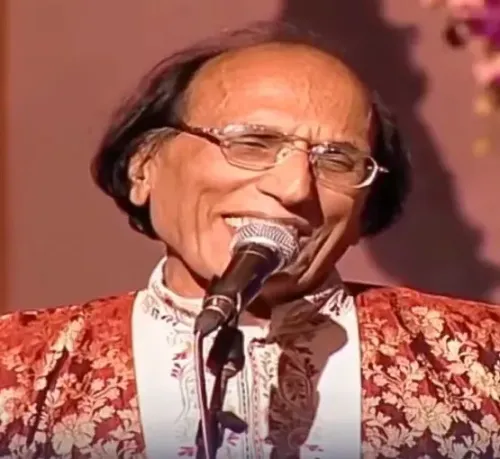
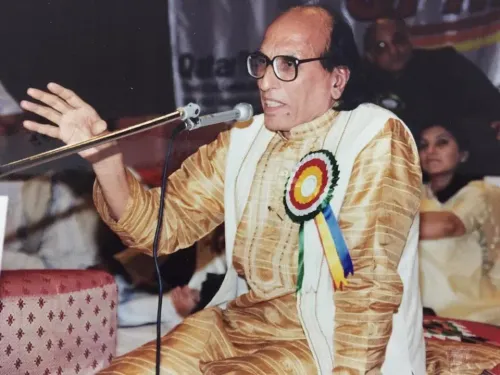
Dr. Jitendra Singh mourns passing of poet Bashir Badr
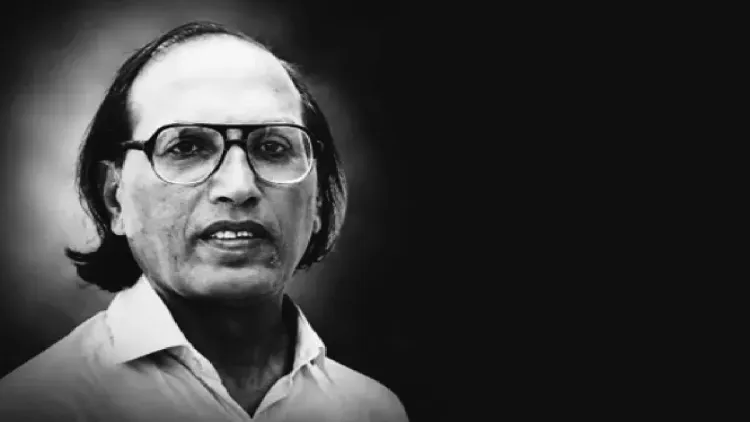
Synopsis
Union Science and Technology Minister Dr. Jitendra Singh paid tribute to veteran Urdu poet Bashir Badr on 29 May 2026, quoting three of his most beloved ghazal verses and recalling how he first encountered the poet's work at a college Mushaira.
Key Takeaways
Jitendra Singh , Union Minister for Science and Technology, mourned the passing of Bashir Badr on 29 May 2026 .
Bashir Badr , born in 1935 , was a recipient of the Sahitya Akademi Award and one of India's foremost Urdu ghazal poets.
Singh quoted three of Badr's celebrated couplets in his tribute, reflecting a personal connection formed at a college-era Urdu Mushaira .
Badr's poetry is known for blending classical Urdu form with accessible, emotionally resonant imagery, earning him audiences across generations.
Memorial programmes and special tributes from the Urdu literary community are expected in the weeks following his demise.
Union Science and Technology Minister Dr. Jitendra Singh on Friday, 29 May 2026 expressed grief over the demise of veteran Urdu poet Bashir Badr, sharing cherished verses from the poet's body of work and recalling a personal connection that began during his college years at an Urdu Mushaira.
Context
In his post, Dr. Singh wrote that he had followed Bashir Badr and his poetry ever since he first heard him at an Urdu Mushaira during his college days. He quoted three of Badr's celebrated couplets, offering them as a tribute to the poet's enduring legacy.
Among the verses shared was the widely recited ghazal line: 'Koi haath bhi na milayega jo gale miloge tapak se' ('No one will shake your hand if you embrace people too eagerly — this is a city of new temperaments, keep a little distance'). Another recalled: 'Ujale apni yaadon ke hamare saath rahne do, na jaane kis gali mein zindagi ki shaam ho jaye' ('Let the light of your memories stay with me, for who knows in which lane the evening of life may fall'). The third verse read: 'Ab hum milenge toh kayi log bichhad jayenge, intezar aur karo agle janam tak mera' ('When we meet now, many will be separated — wait for me until the next life').
Policy Backdrop
Bashir Badr, born in 1935, was among the most celebrated Urdu poets of post-independence India, known for ghazals that blended classical form with accessible, everyday imagery. He was a recipient of the Sahitya Akademi Award, India's highest literary honour conferred by the national academy of letters, and performed at mushairas across the country over several decades.
The Urdu Mushaira — a traditional public gathering for poetry recitation — has historically occupied a central place in north Indian literary and social culture. Its presence in educational institutions meant that generations of students, including those who later entered public life, encountered Urdu literature as a formative experience.
Stakeholders and Impact
Badr's passing is mourned across the Urdu literary community, including poets, scholars, and readers who regard his ghazals as touchstones of modern Urdu verse. His work transcended regional boundaries and was embraced by audiences across India and among Urdu-speaking communities worldwide.
Dr. Singh's tribute reflects a broader pattern in which Indian ministers across portfolios use social media to publicly mourn artists and poets, underscoring the cultural responsibilities expected of elected officials. The personal register of his post — citing a memory from college — lends the tribute an intimacy that goes beyond formal condolence.
What's Next
The Urdu literary world is expected to organise memorial programmes, special recitations, and tribute issues in literary journals in the coming weeks. References to Bashir Badr's contribution to Indian languages may also arise in parliamentary discussions on cultural grants and language policy. His recorded mushaira performances and published collections are likely to see renewed interest among readers and archivists.
Point of View
Pan-Indian cultural sensibility. Badr's ghazals, chosen with care, speak to themes of distance, memory, and parting — lending the tribute a poetic coherence beyond mere protocol. The post may also quietly reinforce the government's positioning on Urdu as part of India's shared literary inheritance, particularly relevant given Dr. Singh's Jammu and Kashmir political base.
NationPress
14 Oct 2026
Frequently Asked Questions
Who was Bashir Badr?
Bashir Badr was a celebrated Indian Urdu poet born in 1935, renowned for his ghazals and a recipient of the Sahitya Akademi Award. He performed at mushairas across India over several decades and is regarded as one of the foremost Urdu poets of the post-independence era.
What did Dr. Jitendra Singh say about Bashir Badr?
Dr. Jitendra Singh said he was 'saddened by the demise' of Bashir Badr and recalled first hearing the poet at an Urdu Mushaira during his college days. He quoted three of Badr's well-known ghazal couplets as part of his tribute.
What is the Sahitya Akademi Award?
The Sahitya Akademi Award is India's highest literary honour, conferred by the Sahitya Akademi — the national academy of letters — for outstanding contributions to Indian literature across recognised languages, including Urdu.
What is an Urdu Mushaira?
An Urdu Mushaira is a traditional public gathering at which poets recite their work, often competitively, before an audience. It has been a central institution of Urdu literary culture in north India for centuries and remains popular today.
Which Bashir Badr poems did Dr. Jitendra Singh quote?
Dr. Singh quoted three couplets: one about emotional restraint in modern social life ('Koi haath bhi na milayega'), one about preserving memories against the uncertainty of life ('Ujale apni yaadon ke'), and one about separation and reunion ('Ab hum milenge toh kayi log bichhad jayenge').