Dr Jitendra Singh: Role-oriented shift at Lucknow conference
Synopsis
Union minister Dr Jitendra Singh, highlighting the annual conference of state personnel secretaries in Lucknow, called for a shift from rule-based to role-oriented administration. He said national governance meets are being taken beyond Delhi so Centre and States can exchange best practices on capacity, competence and citizen responsiveness.
Key Takeaways
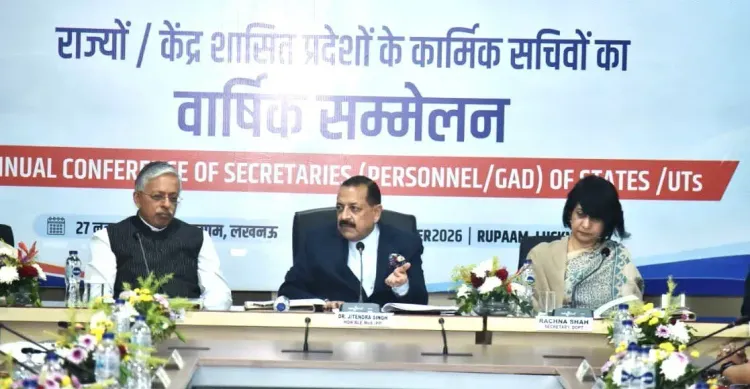
Union Science and Technology Minister Dr Jitendra Singh on 27 November 2026 highlighted the Annual Conference of Secretaries of Personnel and General Administration Departments in Lucknow.
He said administrators must move beyond conventional rule-based functioning towards a role-oriented approach.
He listed institutional capacity, professional competence, ethical conduct and responsiveness to citizens as the core requirements.
He said the Narendra Modi government has pushed national governance conferences beyond Delhi to different regions.
The post tagged the Ministry of Personnel, DoPT and DARPG as the central nodes of the exercise.
The message tracks Mission Karmayogi, the 2020 national programme for competency-based civil services training.
Union Science and Technology Minister Dr. Jitendra Singh on 27 November 2026 set out a hard brief from Lucknow: India's administrators must move beyond conventional rule-based functioning towards a role-oriented approach. Highlighting the Annual Conference of Secretaries of Personnel and General Administration Departments of States and Union Territories, he put institutional capacity, professional competence, ethical conduct and responsiveness to citizens at the core of that shift.
Singh wrote that an evolving governance landscape requires administrators to move beyond conventional rule-based functioning towards a role-oriented approach, with greater emphasis on institutional capacity, professional competence, ethical conduct and responsiveness to citizens. He said the government of Prime Minister Narendra Modi has consistently encouraged taking national-level conferences and governance-related deliberations beyond Delhi to different regions of the country.
Conferences like these, he added, strengthen the exchange of best practices between the Centre and States, and vice versa. The post tagged the Ministry of Personnel, the Department of Personnel and Training (DoPT) and the Department of Administrative Reforms and Public Grievances (DARPG).
Why Lucknow, not Delhi, hosted the secretaries
Rotating a national personnel conference into a state capital is a federalism signal with a practical edge. State secretaries of personnel and general administration sit closest to cadre management, training pipelines and the citizen-facing machinery of government. Putting them in one room outside Delhi is meant to make Centre-State learning a two-way street, not a briefing from the capital.
DoPT owns civil services policy, training and personnel rules. DARPG owns administrative reforms and public grievance redressal. Together they are the natural conveners of a meeting that claims to trade best practices rather than merely issue instructions.
From the rule book to the role
Rule-based functioning keeps a file legally safe. Role-oriented functioning asks who owns the outcome when a citizen is waiting. That is the distinction Singh drew — capacity, competence, ethics and responsiveness as the job, not footnotes to the manual.
The officers in that room are the transmission belt. If role-orientation is to mean anything, personnel and general administration secretaries will have to change how cadres are trained, assessed and posted, not just how conference minutes are drafted.
Mission Karmayogi's competency unfinished business
Mission Karmayogi, launched in 2020 as the National Programme for Civil Services Capacity Building, was designed to shift civil servants from generic, tenure-based instruction to competency-based training. Singh's Lucknow line sits on that same arc: professional competence as an operating requirement.
Annual conferences of state personnel secretaries have been used for several years as a Centre-State exchange. The follow-through to watch is whether DoPT converts the role-oriented language into performance frameworks, and which state capital hosts the next round.
A conference that leaves Delhi only matters if the role leaves the rule book with it. Every state secretariat now has a simple test: can a citizen feel the difference?
Point of View
Roles over circulars. Rotating the secretaries conference out of Delhi is the federalism signal; the harder move is getting state personnel and general administration departments to rewrite how officers are trained and judged. Watch for DoPT follow-up on role-oriented performance frameworks and for the next host city. If those two land, the language stops being a conference line and becomes an administrative operating system.
NationPress
27 Nov 2026
Frequently Asked Questions
What did Jitendra Singh say about the Lucknow personnel secretaries conference?
He said administrators must move beyond conventional rule-based functioning towards a role-oriented approach. He stressed institutional capacity, professional competence, ethical conduct and responsiveness to citizens, and said such conferences help the Centre and States exchange best practices.
Why was the annual secretaries conference associated with Lucknow?
Singh highlighted Lucknow as the venue and said the government has consistently taken national-level conferences beyond Delhi to different regions. The aim, he said, is to strengthen two-way exchange of governance best practices between the Centre and the States.
What is a role-oriented approach in Indian administration?
In Singh's framing, it means officials go beyond applying rules on a file and take ownership of outcomes. The emphasis is on institutional capacity, professional competence, ethical conduct and how quickly and fairly the system responds to citizens.
What are DoPT and DARPG in this conference?
DoPT is the Department of Personnel and Training, which handles civil services policy, training and personnel matters. DARPG is the Department of Administrative Reforms and Public Grievances, which works on administrative reforms and public grievance redressal; both were tagged with the Lucknow conference.
How does Mission Karmayogi relate to this message?
Mission Karmayogi, launched in 2020 as the National Programme for Civil Services Capacity Building, introduced competency-based training for civil servants. Singh's call for role-oriented, professionally competent administration sits on that same capacity-building track.