Culture Minister Shekhawat hails Karunanayak Ram Delhi launch
Synopsis
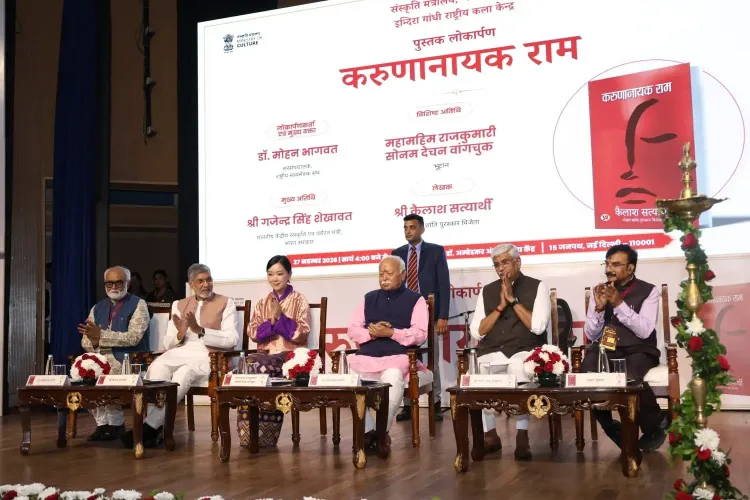
Union Culture and Tourism Minister Gajendra Singh Shekhawat marked the New Delhi launch of Karunanayak Ram in the presence of RSS chief Mohan Bhagwat, Nobel laureate Kailash Satyarthi and Bhutan's Princess Sonam Dechen Wangchuck. He said Lord Ram's life embodies compassion, sacrifice, maryada and social harmony, calling the book an effort to understand that philosophy of living.
Key Takeaways
Union Culture and Tourism Minister Gajendra Singh Shekhawat on 27 November 2026 marked the New Delhi launch of the book Karunanayak Ram.
RSS Sarsanghchalak Dr Mohan Bhagwat, Nobel Peace Prize laureate Kailash Satyarthi and Bhutan's Princess Sonam Dechen Wangchuck were present.
Shekhawat said Lord Ram's life expresses compassion, sacrifice, maryada, social harmony and public welfare.
He called the work an important attempt to understand life-philosophy from Ram's character.
The minister tagged the Ministry of Culture and IGNCA along with Dr Mohan Bhagwat.
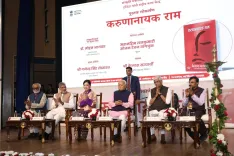
Union Culture and Tourism Minister Gajendra Singh Shekhawat on Friday put a literary evening at the centre of New Delhi's cultural calendar: the launch of Karunanayak Ram, with RSS Sarsanghchalak Dr Mohan Bhagwat, Nobel Peace Prize laureate Kailash Satyarthi and Bhutan's Princess Sonam Dechen Wangchuck in the room. He called Lord Ram's life an unmatched expression of compassion, sacrifice, maryada, social harmony and public welfare.
Posting in Hindi on 27 November 2026, Shekhawat said the book was unveiled in the garimamayi (dignified) presence of Dr Mohan Bhagwat and the special presence of Satyarthi and the Bhutanese princess. He tagged the Ministry of Culture, Bhagwat and the Indira Gandhi National Centre for the Arts (IGNCA).
Bhagwat, Satyarthi and Bhutan's princess in one hall
Three public worlds met in the capital. Dr Mohan Bhagwat, Sarsanghchalak of the Rashtriya Swayamsevak Sangh, is a principal figure in Hindu organisational and cultural life. Kailash Satyarthi, awarded the Nobel Peace Prize in 2014 for advocacy on child rights and education, brought a civil-society pedigree. Princess Sonam Dechen Wangchuck, known for work on cultural preservation, education and India-Bhutan relations, added a royal neighbourhood presence.
The minister did not name a publisher or a principal author. The guest list did the talking. A senior RSS leader, a Nobel laureate and Bhutanese royalty stood together in New Delhi.
Compassion, maryada and social harmony
Shekhawat wrote that Lord Shri Ram's life is an unparalleled expression of the eternal ideals of karuna (compassion), tyag (sacrifice), maryada (ethical restraint), samajik samrasata (social harmony) and lokmangal (public welfare). The book, he said, is an important attempt to understand a philosophy of life from the character of Prabhu Shri Ram.
That framing tracks how the Culture Ministry and IGNCA have used launches and seminars on classical texts and epics: to keep philosophical heritage in public view, not only in ritual space.
A cultural stage with a Bhutanese guest
Princess Wangchuck's attendance fits India's neighbourhood-first cultural diplomacy, in which Bhutanese royal and scholarly guests appear on Indian heritage platforms. Scholars and India-Bhutan cultural networks share that circuit with spiritual organisations and state cultural bodies.
Further IGNCA or Ministry of Culture announcements on similar publications, or on bilateral programmes with Bhutan, would be the natural next beat. For this evening, the minister's point was spare and civilisational: Ram's character, he argues, is still a template for how a society should live.
Point of View
RSS organisational prestige and India-Bhutan cultural diplomacy. Shekhawat's emphasis on compassion, maryada and social harmony recasts a civilisational icon as a contemporary social template rather than a purely ritual figure. Hosting a Nobel laureate and a Bhutanese princess on the same stage as the RSS Sarsanghchalak also shows how state cultural platforms now convene spiritual, civil-society and neighbourhood actors together. Watch for whether IGNCA follows with a publication series or a Bhutan-facing cultural calendar.
NationPress
27 Nov 2026
Frequently Asked Questions
What is the book Karunanayak Ram about?
Karunanayak Ram is a work on Lord Ram's character, presented at a New Delhi launch as an attempt to understand a philosophy of life based on compassion, sacrifice, maryada, social harmony and public welfare. Union Culture Minister Gajendra Singh Shekhawat described Ram's life as an unparalleled expression of those ideals.
Who attended the Karunanayak Ram launch in New Delhi?
RSS Sarsanghchalak Dr Mohan Bhagwat, Nobel Peace Prize winner Kailash Satyarthi and Bhutan's Princess Sonam Dechen Wangchuck were present, according to Gajendra Singh Shekhawat. The event was held in New Delhi on 27 November 2026.
Who is Gajendra Singh Shekhawat?
Gajendra Singh Shekhawat is the Union Minister of Culture and Tourism, a senior BJP leader and Lok Sabha MP from Jodhpur, Rajasthan. He posted about the Karunanayak Ram launch on X.
What did Shekhawat say about Lord Ram at the launch?
He said Lord Shri Ram's life is an unparalleled expression of the eternal ideals of compassion, sacrifice, maryada, social harmony and public welfare. He added that the book is an important effort to grasp that life-philosophy.
What is IGNCA's role in such cultural events?
The Indira Gandhi National Centre for the Arts is an autonomous body under the Ministry of Culture that researches, documents and promotes Indian arts and heritage. Shekhawat tagged IGNCA in his post; the ministry and IGNCA have periodically hosted programmes on classical Indian texts and epics.