Dr. Jitendra Singh: Aug 2019 sparked J&K youth aspirations
Synopsis
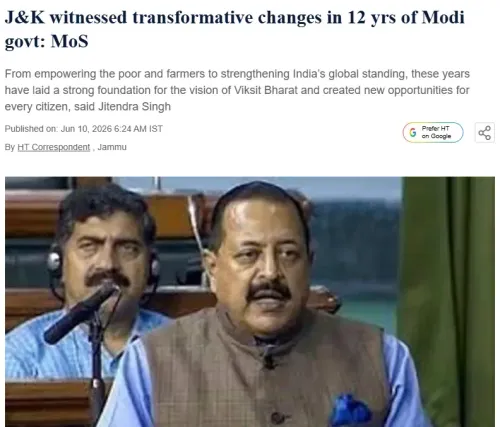
Union Minister Dr. Jitendra Singh on 22 June 2026 shared a report claiming that the August 2019 reorganisation of Jammu and Kashmir instilled a 'feeling of belongingness' among residents, triggering an aspirational surge among the region's youth through expanded access to central schemes and opportunities.
Key Takeaways
Jitendra Singh on 22 June 2026 shared a report attributing a youth aspirational surge in Jammu and Kashmir to the 'feeling of belongingness' generated after August 2019 .
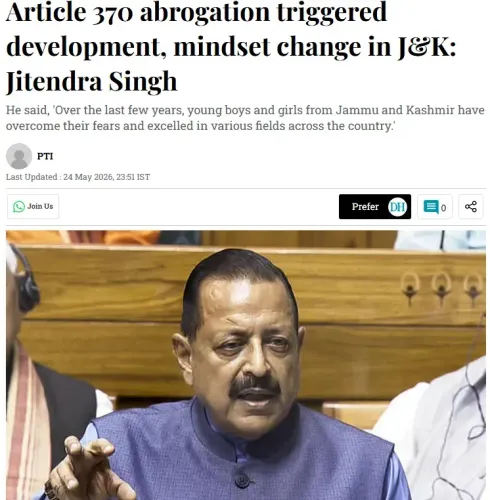
The Jammu and Kashmir Reorganisation Act of August 2019 revoked Article 370 and Article 35A , converting J&K into a Union Territory and extending all central laws to the region.
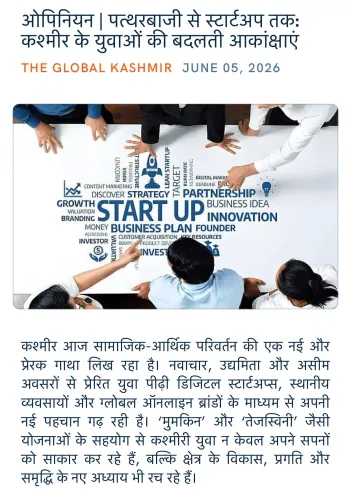
Post-2019, central schemes including PMEGP and Startup India were uniformly extended to Jammu and Kashmir for the first time.
The government's narrative links constitutional integration directly to increased youth participation in national competitive examinations and entrepreneurship.
Statehood restoration for Jammu and Kashmir remains unresolved and continues to be a point of political contention as of 2026.
Upcoming roll-out of skill and innovation hubs in J&K will be a key indicator of whether policy intent translates into ground-level impact.
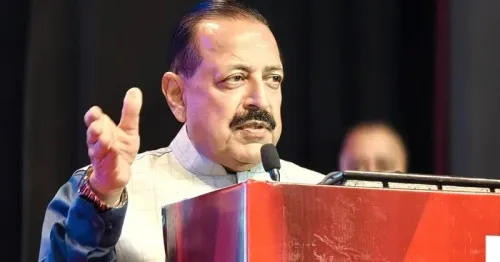
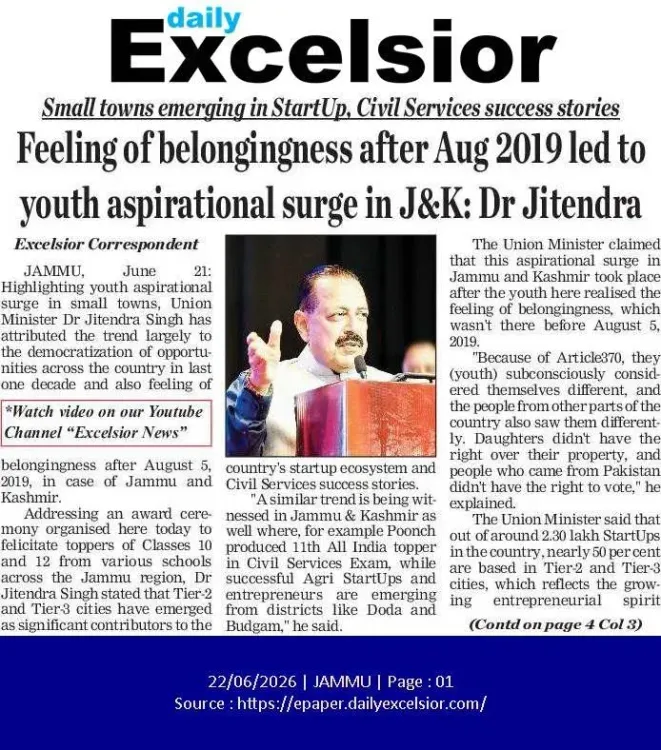
Union Minister of State (Independent Charge) for Science and Technology Dr. Jitendra Singh on Monday, 22 June 2026, shared an analysis arguing that the constitutional changes of August 2019 in Jammu and Kashmir generated a renewed sense of belonging among residents, which in turn fuelled an aspirational surge among the region's youth.
Context
The post references a report headlined: 'Feeling of belongingness after Aug 2019 led to youth aspirational surge in Jammu and Kashmir.' Dr. Singh, who represents the Jammu and Kashmir constituency at the central level and frequently voices the government's position on the region's integration, amplified the report as evidence of the policy's social impact.
The reference to August 2019 points to the moment when Parliament passed the Jammu and Kashmir Reorganisation Act, which revoked Article 370 and Article 35A, bifurcated the former state into two Union Territories — Jammu and Kashmir and Ladakh — and extended the full ambit of central laws and schemes to the region.
Policy Backdrop
Post-reorganisation, the central government extended flagship programmes — including PMEGP, Startup India, and multiple skill-development initiatives — uniformly to Jammu and Kashmir for the first time. Officials have pointed to increased youth participation in national competitive examinations and a rise in entrepreneurship registrations as markers of integration.
The argument of 'belongingness' is a recurring theme in the government's communication around the 2019 changes: that removing the special-status provisions ended a perceived sense of exclusion and opened pathways — educational, economic, and civic — that were previously restricted or unevenly applied.
Stakeholders and Impact
The primary stakeholders cited in this narrative are J&K's youth — aspirational job-seekers, students targeting Union Public Service Commission and other national examinations, and first-generation entrepreneurs. Proponents argue that uniform access to central welfare architecture has expanded opportunity in a region long marked by conflict and administrative separateness.
Critics of the 2019 reorganisation, however, have consistently contested such claims, arguing that political representation remains curtailed and that statehood has not been restored despite earlier assurances. The debate over the empirical evidence behind any 'aspirational surge' remains active and contested in public discourse.
What's Next
Attention will remain on the roll-out of centrally sponsored skill and innovation hubs announced for Jammu and Kashmir, as well as any movement on the statehood restoration question in Parliament. Dr. Singh's amplification of this narrative ahead of potential legislative sessions suggests the government intends to sustain its communication around the developmental dividends of the 2019 reorganisation.
Point of View
Not merely a constitutional one. By centering 'belongingness' and youth aspiration, the government is attempting to shift the J&K narrative from political controversy to developmental dividend. The timing — as statehood restoration remains unresolved — suggests this is as much a political communication exercise as a policy update. Whether the aspirational surge translates into measurable, verifiable outcomes will determine the long-term credibility of this argument.
NationPress
22 Jun 2026
Frequently Asked Questions
What happened in Jammu and Kashmir in August 2019?
In August 2019, Parliament passed the Jammu and Kashmir Reorganisation Act, revoking Article 370 and Article 35A, bifurcating the former state into two Union Territories — Jammu and Kashmir, and Ladakh — and extending all central laws and schemes to the region.
What did Dr. Jitendra Singh say about J&K youth in June 2026?
Dr. Jitendra Singh shared a report on 22 June 2026 arguing that the 'feeling of belongingness' created after August 2019 led to an aspirational surge among Jammu and Kashmir's youth, with greater participation in national opportunities.
How has the August 2019 reorganisation affected youth in Jammu and Kashmir?
The government claims that post-2019, J&K youth gained uniform access to central schemes like PMEGP and Startup India, with increased participation in national examinations and entrepreneurship, though critics dispute the extent of these gains.
Has Jammu and Kashmir been granted statehood after the 2019 reorganisation?
As of mid-2026, Jammu and Kashmir remains a Union Territory and has not had full statehood restored, despite earlier government indications that restoration was being considered.
What central schemes are available to J&K youth after Article 370 was revoked?
After the 2019 reorganisation, flagship central programmes including PMEGP, Startup India, and various skill-development initiatives were extended uniformly to Jammu and Kashmir for the first time.