Jitendra Singh: UT status expanded J&K pension reforms
Synopsis
Union Minister Dr. Jitendra Singh has spotlighted how Jammu and Kashmir's conversion to a Union Territory in 2019 widened the reach of central pension reforms, including the National Pension System, for government employees previously governed by J&K-specific rules.
Key Takeaways
Jitendra Singh shared a report on 17 June 2026 highlighting pension reform gains from J&K 's UT transition.
The Jammu and Kashmir Reorganisation Act, 2019 enabled direct application of central civil service and pension rules to the region.
The National Pension System (NPS) , mandatory for central government recruits from 1 January 2004 , could not be automatically extended to J&K state employees before Article 370 was abrogated.
Post-reorganisation, the J&K UT administration has progressively aligned legacy state rules with pan-India frameworks in finance, personnel, and social security.
Government employees in Jammu and Kashmir are the primary beneficiaries, gaining access to a portable, centrally regulated retirement savings framework.
Further PFRDA and DoPT circulars on NPS coverage numbers and contribution rates for J&K employees are anticipated.
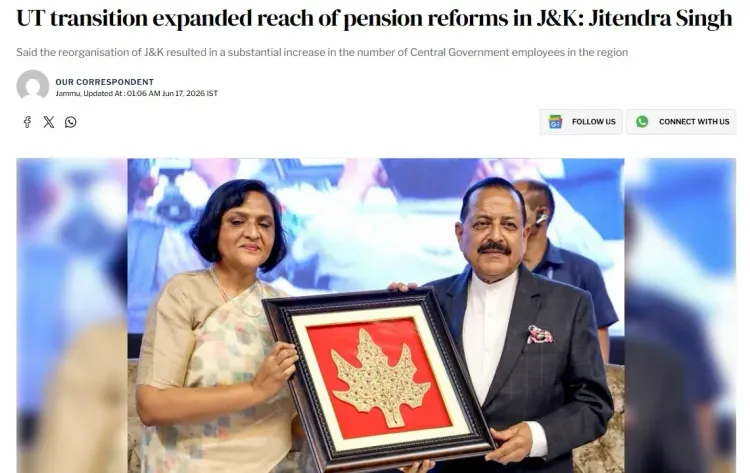
Union Minister of State (Independent Charge) for Science and Technology Dr. Jitendra Singh on Wednesday, 17 June 2026 highlighted how Jammu and Kashmir's transition to a Union Territory has broadened the reach of pension reforms in the region, sharing a report underscoring the governance gains from the 2019 reorganisation.
Context
The post draws attention to how the reorganisation of Jammu and Kashmir under the Jammu and Kashmir Reorganisation Act, 2019 — which abrogated Article 370 and bifurcated the erstwhile state into two Union Territories — enabled the direct application of central civil service rules to the region's government employees. Before the transition, J&K operated under a distinct constitutional framework that kept several pan-India schemes, including modern pension architecture, outside its mandatory purview.
The report flagged by Dr. Jitendra Singh specifically notes that the UT transition 'expanded reach of pension reforms in J&K', pointing to a structural shift in how public-sector workers in the region are covered under social security frameworks aligned with the rest of India.
Policy Backdrop
The National Pension System (NPS), introduced for all central government employees joining service on or after 1 January 2004, replaced the older defined-benefit pension model. Under the NPS, both the employee and the employer make defined contributions to a retirement corpus managed by the Pension Fund Regulatory and Development Authority (PFRDA).
Prior to October 2019, J&K's special status meant that central personnel rules — including NPS applicability — did not automatically extend to state government employees governed by J&K-specific regulations. The reorganisation removed that barrier, enabling the J&K UT administration to progressively align its legacy service rules with the pan-India framework covering finance, recruitment, and social security.
Post-reorganisation, the J&K UT administration has accelerated this harmonisation across multiple domains, with pension reform forming one of the more consequential pillars given the large number of government employees in the region.
Stakeholders and Impact
Jammu and Kashmir government employees are the primary beneficiaries of this expanded coverage, gaining access to a structured, portable, and centrally regulated retirement savings framework. Pension fund administrators and the PFRDA are also stakeholders as the subscriber base from the UT grows.
Dr. Jitendra Singh, a BJP leader from the Jammu region, has been a consistent advocate for highlighting governance improvements in J&K since the reorganisation. His amplification of this report fits a broader pattern of the ruling dispensation presenting post-Article 370 administrative integration as a tangible benefit for residents of the region.
What's Next
Observers will watch for finance department orders and PFRDA or Department of Personnel and Training (DoPT) circulars detailing NPS contribution rates, coverage numbers, and timelines for full harmonisation of J&K employee service rules with central norms. Budget announcements from the J&K UT administration are expected to shed further light on the fiscal contours of the pension transition.
As the J&K UT continues to align its administrative architecture with the rest of India, pension reform could serve as a template for accelerating similar convergences in taxation, welfare, and recruitment — with implications for the long-debated question of eventual statehood restoration for the region.
Point of View
Measurable impact on the financial security of a large and organised constituency: government employees. The move to highlight this in mid-2026 may also be calibrated to the ongoing discourse around J&K's statehood restoration, implicitly arguing that institutional convergence is well advanced. Analysts will note, however, that the pace and completeness of NPS harmonisation for all categories of J&K employees remains subject to scrutiny.
NationPress
16 Sept 2026
Frequently Asked Questions
How did J&K's UT transition affect pension rules for government employees?
The 2019 reorganisation of Jammu and Kashmir into a Union Territory removed the constitutional barrier that had kept central civil service rules — including the National Pension System — from automatically applying to J&K state government employees, enabling progressive alignment with pan-India pension frameworks.
What is the National Pension System (NPS) and who does it cover in J&K?
The National Pension System is a contributory retirement savings framework regulated by the PFRDA, made mandatory for central government recruits joining from 1 January 2004. After J&K's UT transition in 2019, its coverage was extended to J&K government employees previously governed by older state-specific pension regulations.
What did Dr. Jitendra Singh say about pension reforms in J&K?
Dr. Jitendra Singh shared a report on 17 June 2026 stating that the UT transition had 'expanded reach of pension reforms in J&K', underlining governance improvements resulting from the abrogation of Article 370 and the region's reorganisation.
What changes did Article 370 abrogation bring to Jammu and Kashmir's governance?
The abrogation of Article 370 in August 2019 and the subsequent Jammu and Kashmir Reorganisation Act enabled the direct application of central laws, civil service rules, and welfare schemes — including pension, taxation, and recruitment frameworks — to J&K, replacing a range of region-specific regulations.
What is the significance of pension reform for J&K employees post-2019?
Pension reform is significant because it gives J&K government employees access to a portable, nationally regulated retirement corpus under the NPS, replacing older defined-benefit or state-specific arrangements and aligning their social security coverage with counterparts across the rest of India.