DRDO's scramjet test hits 1,200 seconds, advancing India's hypersonic missile push

Synopsis
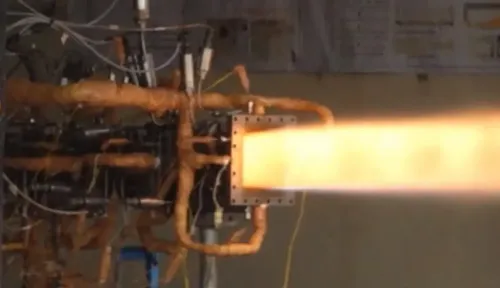
DRDO has clocked over 1,200 seconds on a full-scale scramjet combustor test in Hyderabad — nearly double its January benchmark — marking a pivotal step toward India fielding an operational hypersonic cruise missile. It places India firmly in the company of the world's most advanced hypersonic powers.
Key Takeaways
DRDO's DRDL successfully tested its Actively Cooled Full Scale Scramjet Combustor for over 1,200 seconds at the SCPT Facility, Hyderabad .
The run surpasses the previous benchmark of over 700 seconds achieved in January 2025 .
The combustor uses indigenously developed liquid hydrocarbon endothermic fuel and high-temperature thermal barrier coating.
Defence Minister Rajnath Singh called it "a solid foundation" for India's Hypersonic Cruise Missile Development Programme .
DRDO has transferred 2,200 technologies to industry; over ₹4,500 crore of the defence R&D budget has been utilised by industry, academia, and start-ups.
India's Defence Research and Development Organisation (DRDO) has achieved a significant milestone in its hypersonic missile programme, successfully completing a long-duration ground test of its Actively Cooled Full Scale Scramjet Combustor for over 1,200 seconds at the Scramjet Connect Pipe Test (SCPT) Facility in Hyderabad on Saturday. The test, conducted by the Defence Research and Development Laboratory (DRDL), more than doubles the benchmark set in January this year, when an earlier run exceeded 700 seconds.
What Was Tested and Where
The ground test was carried out at the state-of-the-art SCPT Facility in Hyderabad, one of India's most advanced aerospace propulsion testing infrastructure. The combustor was designed and developed by DRDL and realised in partnership with industry collaborators, according to the Defence Ministry. The test successfully validated both the design of the advanced actively cooled scramjet combustor and the capabilities of the test facility itself.
The Technology Behind the Breakthrough
The achievement is underpinned by a cutting-edge supersonic air-breathing engine that utilises indigenously developed liquid hydrocarbon endothermic fuel, high-temperature thermal barrier coating, and advanced manufacturing processes, according to an official statement. Scramjet engines — which combust fuel using oxygen drawn from the atmosphere at hypersonic speeds — are among the most technically demanding propulsion systems in modern aerospace, and sustained combustion at this duration is considered a critical design validation threshold.
What Government Leaders Said
Defence Minister Rajnath Singh congratulated DRDO, industry partners, and academia on the successful ground test of the Full Scale Actively Cooled Long Duration Scramjet Engine. He described the milestone as "a solid foundation for the nation's Hypersonic Cruise Missile Development Programme." Dr Samir V Kamat, Secretary of the Department of Defence R&D and Chairman of DRDO, also congratulated the teams involved in the test.
Broader Defence R&D Push
The test comes in the context of a wider push to deepen India's defence research ecosystem. Last week, Rajnath Singh noted that DRDO has already transferred 2,200 technologies to various industries, and that 25 per cent of the defence R&D budget has been allocated to industry, academia, and start-ups. These entities have collectively utilised over ₹4,500 crore of the budget to date, according to the minister. Notably, this is the latest in a series of hypersonic propulsion milestones India has pursued as part of its long-term strategic deterrence modernisation.
What Comes Next
With the ground-test phase advancing rapidly, the focus will now shift to integrating validated scramjet combustor designs into full-scale hypersonic cruise missile development. India joins a small group of nations — including the United States, China, and Russia — actively developing operational hypersonic weapons systems, and this test reinforces that trajectory.
Point of View
200-second scramjet combustion run is not a press release milestone — it is an engineering threshold that separates nations with credible hypersonic programmes from those with aspirational ones. India has now crossed it twice in under six months, suggesting DRDL is on a deliberate test-cadence rather than a one-off demonstration. The harder question is timeline to weaponisation: scramjet ground tests and an integrated flight-ready hypersonic cruise missile are separated by years of systems integration, seeker development, and flight trials. The geopolitical context — heightened tensions on both the western and northern fronts — gives this programme an urgency that budget allocations alone do not fully reflect.
NationPress
23 Sept 2026
Frequently Asked Questions
What did DRDO achieve in its latest scramjet test?
DRDO's Defence Research and Development Laboratory successfully ran its Actively Cooled Full Scale Scramjet Combustor for over 1,200 seconds at the SCPT Facility in Hyderabad. This surpasses the earlier benchmark of over 700 seconds set in January 2025 and is a key step toward developing an operational hypersonic cruise missile.
What is a scramjet engine and why does it matter for hypersonic missiles?
A scramjet (supersonic combustion ramjet) is an air-breathing engine that sustains combustion at hypersonic speeds by compressing incoming air rather than carrying oxidiser onboard. It is the propulsion technology of choice for hypersonic cruise missiles because it enables sustained high-speed flight, making interception extremely difficult.
Where was the test conducted?
The test was conducted at the Scramjet Connect Pipe Test (SCPT) Facility in Hyderabad, operated by DRDO's Defence Research and Development Laboratory. The facility is described as one of India's most advanced scramjet ground-testing infrastructure.
What did Defence Minister Rajnath Singh say about the test?
Rajnath Singh congratulated DRDO, industry partners, and academia, describing the achievement as 'a solid foundation for the nation's Hypersonic Cruise Missile Development Programme.' He has also recently highlighted that DRDO has transferred 2,200 technologies to industry and that over ₹4,500 crore of the defence R&D budget has been utilised by private sector and academic partners.
How does this test position India globally in hypersonic technology?
By achieving sustained scramjet combustion exceeding 1,200 seconds, India joins a small group of nations — including the United States, China, and Russia — actively advancing hypersonic propulsion technology. The test validates both the combustor design and the SCPT Facility's capabilities, bringing India closer to a flight-ready hypersonic cruise missile.