What Innovations Did DRDO Unveil for R-Day?
Synopsis
The DRDO's display at the 77th Republic Day Parade highlighted India's advancements in indigenous defence technology, showcasing a range of revolutionary systems including the Long Range Anti-Ship Hypersonic Missile. This groundbreaking missile represents a leap forward in maritime strike capabilities, underscoring India's commitment to national security and self-reliance in defence.
Key Takeaways
DRDO showcased the LR-AShM as a major advancement in hypersonic missile technology.
The missile can engage both static and moving targets with high accuracy.
Indigenous technologies enhance the operational capabilities of the Indian Navy .
The Integrated Combat Suite plays a crucial role in underwater warfare.
Self-reliance in defence technologies is a key focus for India.
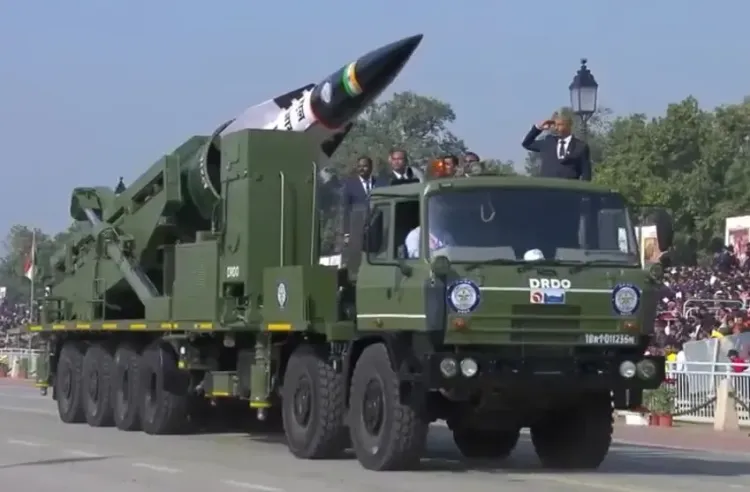
New Delhi, Jan 26 (NationPress) The Defence Research and Development Organisation (DRDO) presented a series of groundbreaking innovations aimed at enhancing national security during the 77th Republic Day Parade at Kartavya Path.
This showcase emphasized India’s burgeoning indigenous defence capabilities, particularly in advanced missile systems and state-of-the-art naval technologies.
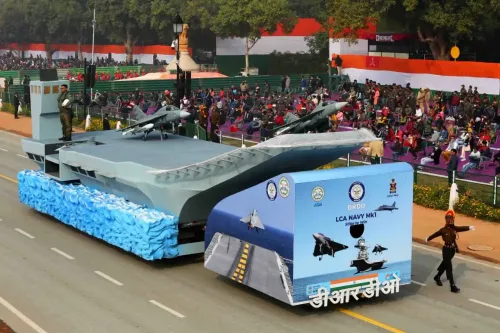
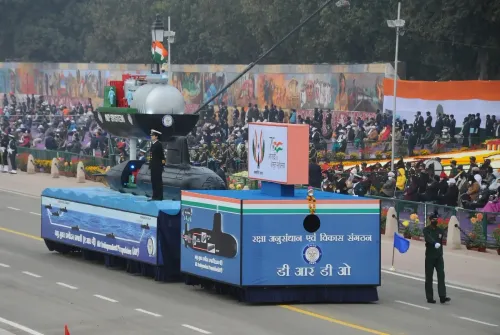
A standout among the displayed systems was the Long Range Anti-Ship Hypersonic Missile (LR-AShM) and the DRDO tableau themed ‘Naval Technologies for Combat Submarines’.
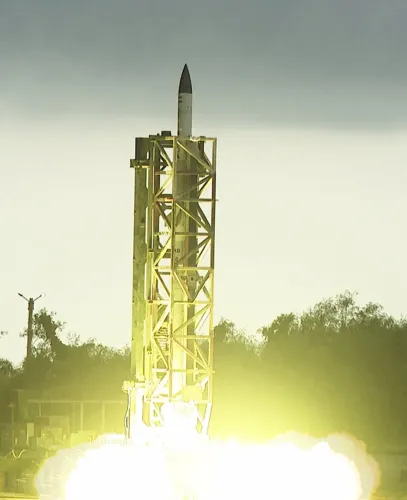
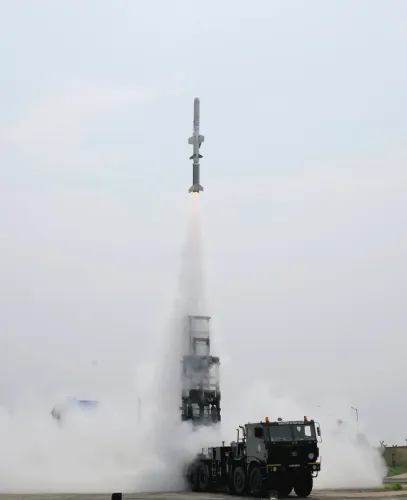
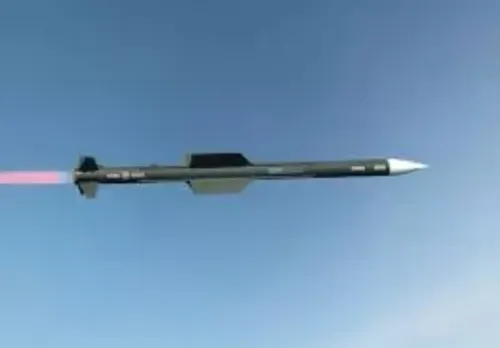
The LR-AShM, accompanied by its launcher, marked a significant milestone in India’s hypersonic weapons initiative. The system is specifically designed to fulfill the coastal battery requirements of the Indian Navy, thereby greatly enhancing its maritime strike capabilities.
The LR-AShM is a hypersonic glide missile that can engage both stationary and moving targets. It is designed to carry a variety of payloads and is touted as a pioneering system featuring fully indigenous avionics and high-precision sensor packages.
This missile follows a quasi-ballistic trajectory, achieving hypersonic speeds from Mach 10 and maintaining an average speed of Mach 5.0 through multiple skips during its flight.
With indigenously developed sensors, the missile can accurately target moving objects in its terminal phase. Due to its low-altitude flight profile, high speed, and agility, enemy ground-based and naval radar systems struggle to detect the missile for most of its flight path, making it a highly survivable and lethal weapon.
The LR-AShM is equipped with a two-stage solid propulsion rocket motor system that propels the missile to the necessary hypersonic velocity.
After depleting the first stage and separation, the second stage further accelerates the missile.
After the Stage-II burnout, the vehicle engages in an unpowered glide while executing essential atmospheric maneuvers before striking its target.
In conjunction with the missile system, the DRDO tableau showcased at Bharat Parv 2026 on ‘Naval Technologies for Combat Submarines’ featured a variety of indigenous technologies that serve as force multipliers for the Indian Navy’s conventional submarine fleet.
Included in this display were the Integrated Combat Suite (ICS), the Wire Guided Heavy Weight Torpedo (WGHWT), and the Air Independent Propulsion (AIP) system, all designed to ensure superiority in underwater combat.
The Integrated Combat Suite is a cutting-edge submarine-based defence system that plays a pivotal role in underwater warfare and anti-submarine operations.
Functioning as a system of systems, it provides comprehensive situational awareness by creating a complete threat landscape that aids tactical decision-making, including weapon selection, launch, and guidance.
As stated by the Ministry of Defence, the ICS is the culmination of collaborative efforts from eight DRDO laboratories, with active involvement from around 150 major industry partners and MSMEs across the nation.
The Wire Guided Heavy Weight Torpedo is a modern submarine-launched weapon intended to counter current surface ship and submarine threats in open waters.
The Ministry of Defence has characterized it as a highly effective weapon in anti-submarine warfare, noting that it serves as the primary armament for submarines.
As the Indian Navy expands its submarine fleet to assert dominance in blue-water naval warfare and secure strategic advantages across vast oceanic expanses, the necessity for indigenous, high-speed, and long-endurance submarine-launched anti-ship and anti-submarine torpedoes has become increasingly crucial.
Emphasizing the significance of the AIP system, the Defence Ministry remarked, "The AIP is essential for prolonged underwater endurance of submarines, thereby enhancing stealth capabilities. It is driven by a domestically developed phosphoric acid fuel cell paired with an innovative onboard hydrogen generator." It further clarified that the system generates power by combining hydrogen and oxygen in phosphoric acid fuel cells.
The generated power, after conditioning, is then routed into the submarine’s power line, allowing the vessel to navigate underwater silently without generating noise.
This technology is modular and can be adapted for future submarine platforms as well.
Additionally, several other systems developed by DRDO were showcased as part of the Armed Forces contingents during the parade.
These included the Arjun Main Battle Tank, Nag Missile System (NAMIS-II), Advanced Towed Artillery Gun System, BrahMos missile, Akash air defence system, Battlefield Surveillance Radar, and Anti-Tank Guided Missile.
The DRDO reaffirmed its role as a vital design and development agency for the Armed Forces, remaining committed to the vision of Aatmanirbhar Bharat.
By collaborating with academia, industry, and military services, the organization strives to provide cutting-edge defence systems.
The indigenous development of these advanced platforms, as stated by DRDO, signifies a monumental achievement in India’s quest for self-reliance in defence technologies and represents a vital step forward towards establishing a robust and secure Aatmanirbhar Bharat.
Point of View
Positioning India as a formidable player on the global stage. As the nation continues to bolster its military capabilities, it reflects a proactive approach to safeguarding sovereignty and ensuring peace in the region.
NationPress
26 Sept 2026
Frequently Asked Questions
What is the Long Range Anti-Ship Hypersonic Missile?
The Long Range Anti-Ship Hypersonic Missile (LR-AShM) is an advanced weapon system designed to engage both static and moving maritime targets at hypersonic speeds.
How does the LR-AShM enhance India's naval capabilities?
The LR-AShM significantly boosts maritime strike capabilities by fulfilling the coastal battery requirements of the Indian Navy and allowing for precise targeting of threats.
What technologies were showcased alongside the LR-AShM?
Other technologies included the Integrated Combat Suite, Wire Guided Heavy Weight Torpedo, and Air Independent Propulsion system, designed to enhance the operational efficiency of submarines.
What is the significance of the Integrated Combat Suite?
The Integrated Combat Suite is a next-generation defence system that provides comprehensive situational awareness for submarine operations, aiding tactical decision-making.
How does the Air Independent Propulsion system work?
The AIP system enhances submarine stealth and endurance, powered by a locally developed phosphoric acid fuel cell with an onboard hydrogen generator.