EC orders electoral roll error check in 26 states during SSR
Synopsis
The Election Commission has told 26 states and Union Territories not to auto-correct suspect voter-list entries during the Special Summary Revision. Every mismatch with Special Intensive Revision data must be physically verified by Booth Level Officers and backed by a signed Form-8, with 1 January 2027 as the qualifying date.
Key Takeaways
The Election Commission of India on 25 November ordered a special verification of probable errors in electoral rolls in 26 states and Union Territories .
The drive is part of the ongoing Special Summary Revision (SSR) , with 1 January 2027 as the qualifying date.
Existing elector details will be compared with data from the Special Intensive Revision (SIR) , covering names, relationship details, dates of birth, mobile numbers and photographs.
Booth Level Officers must physically verify every flagged entry and obtain a signed Form-8 where corrections are needed.
No voter-detail correction will be made solely on automated identification; AERO and ERO disposal on ECINet remains mandatory.
States named include Madhya Pradesh , Chhattisgarh , Uttar Pradesh , Rajasthan , Odisha , West Bengal , Tamil Nadu , Karnataka and Gujarat .
The Election Commission of India (ECI) on 25 November directed election authorities in 26 states and Union Territories to undertake a special verification exercise to identify and rectify probable incorrect or erroneous entries in electoral rolls during the ongoing Special Summary Revision (SSR), with 1 January 2027 as the qualifying date. The instruction, issued to Chief Electoral Officers, is designed to strengthen the accuracy and integrity of voter databases ahead of future elections.
Key developments
In a communication dated 25 November, the Commission asked CEOs — including those of Madhya Pradesh, Chhattisgarh, Uttar Pradesh, Rajasthan, Odisha, West Bengal, Tamil Nadu, Karnataka, Gujarat and several other states and Union Territories — to compare existing elector particulars with information collected during the Special Intensive Revision (SIR).
The comparison will cover names, relationship details, dates of birth, mobile numbers and photographs. Any mismatch is to be flagged for field verification and corrective action. Notably, the order covers a large share of India's electoral geography in a single instruction rather than a state-by-state patchwork.
How the cross-check will work
Officials have been told to treat the SIR dataset as a reference against the current roll. Where an elector's recorded identity markers do not align with SIR-collected information, the entry cannot be left unresolved on the system. It must be pushed into a field workflow.
This comes amid the ongoing SSR cycle that will determine who qualifies as an elector with reference to 1 January 2027. Summary revision is the Commission's established instrument for additions, deletions and corrections; the present direction superimposes a mismatch-driven verification layer on that cycle.
Physical verification and Form-8
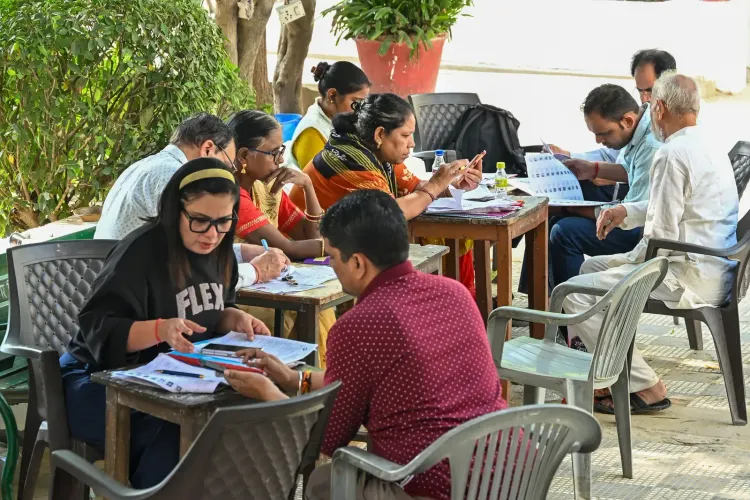
The Commission has made it clear that every flagged entry must undergo physical verification. Booth Level Officers (BLOs) are to visit the concerned electors during the revision process, verify particulars, and obtain duly filled and signed Form-8 applications wherever corrections are required.
Those applications will then be examined and disposed of by the Assistant Electoral Registration Officer (AERO) and the Electoral Registration Officer (ERO) under established procedures. Electors whose names, dates of birth, relationship details, contact numbers or photographs do not match SIR data are the group most directly affected.
No automated corrections
Emphasising transparency and accuracy, the ECI has stated that no corrections to voter details will be made solely on the basis of automated identification systems. Because the exercise updates demographic particulars of electors, every change must rest on a signed Form-8 and approval after prescribed verification by the competent authority.
The entire verification and correction process is to run through the relevant BLO, AERO and ERO modules on the ECINet platform. The Commission has instructed officials to ensure strict compliance with the guidelines and to bring the directions to the notice of all concerned authorities.
What happens next
Field visits by BLOs will proceed alongside the SSR calendar. Flagged electors should expect a doorstep check and, where needed, a request to sign Form-8. Disposal by AEROs and EROs will follow the existing legal process for roll corrections. How quickly mismatches are closed will determine whether the rolls tied to the 1 January 2027 qualifying date are cleaner than the lists they replace.
Point of View
The Commission is choosing due process over speed. The test now is BLO capacity and whether EROs dispose of those applications before the 1 January 2027 qualifying rolls lock in.
NationPress
25 Nov 2026
Frequently Asked Questions
What has the Election Commission ordered on electoral rolls?
The ECI has directed election authorities in 26 states and Union Territories to identify and rectify probable incorrect entries in electoral rolls during the ongoing Special Summary Revision. Existing elector details will be compared with Special Intensive Revision data, and mismatches will go for field verification.
Which states are covered under the ECI verification drive?
The order covers 26 states and Union Territories, including Madhya Pradesh, Chhattisgarh, Uttar Pradesh, Rajasthan, Odisha, West Bengal, Tamil Nadu, Karnataka and Gujarat, among others. Chief Electoral Officers in all listed jurisdictions have been told to enforce the comparison and field-check process.
Will voter details be corrected automatically?
No. The Election Commission has stated that no corrections to voter details will be made solely on the basis of automated identification systems. Every change must be backed by a signed Form-8 and approved after prescribed verification by the competent authority.
What is Form-8 in this ECI roll correction process?
Form-8 is the prescribed application for correcting an elector's particulars. Booth Level Officers must obtain a duly filled and signed Form-8 wherever a correction is required, after which the AERO and ERO examine and dispose of the application under established procedures.
What is the qualifying date for the Special Summary Revision?
The qualifying date for the ongoing Special Summary Revision is 1 January 2027. The special verification of suspected errors is being carried out during this SSR cycle so that rolls used thereafter reflect verified particulars.