Education Minister Pradhan meets MIT Provost on AI curriculum tie-up
Synopsis
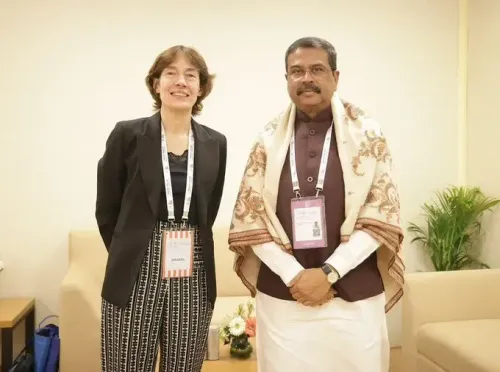
Union Education Minister Dharmendra Pradhan met MIT Provost Anantha Chandrakasan on 2 July 2026 to advance an 'AI Essentials' curriculum collaboration between MIT and IIT Madras, aiming to build foundational AI competencies for Indian students and educators at scale.
Key Takeaways
Dharmendra Pradhan met MIT Provost Anantha Chandrakasan on 2 July 2026 to discuss an AI education collaboration.
The initiative centres on an 'AI Essentials' curriculum jointly developed by MIT and IIT Madras .
The programme targets Indian students and educators , aiming to build foundational AI competencies at scale.
The collaboration aligns with NITI Aayog's National AI Strategy (#AIForAll, 2018) and the National Education Policy 2020 .
Rollout at IIT Madras and potential expansion to other IITs and NITs in the 2026-27 academic cycle will be key milestones to watch.
The tie-up is part of a broader pattern of US-India technology cooperation aimed at positioning India as a global AI hub.
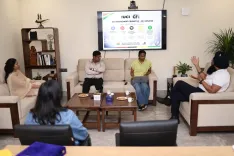
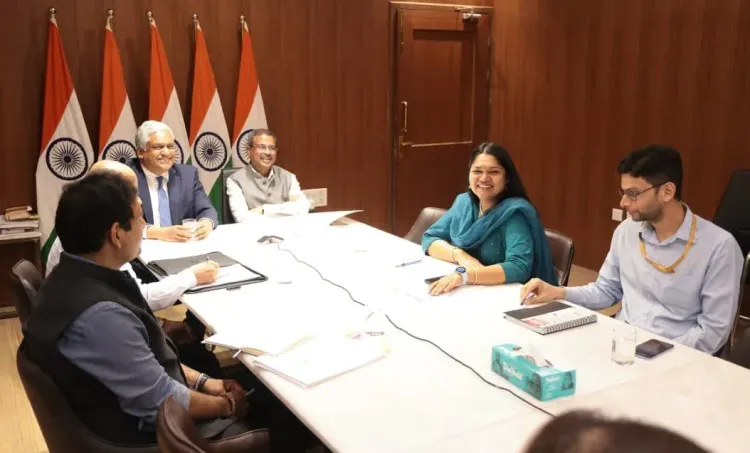
Union Education Minister Dharmendra Pradhan met Prof. Anantha Chandrakasan, Provost of the Massachusetts Institute of Technology (MIT), on 2 July 2026 to discuss a pioneering collaboration between MIT and IIT Madras centred on an 'AI Essentials' curriculum aimed at building foundational artificial intelligence competencies among Indian students and educators.
Context
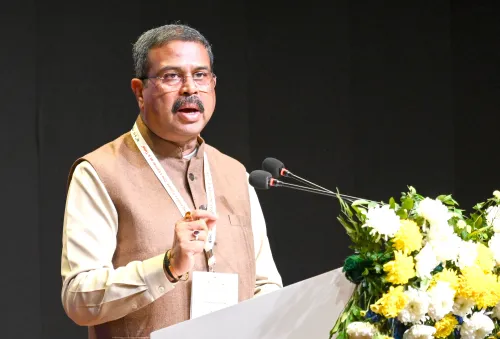
Pradhan described the meeting as an opportunity to advance 'a pioneering collaboration between MIT and IIT Madras on the AI Essentials curriculum,' adding that the initiative 'seeks to build a strong foundation for AI learning among our students and educators.' He noted it will 'open new pathways for innovation, interdisciplinary research and the application of emerging technologies to address real-world challenges.'
Prof. Chandrakasan is a recognised authority in low-power electronics and AI hardware and leads MIT's academic and research enterprise as Provost. IIT Madras, a premier technology institution, has established strengths in engineering and large-scale online education, making it a natural anchor for such a programme.
Policy Backdrop
The collaboration sits squarely within two major policy frameworks. NITI Aayog's National Strategy for Artificial Intelligence (#AIForAll), released in 2018, set India's national vision for responsible AI adoption and talent development at scale. The National Education Policy 2020 subsequently mandated integration of artificial intelligence, coding, and multidisciplinary research across higher-education institutions.
India has increasingly pursued international university partnerships to accelerate domestic AI capacity, consistent with goals of positioning the country as a global innovation hub. Such tie-ups also align with the broader US-India technology cooperation framework that has gained momentum in recent years.
Stakeholders and Impact
The immediate beneficiaries are Indian students and educators who will gain access to a curriculum co-developed with one of the world's foremost technology universities. By anchoring the programme at IIT Madras — which already runs large-scale online learning through its platforms — the initiative carries the potential to reach learners well beyond the Chennai campus.
Pradhan framed the ambition in national terms: 'As India charts its course in the age of artificial intelligence, expanding access to world-class AI education and building talent at scale will be critical.' He added that the collaboration 'reflects our shared commitment to preparing a new generation of innovators and problem-solvers' who can help shape India into 'a global hub of innovation and emerging technologies.'
Talent shortages remain a key constraint as AI adoption accelerates across Indian industry and government. A scalable, foundational curriculum co-designed with MIT could address a structural gap that neither domestic institutions nor private players have fully bridged.
What's Next
The immediate focus will be on the rollout timeline for the AI Essentials curriculum at IIT Madras and whether the model is extended to other IITs or NITs in the 2026-27 academic cycle. Formal announcements — including any memorandum of understanding or funding commitments — are likely to follow as the collaboration moves from dialogue to implementation.
If the programme scales as envisioned, it could set a template for similar AI education partnerships between Indian institutions and global research universities, reinforcing India's stated ambition to become a defining player in the global artificial intelligence landscape.
Point of View
And now to curriculum co-development with a top global university. The true test will be whether the 'AI Essentials' programme achieves the scale and quality needed to meaningfully address India's AI talent gap, or remains a high-profile pilot.
NationPress
2 Jul 2026
Frequently Asked Questions
What is the MIT IIT Madras AI Essentials curriculum?
The 'AI Essentials' curriculum is a collaborative programme between MIT and IIT Madras designed to build foundational artificial intelligence knowledge among Indian students and educators. Details of its full content and launch date are yet to be formally announced.
Who is Anantha Chandrakasan and what is his role at MIT?
Anantha Chandrakasan is the Provost of MIT and a leading expert in low-power electronics and AI hardware. As Provost, he oversees MIT's academic and research functions.
How does this MIT IIT Madras collaboration relate to India's AI policy?
The collaboration aligns with NITI Aayog's National Strategy for Artificial Intelligence released in 2018 and the National Education Policy 2020, both of which call for scaling AI education and international research partnerships.
Will the AI Essentials programme expand beyond IIT Madras?
No formal announcement has been made, but the rollout at IIT Madras could serve as a model for expansion to other IITs and NITs in the 2026-27 academic cycle, given the government's stated goal of building AI talent at scale.
What is Dharmendra Pradhan's role in India's education sector?
Dharmendra Pradhan has served as Union Minister of Education since July 2021. He is a senior BJP leader and was previously Union Minister of Petroleum and Natural Gas. He has been a key driver of implementing the National Education Policy 2020.