CM Fadnavis Alerts Nashik of Cloudburst Risk on July 7

Synopsis
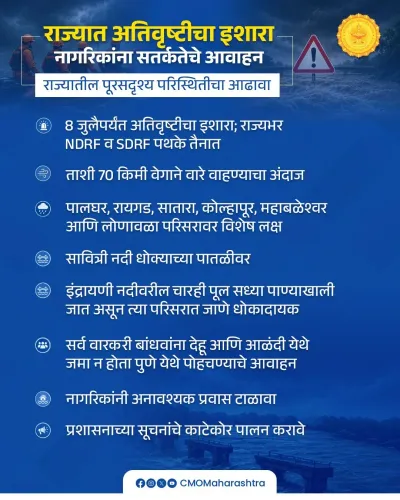
Maharashtra Chief Minister Devendra Fadnavis on July 6 issued a public alert warning of cloudburst-like rainfall in Nashik on July 7, 2026, stating that the district administration is fully mobilised to handle any resulting disaster.
Key Takeaways
Maharashtra CM Devendra Fadnavis issued a public alert on July 6, 2026 warning of cloudburst-like rainfall risk in Nashik on July 7 .
The alert was communicated in both Marathi and Hindi on X, accompanied by a video.
Fadnavis confirmed that the district administration is fully prepared to respond to potential disaster.
Nashik is a major agricultural and religious hub in northern Maharashtra, highly vulnerable to extreme monsoon events.
Maharashtra's disaster preparedness framework has been strengthened since the 2005 Mumbai floods under the National Disaster Management Act.
Further developments to watch include NDRF deployments , district control room activations, and updated IMD forecasts for the region.
Maharashtra Chief Minister Devendra Fadnavis on Monday, July 6, 2026, issued a public alert warning that Nashik faces a significant risk of cloudburst-like extreme rainfall on July 7, adding that the district administration is fully prepared to respond to any resulting disaster.
Context
Posting in both Marathi and Hindi, Fadnavis wrote: 'नाशिकसाठी उद्या (7 जुलै) रोजी महत्त्वाचा अलर्ट जारी करण्यात आला असून, ढगफुटीसदृश पावसाची शक्यता आहे' ('A significant alert has been issued for Nashik tomorrow, July 7, with the possibility of cloudburst-like heavy rainfall'). He added that the administration is fully ready to deal with the potential disaster. The post was accompanied by a video and tagged with #Maharashtra, #Mumbai, and #HeavyRainfall.
A cloudburst is defined as extremely intense rainfall — typically more than 100 mm per hour over a small area — and can trigger flash floods, landslides, and significant infrastructure damage within minutes. Nashik, situated in northern Maharashtra, is particularly vulnerable during the southwest monsoon season due to its topography and proximity to the Western Ghats.
Policy Backdrop
India's monsoon preparedness framework was significantly strengthened after the catastrophic 2005 Mumbai floods, which prompted Maharashtra to overhaul its state disaster management architecture under the National Disaster Management Act, 2005. Since then, state governments are mandated to coordinate with the India Meteorological Department (IMD) — the national agency under the Ministry of Earth Sciences — to issue timely alerts and mobilise resources ahead of extreme weather events.
Between June and September each year, Maharashtra's administration routinely activates district-level control rooms, pre-positions National Disaster Response Force (NDRF) teams, and disseminates public advisories in alignment with national disaster risk reduction guidelines. Chief ministers and senior officials publicly amplifying such alerts on social media has become a standard part of this communication strategy, ensuring wider public reach.
Stakeholders and Impact
The alert directly concerns residents of Nashik city and district, one of Maharashtra's major urban and agricultural centres. The district is home to significant horticultural activity — particularly grape and onion cultivation — meaning extreme rainfall can cause not only human risk but also substantial crop damage. Pilgrims and tourists visiting Nashik's religious sites are also among those who could be affected.
Local civic bodies, the district collectorate, police, and emergency services are the primary administrative stakeholders. The Chief Minister's public statement signals that coordination has already been initiated at the state level, and that district authorities have been placed on high alert ahead of the forecast window.
What's Next
All eyes will be on IMD nowcasts and updated rainfall intensity forecasts for Nashik through July 7. Authorities are expected to monitor river levels — particularly the Godavari, which originates near Nashik — and may activate flood-control protocols if rainfall crosses critical thresholds. Any deployment of NDRF teams or activation of district emergency operations centres will be a key indicator of how the situation develops on the ground.
The episode underscores the increasing reliance on real-time digital communication by state executives to bridge the gap between official weather warnings and public awareness during monsoon emergencies in Maharashtra.
Point of View
Visible, proactive disaster messaging also serves a political function: demonstrating administrative readiness and accountability ahead of any adverse event. The move fits a wider national pattern where disaster preparedness has become a governance performance metric, particularly after high-profile monsoon failures in recent years. If the July 7 rainfall does cause damage, the public record of advance warning will shape both administrative accountability and political optics.
NationPress
5 Oct 2026
Frequently Asked Questions
Why has a cloudburst alert been issued for Nashik on July 7 2026?
Maharashtra CM Devendra Fadnavis announced on July 6, 2026 that a significant alert has been issued for Nashik for July 7, citing the possibility of cloudburst-like extreme rainfall, and confirmed the administration is prepared to respond.
What is a cloudburst and why is Nashik at risk?
A cloudburst refers to extremely intense, localised rainfall — often exceeding 100 mm per hour — that can trigger flash floods and landslides. Nashik's location in northern Maharashtra near the Western Ghats makes it vulnerable to such events during the southwest monsoon season.
What steps has the Maharashtra government taken to prepare for the Nashik rainfall?
According to CM Fadnavis, the district administration is fully ready to deal with the potential disaster. Maharashtra's broader framework includes district control room activations, NDRF pre-positioning, and coordination with the India Meteorological Department.
Who issues cloudburst and heavy rain alerts in Maharashtra?
The India Meteorological Department (IMD), the national weather agency under the Ministry of Earth Sciences, issues official heavy rain and cloudburst alerts. State governments then coordinate response and disseminate warnings to the public.
What happened after the 2005 Mumbai floods in terms of disaster preparedness?
Following the catastrophic 2005 Mumbai floods, Maharashtra strengthened its disaster management framework under the National Disaster Management Act, 2005, improving coordination between state agencies, district administrations, and national response forces.