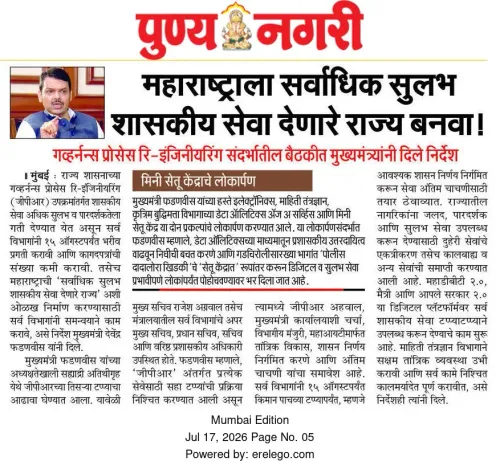
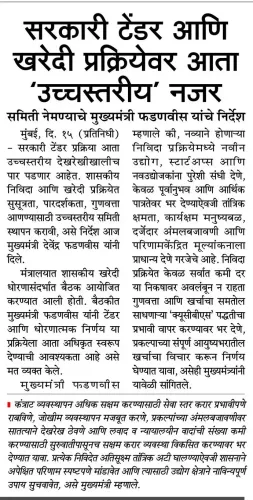
CM Fadnavis to Cut Unnecessary Steps in Govt Services
Synopsis
The Chief Minister's Office of Maharashtra announced on 26 May 2026 that CM Devendra Fadnavis will eliminate unnecessary procedural steps in government services. The move extends the state's decade-long push on administrative simplification, e-governance, and ease of doing business, with department-level notifications expected to follow.
Key Takeaways
The Chief Minister's Office of Maharashtra announced on 26 May 2026 that unnecessary steps in government services will be cut.
CM Devendra Fadnavis is the named driver of this governance reform initiative.
The announcement extends a policy trajectory dating to 2014 , when single-window clearances and e-governance portals were first introduced in Maharashtra.
The state's Aaple Sarkar portal already consolidates multiple services digitally; this move targets remaining redundant procedural layers.
Primary beneficiaries include citizens seeking routine government certificates and business applicants requiring regulatory clearances.
Department-wise notifications specifying which procedures will be eliminated are the key next step to watch.
The Chief Minister's Office of Maharashtra announced on Tuesday, 26 May 2026 that the state government will eliminate unnecessary procedural steps in the delivery of public services, signalling a fresh push toward administrative simplification under Chief Minister Devendra Fadnavis.
Context
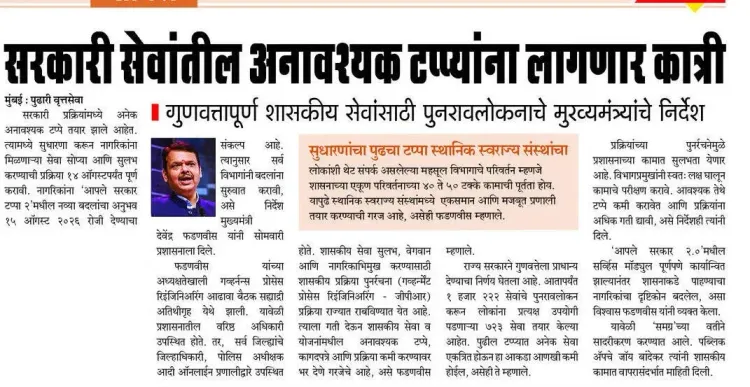
The official CMO post, shared in Marathi, stated: 'सरकारी सेवांतील अनावश्यक टप्प्यांना लागणार कात्री' — loosely translated as 'Unnecessary steps in government services will be cut.' The announcement was tagged directly to @Dev_Fadnavis and accompanied by the hashtags #GoodGovernance and #Maharashtra, framing it as a deliberate governance priority of the current administration.
While the post does not specify which departments or procedures are in scope, the language signals a policy directive aimed at reducing the number of touchpoints citizens and businesses must navigate to access state services.
Policy Backdrop
This is not the first time Fadnavis has pushed administrative streamlining. During his earlier term from 2014 to 2019, the state government introduced single-window clearance systems and expanded e-governance portals to reduce approval timelines. Maharashtra also participated in national Ease of Doing Business rankings from 2015 onward, which prompted successive rounds of compliance reduction across revenue, urban development, and regulatory departments.
The state's integrated online platform Aaple Sarkar was launched to consolidate access to government certificates and services under a single digital roof, reducing the need for citizens to visit multiple offices. The current announcement appears to extend that trajectory by targeting the procedural layers that still require redundant physical or paper-based steps.
Stakeholders and Impact
The primary beneficiaries of such a reform would be ordinary citizens seeking everyday government services — from land records and caste certificates to business licences and utility connections — who currently navigate multi-step, multi-department processes. Small business applicants stand to gain from faster regulatory clearances if redundant approval stages are removed.
Governance reform advocates have long argued that excess procedural steps not only delay service delivery but also create rent-seeking opportunities at each checkpoint. Eliminating such steps, if implemented systematically, could reduce both the time cost and the informal cost burden on citizens.
What's Next
The immediate next step to watch is the issuance of department-wise notifications identifying the specific procedures to be eliminated. Depending on the scope, some changes may require administrative orders while others could need legislative amendments. Maharashtra has historically used government resolutions (GRs) to operationalise such reforms quickly without waiting for legislative cycles.
If the state follows through with a structured, publicly documented list of eliminated steps, it would mark a measurable advance in Maharashtra's governance index standing — and set a benchmark that other states are likely to watch closely.
Point of View
Governance efficiency has been a consistent brand differentiator across tenures, and this move reinforces that positioning ahead of potential administrative reviews. The framing under '#GoodGovernance' also aligns with a broader national discourse on state competitiveness in service delivery indices. The real test will be whether department-wise notifications arrive with specificity and timelines, or whether the reform remains at the level of intent.
NationPress
9 Oct 2026
Frequently Asked Questions
What did the Maharashtra CMO announce on 26 May 2026?
The Chief Minister's Office of Maharashtra announced that unnecessary procedural steps in government services will be eliminated, a reform attributed to CM Devendra Fadnavis.
Which government services will be affected by this reform in Maharashtra?
The specific departments and services have not yet been named in the announcement. Historically, Maharashtra's simplification drives have targeted revenue, urban development, and regulatory departments.
What is the Aaple Sarkar portal and how does it relate to this announcement?
Aaple Sarkar is Maharashtra's integrated online platform for accessing government certificates and services. The current reform appears to build on that foundation by removing remaining redundant procedural steps.
Has Devendra Fadnavis done this before?
Yes. During his 2014-2019 tenure, Fadnavis introduced single-window clearance systems and expanded e-governance portals, and Maharashtra engaged with national Ease of Doing Business rankings from 2015 onward.
How will citizens benefit from cutting unnecessary steps in government services?
Citizens will face fewer touchpoints to obtain services such as land records, caste certificates, and utility connections, reducing both time costs and potential informal payments at each procedural checkpoint.