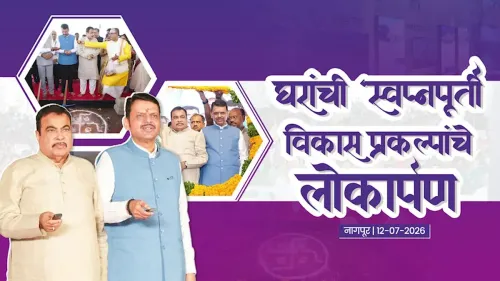
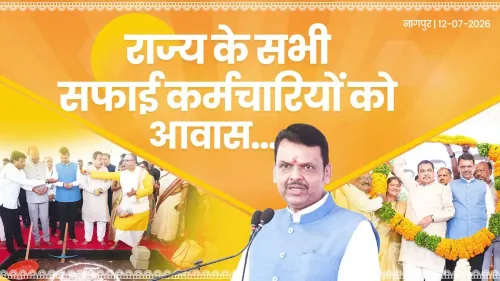
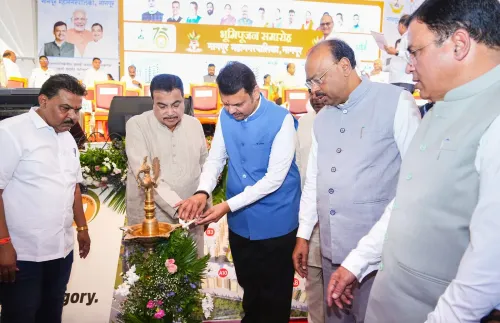
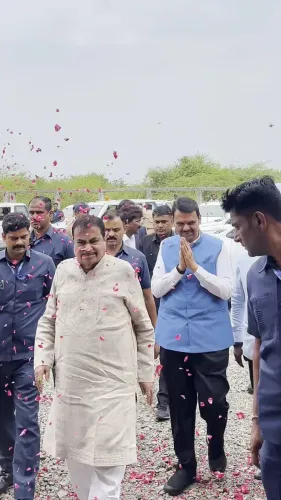
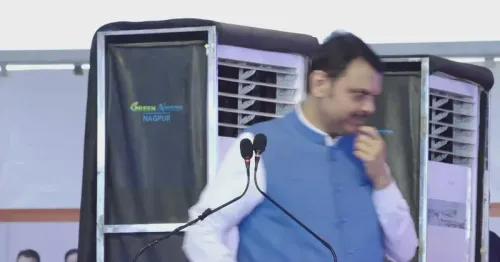
CM Fadnavis breaks ground for free homes for Nagpur sanitation workers
Synopsis
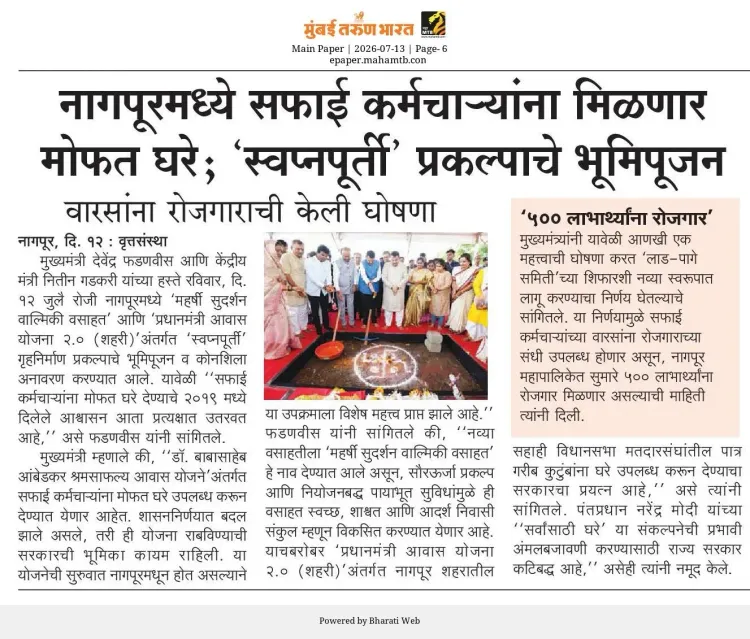
Chief Minister Devendra Fadnavis performed the groundbreaking of the 'Swapnapurti' project in Nagpur on 13 July 2026, committing the Maharashtra government to delivering free homes to the city's sanitation workers under a dedicated state housing initiative.
Key Takeaways
Chief Minister Devendra Fadnavis performed the bhoomipujan of the Swapnapurti project in Nagpur on 13 July 2026 .
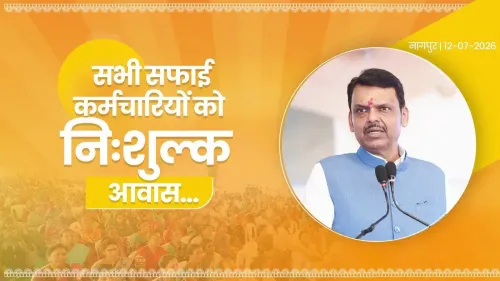
The scheme will provide free homes to sanitation workers ( safai karmacharis ) in Nagpur .
Nagpur is Maharashtra's winter capital and Fadnavis's home constituency, giving the project strong political salience.
The initiative aligns with the national Pradhan Mantri Awas Yojana (Urban) framework, which prioritises sanitation workers as housing beneficiaries.
Maharashtra has a history of in-situ rehabilitation schemes for municipal workers, and Swapnapurti follows that model.
Progress on unit construction and allotment lists will be the key benchmarks to watch in the coming months.
The Chief Minister's Office of Maharashtra announced on Monday, 13 July 2026 that Chief Minister Devendra Fadnavis has performed the groundbreaking ceremony for the 'Swapnapurti' (Dream Fulfilment) project in Nagpur, which will provide free housing to sanitation workers in the city.
Context
The post, shared by the official Chief Minister's Office of Maharashtra account, announced: 'नागपूरमध्ये सफाई कर्मचाऱ्यांना मिळणार मोफत घरे; स्वप्नपूर्ती प्रकल्पाचे भूमिपूजन' — 'Sanitation workers in Nagpur to receive free homes; groundbreaking of the Swapnapurti project.' The ceremony marks a formal state commitment to housing for a section of the urban workforce that is among the most underserved in civic infrastructure.
Nagpur, the winter capital of Maharashtra, has a significant population of municipal sanitation workers employed by the Nagpur Municipal Corporation. These workers, often referred to as safai karmacharis, have historically lived in informal settlements with limited access to secure tenure.
Policy Backdrop
The Swapnapurti project sits within a broader national and state policy framework aimed at housing the urban poor. The Pradhan Mantri Awas Yojana (Urban), launched in 2015, set a precedent for subsidised or free housing for eligible urban households, explicitly including sanitation workers among priority beneficiaries.
Maharashtra governments have periodically announced targeted housing schemes for municipal workers as part of urban local body reform efforts. The preferred approach has been in-situ rehabilitation — building homes near where workers are already settled — rather than relocating them away from their places of work. The Swapnapurti project appears to follow this model for Nagpur.
Stakeholders and Impact
The primary beneficiaries are Nagpur's sanitation workers, a group that performs essential civic duties yet frequently lacks access to formal housing. Secure, government-allocated homes would provide these workers with legal tenure, improved living conditions, and protection from eviction.
Urban policy analysts have noted that housing security for essential service workers reduces absenteeism and improves retention in municipal sanitation departments. The initiative could also serve as a template for other tier-2 cities in Maharashtra where similar housing gaps exist for civic staff.
What's Next
With the bhoomipujan (groundbreaking) now completed, attention will shift to the pace of unit construction and the transparency of the beneficiary allotment process under the Swapnapurti project. Observers will watch whether the Maharashtra government announces similar schemes for sanitation workers in other municipal corporations such as Pune, Nashik, or Aurangabad.
Chief Minister Devendra Fadnavis, who represents Nagpur as his home constituency, has a political as well as administrative stake in the project's successful delivery. The scheme's progress is likely to be a visible marker of the state government's urban welfare commitments ahead of future electoral cycles.
Point of View
Combining genuine social policy with electoral optics. By anchoring the scheme in Maharashtra's winter capital, the Chief Minister reinforces his personal identity with the city while extending the state's urban housing agenda to a constituency — sanitation workers — that is politically mobilisable but chronically underserved. The move also positions the state government as an active partner to the Centre's housing mission rather than a passive recipient of central funds. The real test will be delivery: Maharashtra's track record on housing scheme timelines is mixed, and the gap between groundbreaking and possession has historically been wide.
NationPress
12 Oct 2026
Frequently Asked Questions
What is the Swapnapurti project in Nagpur?
The Swapnapurti project is a Maharashtra government housing scheme under which free homes will be provided to sanitation workers in Nagpur. Its groundbreaking was performed by Chief Minister Devendra Fadnavis on 13 July 2026.
Who will benefit from the Swapnapurti housing scheme?
Sanitation workers, also known as safai karmacharis, employed in Nagpur are the primary beneficiaries of the Swapnapurti project.
Where is the Swapnapurti project located?
The project is located in Nagpur, the winter capital of Maharashtra and Chief Minister Devendra Fadnavis's home constituency.
Is the Swapnapurti scheme linked to PM Awas Yojana?
The scheme aligns with the broader framework of the Pradhan Mantri Awas Yojana (Urban), which was launched in 2015 and identifies sanitation workers as priority beneficiaries for urban housing support.
Will other Maharashtra cities get similar housing schemes for sanitation workers?
No formal announcements have been made yet, but policy observers expect the government may replicate the Swapnapurti model in other municipal corporations such as Pune, Nashik, or Aurangabad if the Nagpur project progresses well.