CM Fadnavis Directs Stress-Free NEET Retest for Maharashtra
Synopsis
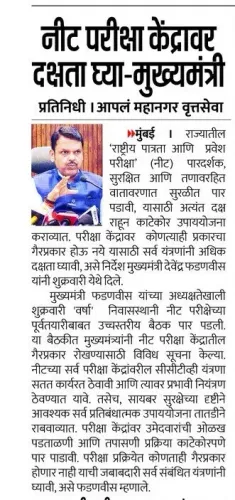
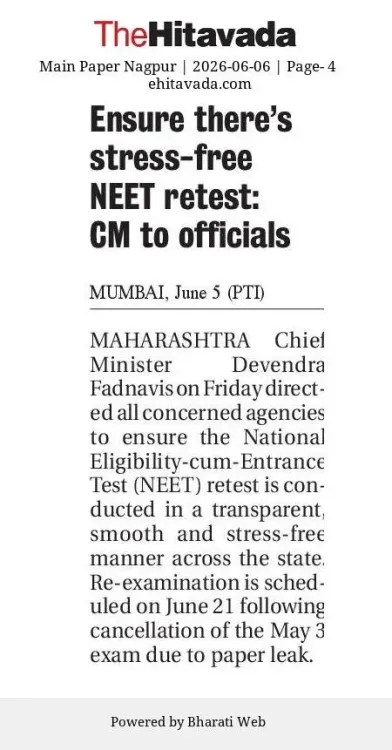
Chief Minister Devendra Fadnavis on June 6, 2026, directed authorities to ensure a stress-free NEET retest, signalling Maharashtra's active push for fair exam administration amid ongoing federal scrutiny of the National Testing Agency's processes.
Key Takeaways
CM Devendra Fadnavis publicly directed that the upcoming NEET retest be conducted in a stress-free manner for aspirants.
The directive was shared by the official Chief Minister's Office of Maharashtra account on June 6, 2026 .
NEET , conducted by the National Testing Agency , has faced repeated judicial scrutiny over alleged irregularities, including a major controversy in 2024 .
Maharashtra is one of India's largest pools of NEET aspirants, giving the state government a significant stake in exam administration.
Operational responsibility for retest logistics rests with the NTA under the Ministry of Education , not the state government.
The Bombay High Court and Supreme Court remain potential avenues for further oversight if concerns persist.
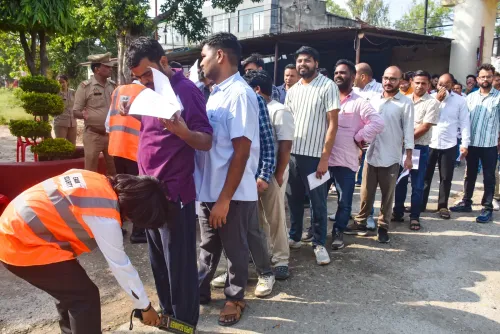
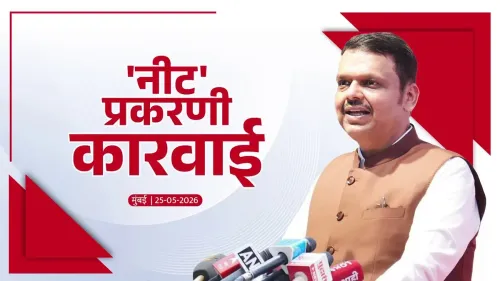
The Chief Minister's Office of Maharashtra on Saturday, June 6, 2026, shared a directive from Chief Minister Devendra Fadnavis calling for a stress-free retest of the National Eligibility cum Entrance Test (NEET), signalling the state government's active engagement with the concerns of medical aspirants.
Context
The post, shared from the official CMO Maharashtra account, quotes CM Devendra Fadnavis directly: 'Ensure there's a stress-free NEET retest.' The statement reflects the Chief Minister's personal intervention in an examination process that falls under the purview of the central government's National Testing Agency (NTA). No further specifics on the trigger for the retest were provided in the post.
NEET is the single national entrance examination for undergraduate medical admissions across India, conducted by the NTA under the Ministry of Education. Maharashtra consistently ranks among the states with the highest number of NEET aspirants each year, giving the state government a strong stake in how the examination is administered.
Policy Backdrop
NEET was introduced in 2013 as a unified replacement for multiple state-level medical entrance tests, and a 2016 Supreme Court ruling made it mandatory for all medical admissions, including state quota seats. The examination has since been subject to repeated judicial scrutiny over allegations of irregularities, most prominently in 2024 when the Supreme Court examined claims of grace marks and paper leaks, leading to limited retests for affected candidates.
State governments across India have periodically intervened in NEET-related matters when perceived lapses affect large numbers of local candidates, reflecting an ongoing federal tension over education policy. Maharashtra has a documented history of demanding transparent re-examinations and has previously seen such demands reach the courts.
Stakeholders and Impact
The primary stakeholders are Maharashtra's medical aspirants — students who have invested years of preparation and whose futures hinge on a fair examination process. A retest, if not administered smoothly, can compound anxiety, disrupt academic calendars, and delay admissions to medical colleges across the state and country.
The NTA bears operational responsibility for any retest logistics, including scheduling, centre allocation, and grievance redressal. CM Fadnavis's public directive places political pressure on both the central agency and state-level coordination machinery to prioritise candidate welfare over administrative convenience.
What's Next
The immediate focus will be on any follow-up directives from the NTA regarding retest dates, eligible candidates, and examination centre arrangements. The Bombay High Court and the Supreme Court of India remain potential forums for further judicial oversight should logistical or fairness concerns arise.
CM Fadnavis's statement sets a public benchmark: the retest must be demonstrably stress-free. How the central agency responds — and whether the state government follows up with formal communication to the Ministry of Education — will determine the practical impact of this intervention on Maharashtra's lakhs of NEET aspirants.
Point of View
Making any retest mismanagement politically costly. Whether the directive translates into formal inter-governmental communication or remains a public posture will be the real test of its policy intent.
NationPress
21 Oct 2026
Frequently Asked Questions
Why is CM Devendra Fadnavis asking for a stress-free NEET retest?
CM Devendra Fadnavis issued the directive to ensure that Maharashtra's medical aspirants face a smooth, fair retest process, reflecting the state government's concern for candidates affected by NEET-related issues. The specific trigger for the retest was not detailed in the post.
Who conducts the NEET retest in India?
The National Testing Agency (NTA) , an autonomous body under the Ministry of Education , is responsible for conducting NEET and any associated retests across India, including for candidates from Maharashtra .
What is the history of NEET controversies in India?
NEET has faced multiple controversies since its nationwide rollout in 2013 . The most significant recent episode was in 2024 , when the Supreme Court examined allegations of grace marks and paper leaks, which led to limited retests for affected candidates.
Can the Maharashtra government change NEET rules or conduct its own exam?
No. Following a 2016 Supreme Court ruling, NEET is mandatory for all medical admissions across India, and the NTA under the central government holds exclusive authority over its conduct. State governments can only advocate for fair administration.
What happens if the NEET retest is not conducted fairly?
Affected candidates can approach the Bombay High Court or the Supreme Court of India , both of which have historically exercised oversight over NTA exam processes. Political pressure from state governments like Maharashtra can also prompt central government action.