CM Fadnavis: Centre Acts on NEET Exam Irregularities, Makes Arrests
Synopsis
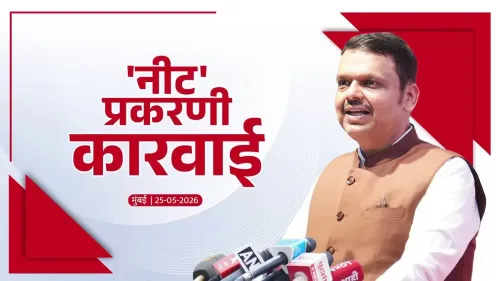
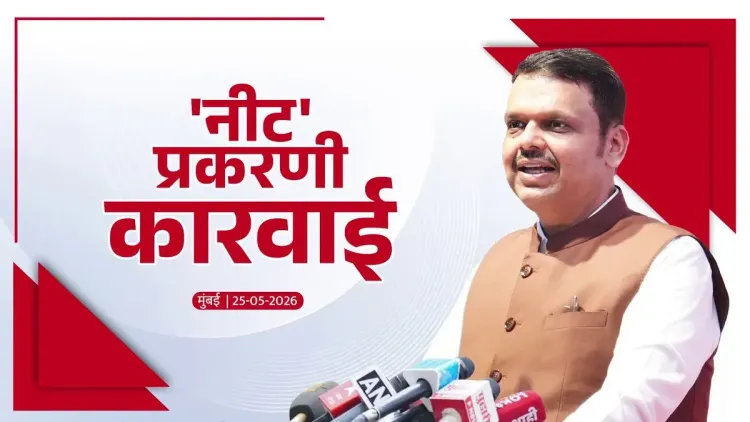
Maharashtra CM Devendra Fadnavis declared on 25 May 2026 that the central government has taken serious cognisance of the NEET examination irregularities case and that arrests have been made after investigators traced the matter to its roots, posting the statement in both Marathi and Hindi from Mumbai.
Key Takeaways
Devendra Fadnavis posted on 25 May 2026 from Mumbai stating the Centre has acted seriously on the NEET irregularities case.
He confirmed that arrests have been made after investigators traced the case 'to its roots.' The post was made in both Marathi and Hindi , indicating a broad regional outreach.
The statement was a reply post, suggesting it responded to a direct query or criticism about the NEET matter.
NEET is conducted by the National Testing Agency and has been India's sole undergraduate medical entrance exam since the Supreme Court's 2016 directive.
Central investigative agencies have probed NEET-related malpractice in multiple recent cycles, forming part of a broader effort to restore exam credibility.
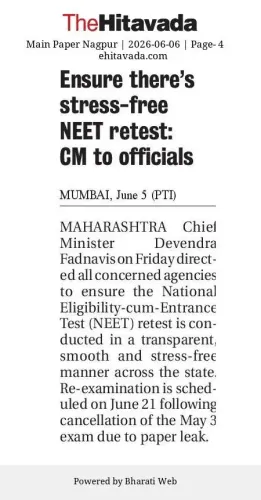
Maharashtra Chief Minister Devendra Fadnavis on Monday, 25 May 2026, stated that the central government has taken serious cognisance of the NEET examination irregularities case and that arrests have been made after investigators traced the matter to its roots. The remarks were posted from Mumbai as a reply on his official X account.
Context
Fadnavis posted in both Marathi and Hindi, signalling a deliberate outreach to audiences across Maharashtra and the broader Hindi-speaking belt. In Marathi, he wrote: 'नीट परीक्षा प्रकरणासंदर्भात केंद्र सरकारने गंभीर दखल घेतली असून, या प्रकरणाची पाळेमुळे खणून काढत संबंधितांना अटकही करण्यात आली आहे' — meaning, 'The central government has taken serious cognisance of the NEET examination matter, and after digging out the roots of this case, the concerned persons have also been arrested.' The Hindi portion conveyed an identical message.
The post is framed as a reply, suggesting it was a direct response to a query or criticism directed at the Chief Minister regarding the handling of the NEET controversy. Fadnavis used the occasion to defend the Centre's record, emphasising both the gravity of the response and the concrete outcome of arrests.
Policy Backdrop
The National Eligibility cum Entrance Test (NEET) is the sole undergraduate medical and dental entrance examination in India, conducted by the National Testing Agency (NTA), an autonomous body under the Ministry of Education. The Supreme Court of India mandated NEET as the single common entrance test in 2016, replacing a patchwork of state-level examinations.
In recent years, central investigative agencies — including the Central Bureau of Investigation (CBI) — have probed multiple alleged paper leaks and organised malpractice networks linked to NEET and other high-stakes national examinations. These investigations reflect a broader pattern of institutional scrutiny aimed at restoring credibility to entrance tests that determine access to medical education for lakhs of aspirants annually.
Stakeholders and Impact
The most directly affected stakeholders are medical aspirants across India — students who invest years of preparation for NEET, and whose futures hinge on the integrity of the examination process. Any evidence of paper leaks or malpractice fundamentally undermines the principle of merit-based selection that NEET was designed to enforce.
State education departments, including Maharashtra's, also have a stake in the outcome: state governments bear political accountability for how their students fare and for the broader perception of examination fairness within their jurisdictions. Fadnavis's statement positions the ruling dispensation as proactive rather than reactive on the issue.
What's Next
Attention will now turn to whether the arrests cited by Fadnavis lead to formal chargesheets and trial proceedings, and whether the NTA or the Ministry of Education announces revised examination protocols to prevent recurrence. Parliamentary scrutiny of the agency's processes remains a live possibility.
Any further disclosures from the ongoing probe — including the identities of those arrested and the specific irregularities alleged — will determine whether the political narrative around NEET shifts from crisis management to systemic reform.
Point of View
Defending the BJP-led central government's record on examination integrity at a time when NEET controversies have become a recurring flashpoint for opposition parties. By foregrounding arrests rather than systemic reform, the statement prioritises law-and-order optics over institutional accountability. The framing fits a broader pattern in which ruling-party leaders at the state level amplify central enforcement actions to deflect criticism of the NTA's governance. Whether the arrests translate into convictions and structural change at the NTA will ultimately determine whether this response is seen as substantive or performative.
NationPress
9 Oct 2026
Frequently Asked Questions
What did CM Devendra Fadnavis say about the NEET exam case?
CM Fadnavis stated on 25 May 2026 that the central government has taken serious cognisance of the NEET examination irregularities and that arrests have been made after investigators traced the matter to its roots.
Who conducts the NEET examination in India?
NEET is conducted by the National Testing Agency (NTA), an autonomous body under the Ministry of Education. The Supreme Court mandated it as the sole undergraduate medical entrance exam in 2016.
What is the NEET paper leak controversy?
In recent years, central investigative agencies have probed multiple alleged paper leaks and organised malpractice networks linked to NEET, raising concerns about the integrity of the exam that determines medical college admissions for lakhs of students.
Has anyone been arrested in the NEET irregularities case?
According to CM Fadnavis's post on 25 May 2026, arrests have been made in connection with the NEET irregularities case after investigators traced the matter to its roots. Specific identities of those arrested were not mentioned in the post.
Why is NEET important for students in Maharashtra?
NEET is the sole gateway to undergraduate medical and dental admissions across India, including Maharashtra. Lakhs of students from the state appear for the exam each year, making its integrity a significant concern for Maharashtra's education ecosystem.