CM Fadnavis hails Dharmendra Pradhan's education reforms after resignation
Synopsis
Maharashtra CM Devendra Fadnavis on 25 July 2026 lauded Dharmendra Pradhan's contributions to education reform — NEP rollout, PM SHRI Schools, IIT global expansion and 19-language entrance exams — calling his resignation an act of national interest over personal gain.
Key Takeaways
Devendra Fadnavis publicly praised Dharmendra Pradhan on 25 July 2026 following his resignation as Union Education Minister.
Pradhan is credited with implementing the National Education Policy 2020 , which replaced the 1986 education framework.
The PM SHRI Schools scheme was launched under his tenure to create model schools embodying NEP principles.
Entrance examinations were expanded to 19 languages , widening access for regional-language students across India.
Plans for IIT campuses abroad were advanced to extend India's higher-education footprint globally.
Fadnavis described the resignation as placing national interest above personal interest, framing it as a defining trait of a true BJP worker.
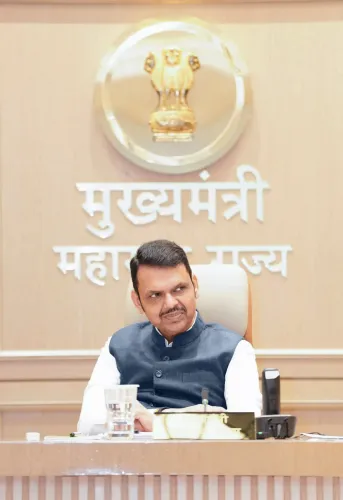
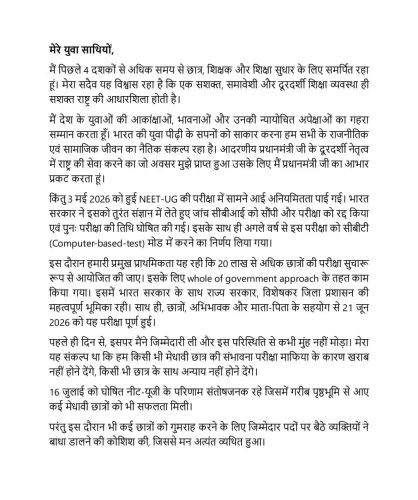
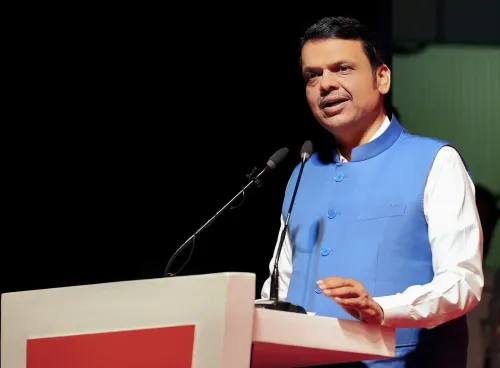
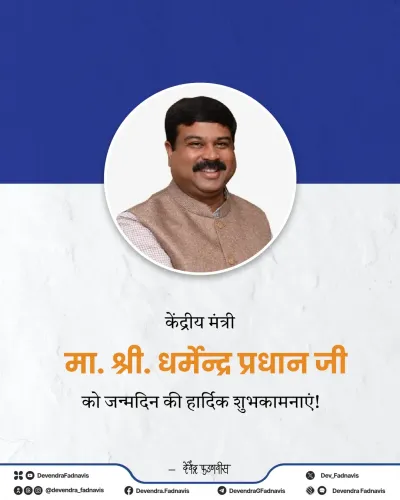
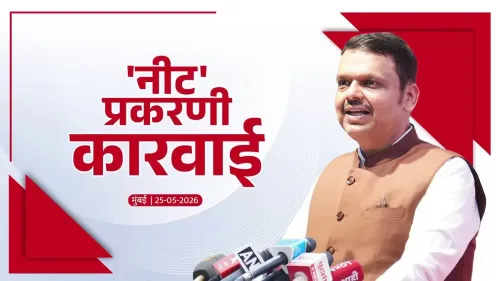
Maharashtra Chief Minister Devendra Fadnavis on Saturday, 25 July 2026 praised outgoing Union Education Minister Dharmendra Pradhan, crediting him with landmark reforms in India's education sector and calling his resignation an act of national interest over personal ambition.
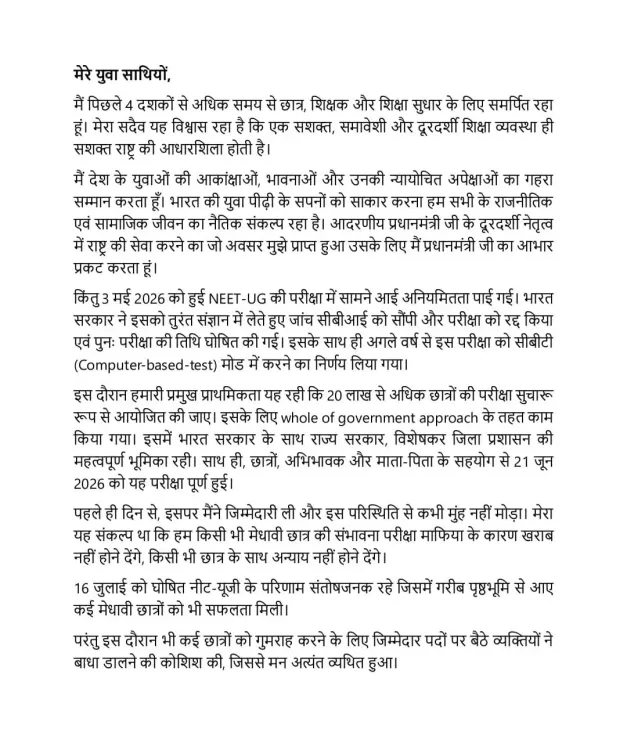
Posting on X, Fadnavis wrote: 'व्यापक समाज हित के लिए अपनी प्रतिबद्धता दर्शाते हुए उन्होंने आज अपना त्यागपत्र दिया' — 'Demonstrating his commitment to the broader public good, he submitted his resignation today.' He added that Pradhan placed national interest above personal interest, describing this as the hallmark of a true BJP worker, and that the entire BJP family stands with him.
Context
Dharmendra Pradhan served as Union Minister of Education and was the principal architect of the government's education modernisation agenda. Fadnavis specifically cited three pillars of Pradhan's tenure: implementation of the National Education Policy (NEP), the launch of PM SHRI Schools, expansion of Indian Institutes of Technology (IITs) to overseas campuses, and the extension of entrance examinations to 19 languages. The resignation was described by Fadnavis as a voluntary act in the public interest, not a political compulsion.
Policy Backdrop
The National Education Policy 2020, approved by the Union Cabinet in July 2020, replaced a policy dating to 1986 and introduced multidisciplinary learning, mother-tongue instruction at foundational levels, and greater flexibility in course choices. Pradhan oversaw its rollout across states and union territories, making it one of the most sweeping overhauls of India's education framework in decades.
The PM SHRI Schools scheme was launched to create model schools that embody NEP principles, serving as demonstration centres for teachers and administrators nationwide. Simultaneously, the government began expanding competitive entrance examinations — including JEE and NEET — to regional languages from 2021 onward, culminating in the 19-language reach highlighted by Fadnavis. Plans to establish IIT campuses abroad marked an effort to project Indian technical education onto a global stage.
Stakeholders and Impact
The reforms championed by Pradhan directly affect millions of school students, undergraduate aspirants, and higher-education institutions across India. The language expansion of entrance tests is particularly significant for students from non-Hindi, non-English speaking backgrounds in states such as Tamil Nadu, West Bengal, Odisha, and the northeastern region, who previously faced a linguistic barrier in national-level competitive exams.
Higher-education institutions, especially IITs, stand to gain international visibility and student diversity through overseas campuses. Fadnavis's statement signals that the BJP intends to project Pradhan's record as a governance success story even as a leadership transition unfolds in the education ministry.
What's Next
Attention now turns to who will be appointed as the next Union Minister of Education and whether the incoming minister will sustain the pace of NEP implementation, PM SHRI school rollouts, and the overseas IIT expansion programme. State-level compliance with NEP timelines — particularly on curriculum restructuring and teacher training — will be an early test for the new leadership. Fadnavis's public endorsement of Pradhan reinforces the BJP's organisational message that ministerial transitions are managed within a framework of collective party purpose rather than individual ambition.
Point of View
The BJP reinforces its internal narrative that leaders subordinate themselves to organisational and national priorities, a theme the party has deployed consistently during cabinet reshuffles. The specific enumeration of policy achievements — NEP, PM SHRI, IIT internationalisation, and language inclusion — serves to lock in a favourable legacy reading before a successor can reframe the education ministry's record. The statement also signals that Pradhan retains significant standing within the party, leaving open the possibility of a future reassignment. Politically, it insulates the BJP from any narrative that the resignation was forced or contentious.
NationPress
24 Oct 2026
Frequently Asked Questions
Why did Dharmendra Pradhan resign as Education Minister?
According to CM Devendra Fadnavis , Pradhan submitted his resignation on 25 July 2026 as an act of commitment to broader public interest, placing national interest above personal office. No other official reason has been stated.
What were Dharmendra Pradhan's key achievements as Education Minister?
Pradhan oversaw the implementation of the National Education Policy 2020 , launched the PM SHRI Schools scheme, expanded entrance exams like JEE and NEET to 19 languages , and advanced plans for IIT campuses overseas.
What is the PM SHRI Schools scheme?
PM SHRI Schools is a central government scheme that selects and upgrades existing schools to serve as model institutions demonstrating the principles of the National Education Policy 2020 , acting as demonstration centres for best teaching and administrative practices.
What is the National Education Policy 2020?
The National Education Policy 2020 was approved by the Union Cabinet in July 2020 . It replaced the 1986 education policy and introduced multidisciplinary learning, mother-tongue instruction at foundational levels, and greater flexibility in academic choices.
Who will be the next Union Education Minister after Pradhan's resignation?
As of 25 July 2026 , no successor has been officially announced. The appointment of the next Union Minister of Education and continuity of NEP and PM SHRI implementation are being closely watched.