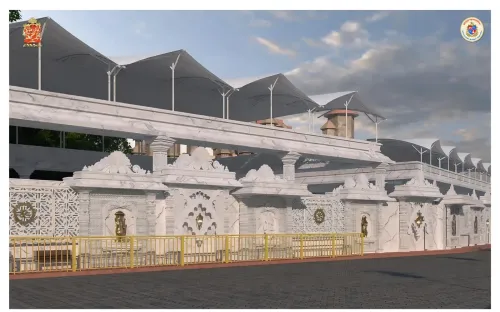
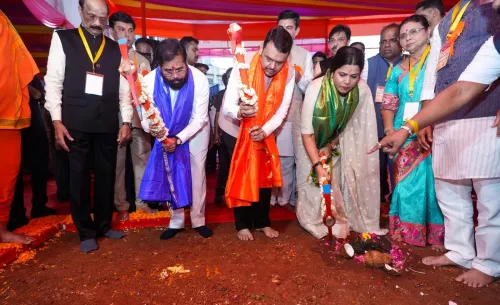
CM Fadnavis Launches Phase 1 of Siddhivinayak Temple Corridor
Synopsis
The Chief Minister's Office of Maharashtra announced on 26 May 2026 that work on the first phase of the Shri Siddhivinayak Temple Corridor in Mumbai has commenced, with CM Devendra Fadnavis associated with the launch of the urban-religious infrastructure project in Prabhadevi.
Key Takeaways
The Chief Minister's Office of Maharashtra officially announced the start of Phase 1 of the Shri Siddhivinayak Temple Corridor on 26 May 2026 .
Chief Minister Devendra Fadnavis is directly associated with the project's launch, as tagged in the official announcement.
The Siddhivinayak Temple in Prabhadevi, Mumbai attracts millions of devotees annually and has long faced congestion challenges.
The corridor project is being executed in phases, consistent with similar temple corridor initiatives undertaken across India.
Key areas to watch include progress on subsequent phases, land acquisition, and heritage or traffic impact consultations in the Prabhadevi area.
The Chief Minister's Office of Maharashtra announced on Tuesday, 26 May 2026 that work on the first phase of the Shri Siddhivinayak Temple Corridor in Mumbai has commenced, marking a significant step in the state government's urban and religious infrastructure agenda. Chief Minister Devendra Fadnavis is associated with the initiative, which aims to improve access and facilities around one of India's most visited Ganesh temples.
Context
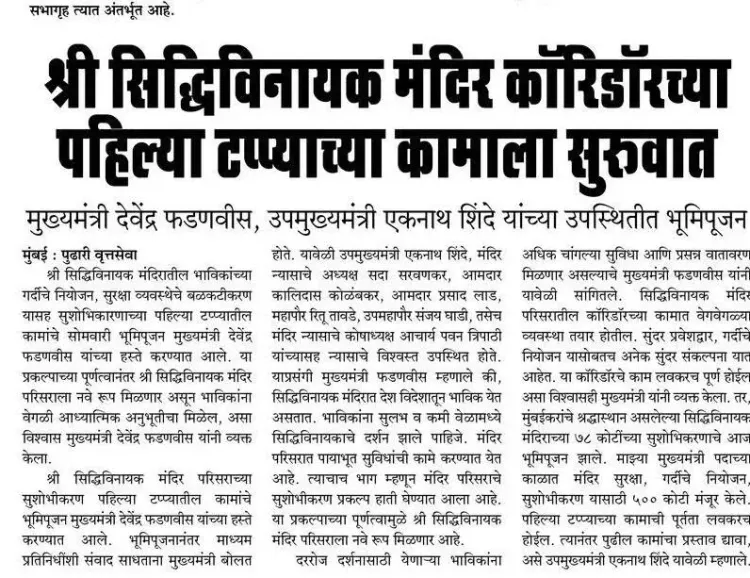
The post by the official Chief Minister's Office of Maharashtra account reads: 'श्री सिद्धिविनायक मंदिर कॉरिडॉरच्या पहिल्या टप्प्याच्या कामाला सुरुवात' — translated as 'Work on the first phase of the Shri Siddhivinayak Temple Corridor has begun.' The announcement tags Chief Minister Devendra Fadnavis directly, indicating his personal involvement in the project's launch.
The Siddhivinayak Temple, located in Prabhadevi, Mumbai, is among the most prominent religious sites in Maharashtra, drawing millions of devotees every year. The temple is managed by a public trust and sits in a densely populated urban neighbourhood, where footfall has long created congestion challenges.
Policy Backdrop
Maharashtra has a history of supporting redevelopment around major religious sites, with earlier proposals for improved facilities near Siddhivinayak having been discussed since the 2010s. The corridor project follows a broader national pattern in which state governments have pursued phased temple corridor developments to expand approach roads, add pilgrim amenities, and ease traffic around high-footfall shrines.
Similar corridor projects at prominent temples across India have combined urban planning objectives with religious tourism goals, typically executed in phases to manage both costs and disruption to surrounding neighbourhoods. The Government of Maharashtra, through its public works and urban development machinery, is the approving and funding authority for this initiative.
Stakeholders and Impact
The primary beneficiaries of the corridor project are the millions of devotees who visit Siddhivinayak Temple annually, as improved infrastructure is expected to ease access and reduce overcrowding. Mumbai residents in the Prabhadevi area stand to be directly affected by construction activity during the execution phase, with longer-term gains anticipated in traffic management and pedestrian safety.
The temple trust, local civic bodies, and urban planners are key institutional stakeholders. Heritage and community groups in the area may also weigh in as the project progresses, particularly regarding any changes to the built environment around the historic shrine.
What's Next
With the first phase now officially under way, attention will turn to the scope and pace of subsequent phases of the corridor. Land acquisition outcomes, public consultations on traffic rerouting, and any heritage impact assessments in the Prabhadevi neighbourhood will be closely watched by residents and civic groups alike.
The project's execution will also be a marker for the Fadnavis government's ability to deliver on urban infrastructure promises in Mumbai, a city where large-scale redevelopment projects have historically faced delays due to logistical and regulatory complexities.
Point of View
Who can now point to visible action on a project with deep emotional resonance among Mumbai's large devotee base. Temple corridor projects across India have served dual purposes — genuine urban decongestion and high-visibility governance symbolism — and Maharashtra is now firmly part of that national trend. For Fadnavis, delivering on this project in a phased, credible manner will matter more than the launch itself, given Mumbai's history of stalled redevelopment schemes. The project's trajectory will be watched as a test of the government's capacity to navigate the complex intersection of urban planning, heritage sensitivity, and religious sentiment in one of India's most scrutinised cities.
NationPress
10 Oct 2026
Frequently Asked Questions
What is the Siddhivinayak Temple Corridor project?
The Siddhivinayak Temple Corridor is a phased infrastructure project by the Maharashtra government to improve access roads, pedestrian facilities, and crowd management around the historic Siddhivinayak Temple in Prabhadevi, Mumbai.
When did work on the Siddhivinayak Temple Corridor begin?
Work on the first phase of the Siddhivinayak Temple Corridor officially began on 26 May 2026 , as announced by the Chief Minister's Office of Maharashtra.
Who is overseeing the Siddhivinayak Temple Corridor project?
Chief Minister Devendra Fadnavis and the Government of Maharashtra are overseeing the project, which is expected to be executed through the state's public works and urban development departments.
Where is the Siddhivinayak Temple located?
The Siddhivinayak Temple is located in Prabhadevi, Mumbai , Maharashtra. It is one of the most visited Ganesh temples in India.
How many phases does the Siddhivinayak Temple Corridor have?
The project is being developed in multiple phases. Phase 1 has now commenced; details of subsequent phases and their timelines are yet to be officially announced.