CM Fadnavis Eyes Maharashtra as Electronics Logistics Hub
Synopsis
Chief Minister Devendra Fadnavis has declared Maharashtra will become India's electronics logistics hub, leveraging the state's ports, industrial zones, and logistics corridors to attract supply-chain investment amid the national PLI-driven electronics manufacturing push.
Key Takeaways
The Chief Minister's Office of Maharashtra posted on 6 June 2026 , quoting CM Devendra Fadnavis on the state's electronics logistics hub ambition.
Maharashtra possesses strategic logistics assets including JNPT , Mumbai Port , and industrial clusters in Pune , Nashik , and Aurangabad .
India's PLI scheme for electronics , launched in 2020 , has intensified inter-state competition for electronics manufacturing and logistics investment.
Key stakeholders include electronics manufacturers, logistics firms, and ancillary industries such as packaging and last-mile delivery networks.
The next policy milestone to watch is a formal state electronics logistics policy or infrastructure announcement in the upcoming assembly session.
Maharashtra faces stiff competition from Tamil Nadu , Telangana , and Uttar Pradesh in attracting electronics sector investment.
The Chief Minister's Office of Maharashtra on Saturday, 6 June 2026, shared a post on X quoting Chief Minister Devendra Fadnavis, announcing the state's ambition to become a hub for electronics logistics. The post, carrying the hashtags #Maharashtra, #DevendraFadnavis, and #Electronics, signals a fresh push by the state government to position itself at the centre of India's growing electronics supply chain.
Context
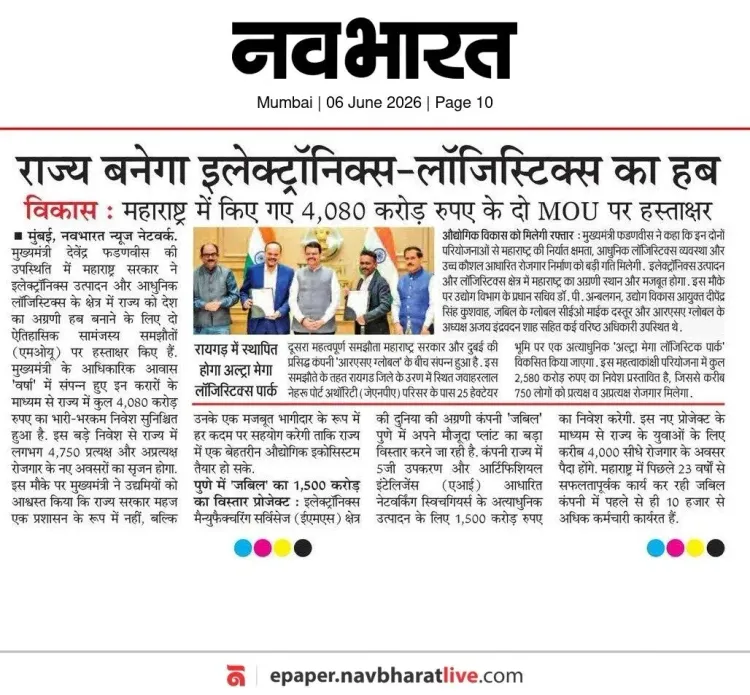
The post quotes CM Fadnavis as saying, 'Rajya banega electronics logistics ka hub' ('The state will become an electronics logistics hub'). The statement reflects a deliberate branding effort by the Maharashtra government to attract investment in the electronics sector, particularly in warehousing, distribution, and last-mile logistics infrastructure that supports component and finished-goods movement.
Maharashtra already hosts some of India's busiest logistics corridors, anchored by the ports of Mumbai and Jawaharlal Nehru Port (JNPT), multiple special economic zones, and established industrial clusters in Pune, Nashik, and Aurangabad. These assets give the state a structural advantage as electronics manufacturers seek efficient inbound and outbound supply chains.
Policy Backdrop
India's Production Linked Incentive (PLI) scheme for large-scale electronics manufacturing, launched in 2020, has accelerated domestic production and drawn global supply chains into the country. States have since competed aggressively to capture different segments of this ecosystem — from semiconductor fabrication and component manufacturing to assembly and logistics.
Maharashtra has historically focused on attracting large-scale industrial investment, and the Fadnavis administration has continued that tradition with targeted outreach to electronics and technology companies. A dedicated state electronics policy, alongside proposals for component parks and plug-and-play industrial zones, forms the broader policy architecture within which this announcement sits.
Indian states are now vying not just for manufacturing plants but for the logistics layer that connects factories to consumers — a segment that generates significant employment and ancillary economic activity. CM Fadnavis's framing of Maharashtra as an 'electronics logistics hub' is a direct play for this emerging market.
Stakeholders and Impact
Electronics manufacturers with production facilities in Maharashtra stand to benefit most directly from improved logistics infrastructure, as faster and cheaper movement of components reduces inventory costs and improves competitiveness. Logistics firms — both domestic and multinational — are the other primary audience, as hub status implies dedicated freight capacity, warehousing incentives, and regulatory facilitation.
Smaller ancillary industries, including packaging, cold-chain services for sensitive components, and last-mile delivery networks, could also see investment inflows if the state follows through with enabling policy. Employment generation in semi-skilled and skilled logistics roles is a downstream benefit that aligns with the government's broader jobs agenda.
What's Next
The immediate watch-point is whether the Maharashtra government tables a formal electronics logistics policy or announces specific infrastructure projects — such as dedicated electronics freight corridors or component parks — in the upcoming assembly session. Incentive structures for warehousing and multimodal logistics facilities would be key details to track.
Longer term, the state's ability to attract anchor tenants — large electronics brands or their tier-one suppliers — will determine whether the 'hub' ambition translates into measurable investment and job creation. The competitive pressure from states such as Tamil Nadu, Telangana, and Uttar Pradesh, all of which are aggressively courting the same sector, means Maharashtra will need to move quickly to convert intent into committed projects.
Point of View
But the announcement's impact will depend entirely on the policy specifics that follow. The BJP-led state government has a pattern of high-visibility investment pitches; the test is whether this translates into binding commitments from anchor investors. In a sector where speed of execution matters, the gap between political intent and on-ground infrastructure will be the defining variable.
NationPress
21 Oct 2026
Frequently Asked Questions
What did CM Devendra Fadnavis say about Maharashtra's electronics sector?
CM Devendra Fadnavis declared that Maharashtra will become an electronics logistics hub, signalling the state's intent to attract investment in electronics supply-chain and logistics infrastructure.
What is the PLI scheme and how does it relate to Maharashtra?
India's Production Linked Incentive scheme for electronics manufacturing was launched in 2020 to boost domestic production. Maharashtra is positioning itself to benefit from the scheme by developing logistics infrastructure that supports PLI-linked manufacturers.
Why is Maharashtra well-placed to become an electronics logistics hub?
Maharashtra has key logistics assets including JNPT, Mumbai Port, and industrial clusters in Pune, Nashik, and Aurangabad, making it a natural base for electronics freight and distribution.
Which states are competing with Maharashtra for electronics investment?
Tamil Nadu, Telangana, and Uttar Pradesh are among the states actively competing with Maharashtra to attract electronics manufacturers and logistics companies.
What policy announcements should we expect from Maharashtra on electronics logistics?
Analysts will watch for a formal state electronics logistics policy, dedicated freight corridor proposals, component park announcements, and warehousing incentive schemes in the upcoming Maharashtra assembly session.