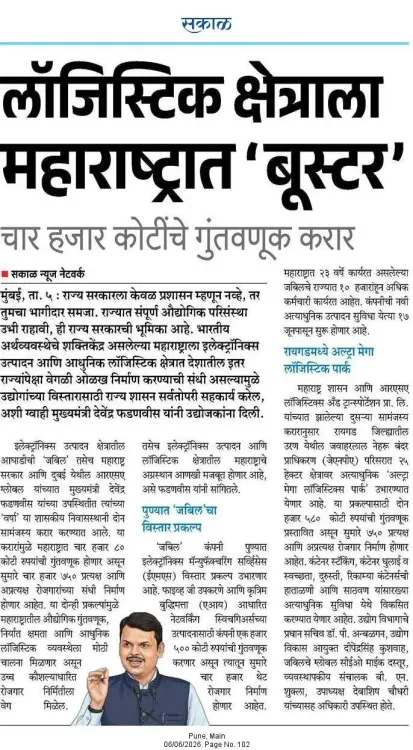
CM Fadnavis Gives Logistics Sector a 'Booster' in Maharashtra
Synopsis
The Chief Minister's Office of Maharashtra announced a 'booster' for the state's logistics sector on 6 June 2026, with CM Devendra Fadnavis credited for the push. The move aligns with central frameworks including the National Logistics Policy and PM Gati Shakti, positioning Maharashtra as a leading logistics hub in western India.
Key Takeaways
The Chief Minister's Office of Maharashtra announced a logistics sector boost on 6 June 2026 , crediting CM Devendra Fadnavis .
Maharashtra hosts JNPT , India's busiest container port, giving it a structural edge in logistics and trade.
The state's move aligns with the Union government's National Logistics Policy (2022) and the PM Gati Shakti Master Plan (2021) .
Key beneficiaries include private logistics operators, port-linked warehousing firms, and export-oriented manufacturers in hubs like Pune , Nashik , and Aurangabad .
Rollout details — including logistics park locations and investment commitments — are expected to follow in the coming weeks.
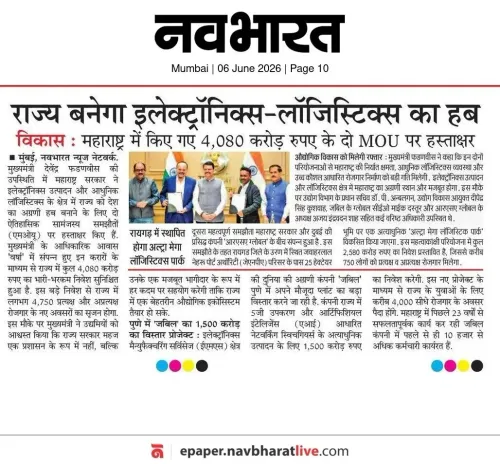
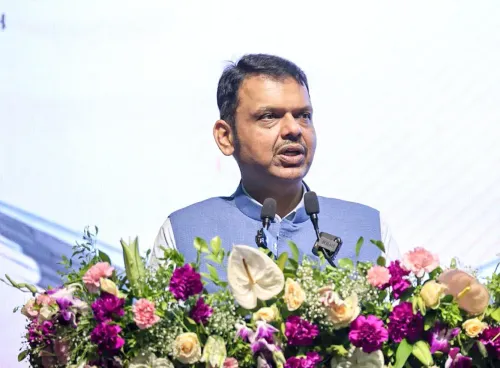
The Chief Minister's Office of Maharashtra announced on Saturday, 6 June 2026 that the logistics sector in the state is receiving a significant push, attributing the development to Chief Minister Devendra Fadnavis. The post, shared on the official CMO handle, described the move as a 'booster' — बूस्टर — for the logistics sector in Maharashtra.
Context
The CMO's post, captioned 'लॉजिस्टिक क्षेत्राला महाराष्ट्रात बूस्टर' — meaning 'A booster for the logistics sector in Maharashtra' — signals a fresh state-level initiative to strengthen the movement of goods, warehousing, and supply-chain infrastructure. Chief Minister Devendra Fadnavis, who has consistently championed industrial and infrastructure policy across his tenures, is credited with anchoring this push.
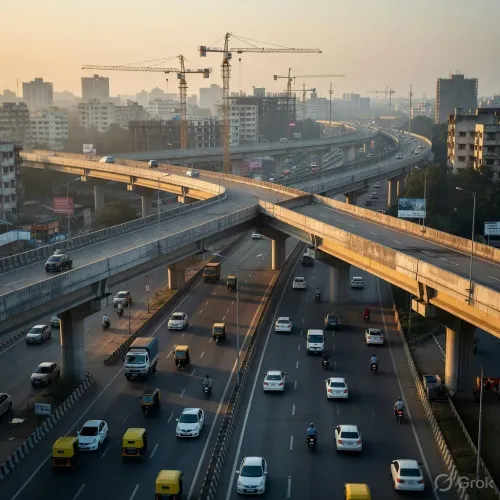
Maharashtra, as one of India's largest and most economically active states, is home to Jawaharlal Nehru Port Trust (JNPT) — the country's busiest container port — making it a natural hub for logistics activity. The state's coastline and road-rail connectivity give it a structural advantage in competing for warehousing and multimodal investment.
Policy Backdrop
The announcement aligns with two major central government frameworks. The National Logistics Policy, launched by the Union government in September 2022, set out to create a unified logistics ecosystem and reduce the country's high logistics cost as a share of GDP. Complementing this, the PM Gati Shakti National Master Plan, unveiled in October 2021, aims to integrate infrastructure planning across ministries and states through a digital mapping platform.
Maharashtra has been among the states most active in aligning its own industrial and infrastructure strategies with these central schemes. By positioning logistics as a priority sector, the state government is seeking to attract investment in multimodal parks, last-mile connectivity, and cold-chain infrastructure — areas identified as critical gaps in India's supply-chain ecosystem.
Stakeholders and Impact
The primary beneficiaries of a logistics 'booster' in Maharashtra would include private logistics operators, port-linked warehousing firms, e-commerce fulfilment players, and export-oriented manufacturers who depend on efficient cargo movement through Mumbai and Navi Mumbai corridors. Small and medium enterprises in manufacturing belts such as Pune, Nashik, and Aurangabad stand to gain from reduced turnaround times and lower freight costs.
India's ranking on the World Bank Logistics Performance Index has been a benchmark that both central and state governments have cited when justifying infrastructure investment. State-level execution — through land allocation, single-window clearances, and dedicated logistics zones — is widely regarded as the determining factor in translating national policy into ground-level change.
What's Next
Observers will watch for the rollout of specific incentive packages, the identification of new logistics park locations, and any formal investment commitments tied to this announcement. Maharashtra's industrial promotion agencies are expected to operationalise the details in the coming weeks.
With Indian states competing intensely to attract warehousing and multimodal investment, Maharashtra's latest push could set a benchmark for how coastal states leverage central logistics frameworks to deepen their industrial advantage — and strengthen their case ahead of future investor summits.
Point of View
The announcement is as much about signalling policy intent to investors as it is about on-ground delivery. Maharashtra's ability to translate central frameworks into state-level execution will be the real test — and one that competing states such as Gujarat and Telangana are watching closely. The timing also suggests the government is building a narrative around industrial momentum ahead of potential investor conclaves.
NationPress
22 Oct 2026
Frequently Asked Questions
What is the Maharashtra logistics booster announced by CM Fadnavis?
The Chief Minister's Office of Maharashtra announced a 'booster' for the logistics sector in the state on 6 June 2026, signalling fresh state-level investment and policy support for warehousing, multimodal parks, and supply-chain infrastructure under CM Devendra Fadnavis.
How does Maharashtra's logistics push connect to the National Logistics Policy?
Maharashtra's initiative aligns with the Union government's National Logistics Policy, launched in September 2022, which aims to create a unified logistics ecosystem and reduce logistics costs across India through coordinated state-level execution.
What is PM Gati Shakti and how does it relate to Maharashtra?
PM Gati Shakti is a national master plan launched in October 2021 to integrate infrastructure planning across ministries and states. Maharashtra is among the states aligning its logistics and industrial strategy with this framework to attract multimodal investment.
Which industries benefit from better logistics infrastructure in Maharashtra?
Private logistics operators, port-linked warehousing firms, e-commerce fulfilment players, and export-oriented manufacturers in industrial hubs such as Pune, Nashik, and Aurangabad stand to benefit from improved logistics infrastructure in Maharashtra.
Why is Maharashtra important for India's logistics sector?
Maharashtra hosts JNPT, India's busiest container port, and has extensive road-rail connectivity, making it a critical gateway for western India's trade and a natural anchor for national logistics improvement efforts.