CM Fadnavis: New Criminal Laws Boost Property Recovery for Victims
Synopsis
Maharashtra CM Devendra Fadnavis told the state assembly on 10 July 2026 that property recovery rates for complainants have risen under the new criminal laws — the BNSS and allied codes — that replaced India's colonial-era CrPC framework in July 2024.
Key Takeaways
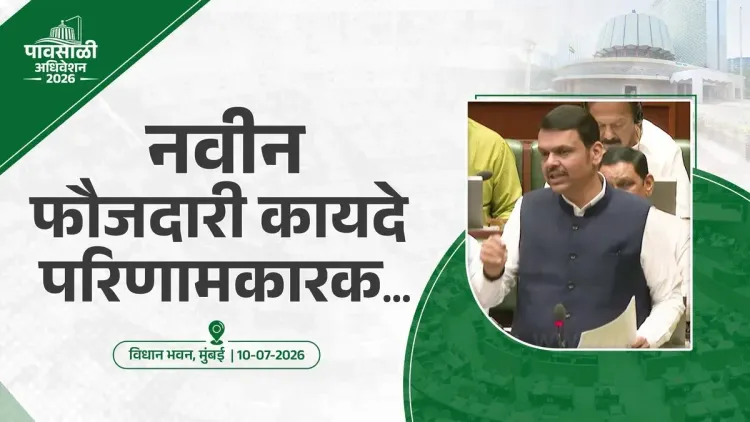
Maharashtra CM Devendra Fadnavis made the announcement at the Maharashtra Legislative Assembly during the Monsoon Session 2026 on 10 July 2026 .
He stated that the rate of property recovery for complainants has increased under the new criminal laws.
The new laws — Bharatiya Nyaya Sanhita , Bharatiya Nagarik Suraksha Sanhita , and Bharatiya Sakshya Adhiniyam — replaced the IPC, CrPC, and Evidence Act in July 2024 .
The BNSS introduced provisions for quicker, including interim, return of seized property to victims during ongoing trials.
Maharashtra is among the first states to formally present implementation outcomes of the new criminal codes before a state legislature.
State-wise data on the transition is being monitored nationally, with Maharashtra's figures likely to serve as a reference point.
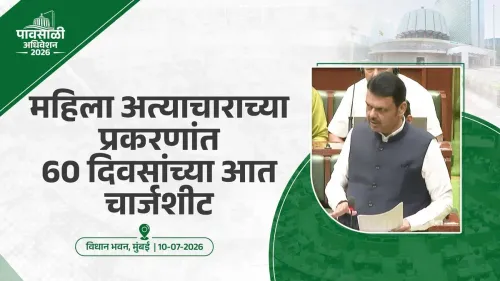
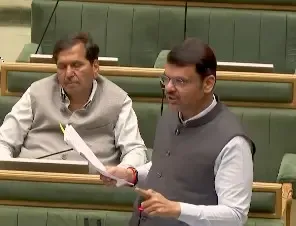
Maharashtra Chief Minister Devendra Fadnavis on Friday, 10 July 2026, told the Maharashtra Legislative Assembly in Mumbai that the rate of property recovery for complainants has risen under the new criminal laws that replaced India's colonial-era legal framework in July 2024.
Addressing the ongoing Monsoon Session 2026, Fadnavis stated — in both English and Marathi — that the नवीन फौजदारी कायद्यांमुळे फिर्यादीला मालमत्ता परत मिळण्याच्या प्रमाणात वाढ ('under the new criminal laws, the rate at which complainants receive their property back has increased'). The remarks signal that Maharashtra is tracking implementation outcomes of the landmark legal transition and presenting them before the legislature.
Context
In December 2023, Parliament passed three laws — the Bharatiya Nyaya Sanhita, the Bharatiya Nagarik Suraksha Sanhita (BNSS), and the Bharatiya Sakshya Adhiniyam — to replace the Indian Penal Code, the Code of Criminal Procedure, and the Indian Evidence Act respectively. All three came into force on 1 July 2024. The BNSS, in particular, introduced procedural provisions intended to expedite the return of seized property to victims and complainants.
The overhaul was framed by the central government as a move away from a colonial-era punitive framework toward one that centres victim rights and time-bound justice. State governments were tasked with operationalising the new codes and monitoring their on-ground impact.
Policy Backdrop
Property restitution to complainants has historically been a slow process under the old Code of Criminal Procedure (CrPC), often delayed by prolonged trials and procedural bottlenecks. The BNSS introduced clearer timelines and provisions that allow courts to order interim return of property to rightful owners even while a case is under trial.
State governments across India have been directed to compile and report implementation metrics during legislative sessions as part of a national monitoring framework for the criminal law transition. Maharashtra's presentation before the assembly represents one of the more formal instances of a state government placing such data on legislative record.
Stakeholders and Impact
The primary beneficiaries of improved property recovery rates are crime victims and complainants — individuals whose assets were seized as part of criminal investigations or court proceedings. Faster restitution reduces the economic hardship that complainants, particularly from lower-income groups, face during prolonged legal processes.
Law enforcement agencies, including the Maharashtra Police, are key operational stakeholders, as the speed of property return depends heavily on how efficiently investigating officers complete documentation and courts process applications. Lawyers and legal aid organisations working with victims also stand to benefit from clearer procedural norms under the BNSS.
What's Next
The Monsoon Session 2026 is expected to see further discussion on Maharashtra's implementation of the new criminal codes, potentially including data on case disposal rates and victim compensation. At the national level, central review meetings are likely to aggregate state-wise metrics, with Maharashtra's performance forming part of a broader assessment of how effectively the July 2024 legal transition has served victims across the country.
If Maharashtra's property recovery trends are formally tabled as a report, they could serve as a benchmark for other states still calibrating their implementation of the BNSS, strengthening the case for victim-centric criminal procedure reform as a measurable governance outcome.
Point of View
The Maharashtra government is signalling that the shift from the CrPC to the BNSS is yielding tangible victim-side benefits, not just procedural change on paper. This fits a broader BJP governance narrative that frames the 2024 criminal law overhaul as a break from colonial-era indifference to victims. How robustly Maharashtra can back these claims with granular, publicly available data will determine whether the statement becomes a replicable governance model or remains a rhetorical marker.
NationPress
9 Oct 2026
Frequently Asked Questions
What are the new criminal laws CM Fadnavis referred to in the Maharashtra Assembly?
The new criminal laws are the Bharatiya Nyaya Sanhita, the Bharatiya Nagarik Suraksha Sanhita (BNSS), and the Bharatiya Sakshya Adhiniyam, which replaced the IPC, CrPC, and Indian Evidence Act respectively and came into force on 1 July 2024.
How do the new criminal laws help complainants get their property back faster?
The BNSS introduced clearer timelines and provisions allowing courts to order the interim return of seized property to complainants even while a criminal case is still under trial, reducing the delays that were common under the old CrPC.
What did Devendra Fadnavis say in the Maharashtra Assembly on 10 July 2026?
CM Fadnavis stated that the rate at which complainants recover their property has increased under the new criminal laws, making the announcement during the Monsoon Session 2026 at the Maharashtra Legislative Assembly in Mumbai.
What is the Maharashtra Monsoon Session 2026 about?
The Maharashtra Legislative Assembly's Monsoon Session 2026 covers a range of governance and policy topics, including the implementation and outcomes of India's new criminal laws that replaced the colonial-era IPC-CrPC framework.
Which states are tracking the impact of the new criminal laws on victims?
State governments across India have been directed to monitor and report implementation metrics of the new criminal codes. Maharashtra is among the states formally presenting such outcomes before its state legislature.