CM Fadnavis vows to keep Maharashtra's data centre lead intact

Synopsis
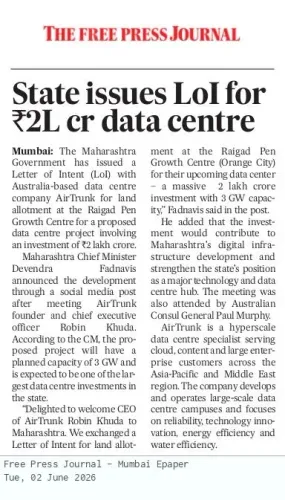
The Chief Minister's Office of Maharashtra declared on 28 October 2026 that the state will maintain its lead in India's data centre sector, with CM Devendra Fadnavis signalling policy continuity as competing states intensify efforts to attract cloud infrastructure investment.
Key Takeaways
The Chief Minister's Office of Maharashtra posted on 28 October 2026 asserting Maharashtra's intent to retain leadership in the data centre sector.
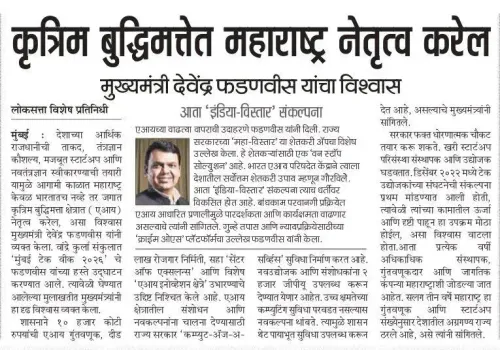
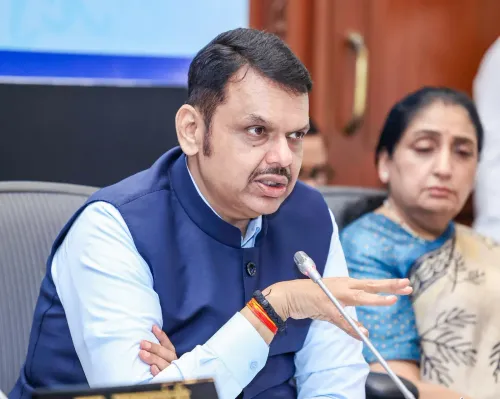
CM Devendra Fadnavis is the principal political figure behind the state's technology investment push.
The Maharashtra Data Centre Policy 2021 offers power-tariff subsidies and land allocation incentives to attract investment.
Mumbai has historically dominated India's data centre capacity due to sub-sea cable access, enterprise density, and grid maturity.
Multiple Indian states have launched rival data centre policies since 2020 , intensifying competition for hyperscale and colocation projects.
The next Invest Maharashtra summit is the expected platform to reveal specific new project commitments.
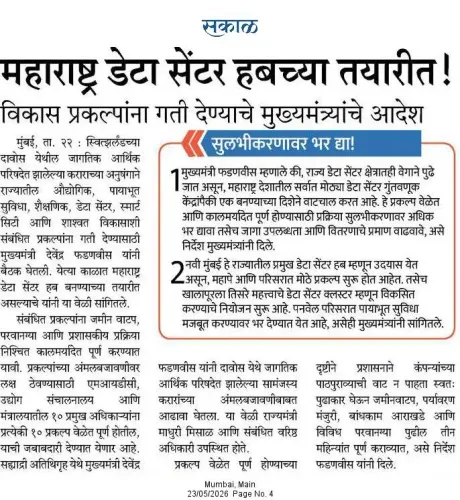
Maharashtra is not done chasing the cloud. On Wednesday, 28 October 2026, the Chief Minister's Office of Maharashtra posted a pointed declaration on X, signalling that the state under Chief Minister Devendra Fadnavis intends to defend its position at the top of India's data centre map: 'डेटा सेंटर के क्षेत्र में महाराष्ट्र का नेतृत्व बरकरार रहेगा!' — 'Maharashtra's leadership in the data centre sector will remain intact!'
Why Maharashtra became India's data centre capital
Maharashtra — and Mumbai in particular — emerged as the natural home for India's digital infrastructure because of a combination that no other state could easily replicate: sub-sea cable landing stations, a dense enterprise-client base, mature power grids, and decades of financial-sector connectivity. By the early 2020s, the state hosted a substantial share of national data centre capacity, attracting hyperscale cloud operators, colocation providers, and banking-sector IT stacks alike.
That head-start was formalised by the Maharashtra Data Centre Policy 2021, which offered structured incentives — including power-tariff subsidies and streamlined land allocation — to anchor new investments in the state. The policy was a direct competitive response to aggressive moves by Telangana, Tamil Nadu, and Uttar Pradesh, each rolling out their own data centre frameworks to capture a slice of demand driven by cloud adoption, digital payments, and India's data-localisation push.
A crowded race for cloud real estate
Since 2020, nearly every major Indian state has introduced some form of data centre incentive policy. The trigger: an explosion in enterprise cloud migration, the Reserve Bank of India's storage norms for payment data, and global hyperscalers scouting for Asia-Pacific expansion nodes. The demand pipeline is real and it is large — and rival state governments know it.
That competitive pressure is precisely what makes Fadnavis's assertion strategically timed. Reaffirming Maharashtra's ambitions publicly keeps investor confidence high and signals to data centre developers already in talks that policy continuity is not in question. Land acquisition timelines, power-purchase agreements, and connectivity upgrades are the unglamorous machinery behind such pledges — and the next Invest Maharashtra summit is the expected venue where those specifics will be tested.
What Fadnavis's signal means for investors
For data centre developers and IT companies eyeing western India, political commitment at the chief-ministerial level matters as much as the fine print of any policy document. Permitting bottlenecks, power-supply guarantees, and water-cooling infrastructure are perennial pain points in the sector; a direct statement from the CMO is a public accountability marker that industry groups will reference in future negotiations.
Maharashtra's challenge is to translate the rhetoric of leadership into faster project rollouts — because the states chasing it are no longer just offering incentives on paper. They are commissioning land banks and dedicated power feeders. The gap that once made Mumbai the default answer is narrowing. Whether Fadnavis widens it again or merely holds the line will show up in megawatt capacity numbers, not press releases.
Point of View
Publicly anchoring the state's ambitions keeps investor pipelines warm and reinforces the brand ahead of the next Invest Maharashtra summit. The real test, however, is execution: land clearances, dedicated power feeders, and water-cooling approvals are where Maharashtra has sometimes lagged its own rhetoric. The gap between a chief minister's tweet and a commissioned data centre hall is where the state's credibility will ultimately be measured.
NationPress
28 Oct 2026
Frequently Asked Questions
What did the Maharashtra CMO say about data centres on 28 October 2026?
The Chief Minister's Office of Maharashtra posted that 'Maharashtra's leadership in the data centre sector will remain intact,' signalling continued state commitment to attracting data centre investment under CM Devendra Fadnavis.
What is the Maharashtra Data Centre Policy 2021?
Introduced in 2021, the Maharashtra Data Centre Policy offers incentives including power-tariff subsidies and streamlined land allocation to attract data centre developers and IT companies to the state.
Why is Maharashtra a major hub for data centres in India?
Maharashtra, particularly Mumbai, benefits from sub-sea cable landing stations, a large enterprise and financial-sector client base, mature power infrastructure, and strong connectivity — making it the default location for much of India's data centre capacity.
Which states are competing with Maharashtra for data centre investments?
Telangana, Tamil Nadu, and Uttar Pradesh are among the states that have introduced their own data centre incentive policies since 2020, aiming to capture demand from cloud services, digital payments, and data localisation requirements.
When is the next Invest Maharashtra summit?
Specific dates for the next Invest Maharashtra summit have not been announced in the available information, but it is the expected platform where new data centre project commitments and policy updates are typically unveiled.