CM Fadnavis: No 'regime change' dream will succeed in India
Synopsis
Maharashtra Chief Minister Devendra Fadnavis, speaking in Nagpur on 18 October 2026, warned that those seeking to replicate regime changes seen in Nepal, Bangladesh, Sri Lanka, and Pakistan by rejecting India's Constitution will never prevail — a pointed message aimed at domestic opposition forces.
Key Takeaways
Devendra Fadnavis made the remarks in Nagpur on 18 October 2026 , a city with deep significance for BJP and RSS political messaging.
He explicitly named Nepal, Bangladesh, Sri Lanka, and Pakistan as examples of destabilising regime change to contrast with India's constitutional continuity.
The statement targets those he described as working to 'reject the Constitution' as the basis for political change in India.
BJP leaders have a long pattern of invoking constitutional supremacy during periods of heightened domestic political contestation.
Opposition parties in Maharashtra are expected to respond, questioning whether the remarks deflect from governance accountability.
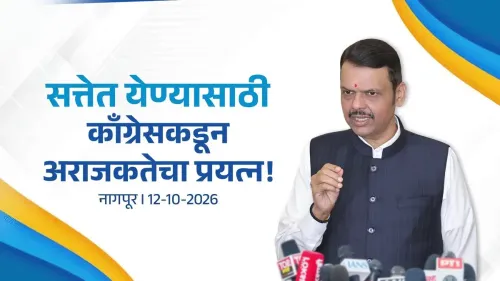
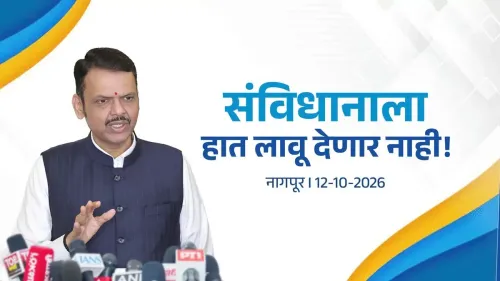
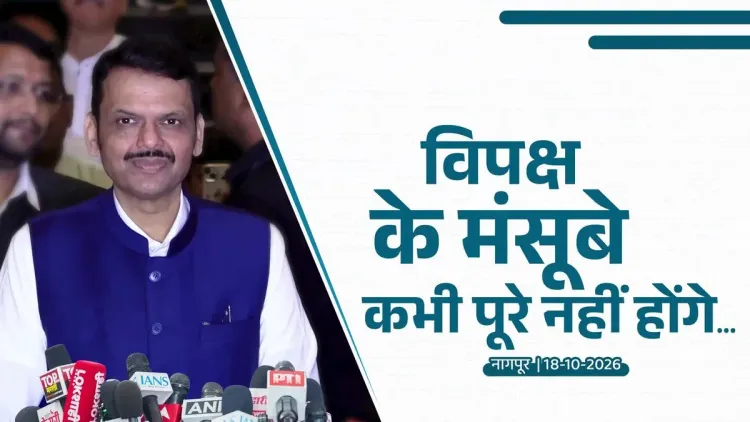
Those who dream of replicating the political upheavals of Nepal, Bangladesh, Sri Lanka, and Pakistan inside India — by rejecting its Constitution — will never succeed. That was the blunt, combative message Maharashtra Chief Minister Devendra Fadnavis delivered in Nagpur on Sunday, 18 October 2026, in remarks that immediately ignited political debate across the state.
Speaking at an event in the city that has historically served as a crucible for BJP and RSS political messaging, Fadnavis declared: 'Bharat mein Samvidhan ko nakar kar Nepal, Bangladesh, Sri Lanka aur Pakistan jaise regime change karne ka khwab dekhne walon ke mansoobe kabhi poore nahi honge' — 'The designs of those who dream of bringing about a regime change in India like Nepal, Bangladesh, Sri Lanka, and Pakistan — by rejecting the Constitution — will never be fulfilled.'
Four neighbours, one warning
The four countries Fadnavis invoked each carry a distinct, cautionary political history. Nepal dismantled its monarchy and rebuilt as a federal republic after prolonged unrest culminating in 2008. Bangladesh has cycled between elected governments and periods of military or caretaker rule across its existence since 1971. Sri Lanka saw its president resign and flee in 2022 after mass street protests fuelled by an acute economic crisis. Pakistan's history since independence is punctuated by military coups interspersed with fragile civilian rule.
By stitching those four names together, Fadnavis was drawing a deliberate contrast: India's constitutional order, he argued, is the bedrock that separates it from the political volatility next door. The subtext — pointed and unmistakable — was directed at domestic critics and opposition forces he characterised as working to delegitimise that constitutional framework.
Nagpur as a stage, the Constitution as armour
The choice of Nagpur is never incidental for BJP leaders. The city is the headquarters of the Rashtriya Swayamsevak Sangh (RSS), and major ideological statements from the party's Maharashtra leadership regularly originate here, amplifying their reach and symbolic weight.
Senior BJP leaders have repeatedly used constitutional continuity as both a shield and a sword in electoral and ideological battles — invoking it to deflect charges of democratic backsliding while simultaneously using it to delegitimise street-level protest or opposition mobilisation. Fadnavis's formulation follows that established playbook, but with heightened sharpness: naming specific foreign precedents raises the rhetorical stakes considerably.
Opposition parties in Maharashtra are expected to respond sharply, with several likely to argue that invoking foreign instability is a deflection from domestic governance accountability. What Fadnavis has done, deliberately or otherwise, is set the frame for that debate — on his own terms, on home ground, in Nagpur.
India's Constitution has survived seventy-plus years of stress tests. Whether today's political temperature demands that reminder — or whether it reveals anxiety about it — is the question the opposition will now press hard.
Point of View
With the Constitution repositioned as a nationalist totem rather than a shared civic compact. Naming four specific neighbours — each with a distinct crisis biography — raises the rhetorical temperature and forces opponents to argue on terrain Fadnavis has chosen. The Nagpur location compounds the signal, broadcasting the message to the broader Sangh ecosystem. The strategic risk is equally clear: framing dissent as a 'regime change' plot can itself invite accusations of conflating legitimate opposition with anti-state activity, a line the Supreme Court and civil society have historically been alert to.
NationPress
18 Oct 2026
Frequently Asked Questions
What did CM Devendra Fadnavis say in Nagpur on 18 October 2026?
Fadnavis declared that those dreaming of bringing about a regime change in India — by rejecting its Constitution — on the lines of what occurred in Nepal, Bangladesh, Sri Lanka, and Pakistan, will never succeed.
Why did Fadnavis mention Nepal, Bangladesh, Sri Lanka, and Pakistan?
He invoked those four countries as examples of political instability caused by the rejection of constitutional order, contrasting their experiences with India's constitutional continuity to warn against similar attempts domestically.
What is the significance of the speech being delivered in Nagpur?
Nagpur is the headquarters of the RSS and a historically important site for BJP and Sangh ideological messaging, lending additional symbolic weight to political statements made there.
Who is Devendra Fadnavis?
Devendra Fadnavis is the Chief Minister of Maharashtra and a senior BJP leader who has held the post multiple times.
How have opposition parties reacted to Fadnavis's statement?
Formal opposition responses had not been issued at the time of publication, but opposition groups are expected to argue that invoking foreign instability deflects from domestic governance accountability in Maharashtra.