CM Fadnavis unveils AI tool 'Tapas Saarathi' for Maharashtra Police
Synopsis
Maharashtra CM Devendra Fadnavis announced 'Tapas Saarathi', an AI-assisted investigation tool for the state police force, at the Vidhan Sabha during the Monsoon Session 2026 in Mumbai on 10 July 2026. The move advances Maharashtra's technology-driven policing agenda and follows national AI and digital governance initiatives.
Key Takeaways
Tapas Saarathi is an AI-assisted investigation tool developed specifically for the Maharashtra Police force.
The announcement was made by CM Devendra Fadnavis at the Maharashtra Legislative Assembly in Mumbai on 10 July 2026 .
The disclosure came during the Monsoon Session 2026 , giving it formal legislative significance.
Maharashtra's move follows similar AI policing pilots in Delhi and Telangana and aligns with the central government's Digital India agenda.
Rollout timelines, training plans, and data-oversight rules for the tool are yet to be publicly detailed.
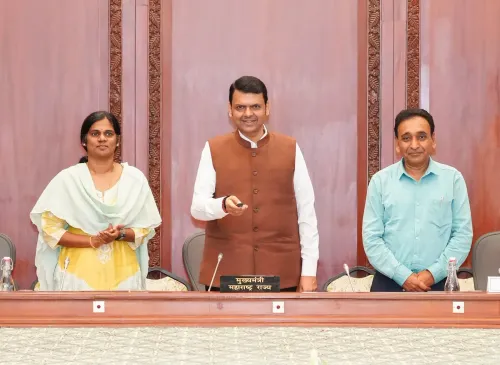
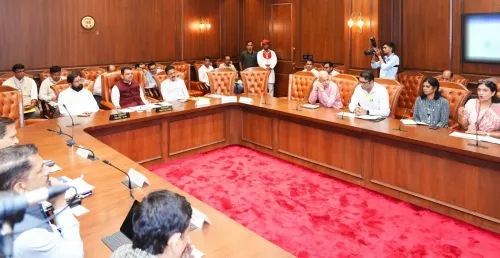
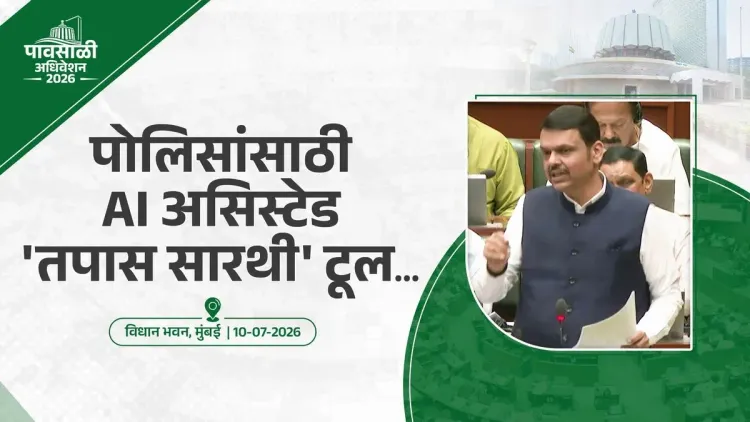
Maharashtra Chief Minister Devendra Fadnavis announced on 10 July 2026 that an AI-assisted investigation tool named 'Tapas Saarathi' has been developed for the state police force, making the disclosure during the ongoing Monsoon Session 2026 of the Maharashtra Legislative Assembly in Mumbai.
Addressing the Vidhan Sabha, Fadnavis stated — in his own words — that 'पोलीस दलासाठी एआय असिस्टेड तपास सारथी टूल विकसित केले आहे' ('An AI-assisted investigation tool, Tapas Saarathi, has been developed for the police force'). The announcement signals a significant step in the state government's effort to modernise criminal investigations through technology.
Context
The name Tapas Saarathi combines the Hindi/Marathi word for investigation (tapas, derived from tapaas meaning inquiry) with saarathi, meaning charioteer or guide — suggesting a tool designed to steer investigators through complex cases. The announcement was made from the floor of the state legislature, lending it formal weight beyond a routine administrative communication.
Fadnavis, who also holds the Home portfolio in Maharashtra, has consistently championed technology-driven policing since returning to the Chief Minister's office. The assembly's Monsoon Session 2026 has served as a platform for several governance announcements this week.
Policy Backdrop
India's push for AI in law enforcement has deep roots. The central government launched the Crime and Criminal Tracking Network and Systems (CCTNS) in 2009 to digitise police records and link stations nationwide. NITI Aayog's 2018 National Strategy for Artificial Intelligence flagged public safety as a priority domain for AI deployment.
Maharashtra's move follows pilots in states such as Delhi and Telangana, which have experimented with AI for facial recognition, predictive crime mapping, and document analysis. These state-level initiatives align with the central government's broader Digital India and internal security modernisation agenda.
Stakeholders and Impact
Maharashtra Police, one of India's largest state law enforcement agencies, stands to be the primary beneficiary. Investigation teams handling complex criminal cases could use the tool to process evidence faster and reduce case pendency — a persistent challenge in the Indian criminal justice system.
Civil liberties advocates and legal experts are likely to scrutinise the tool's data-handling framework, particularly around privacy safeguards and oversight mechanisms. The assembly session itself offers an immediate forum for legislators to seek those details from the government.
What's Next
Key questions remaining unanswered include the rollout schedule for Tapas Saarathi, the scope of police training modules that will accompany it, and whether the government will introduce formal rules governing data use and algorithmic accountability. Legislators from both the treasury and opposition benches are expected to seek specifics in the ongoing session.
If Maharashtra frames a robust regulatory structure alongside the tool's deployment, it could set a template for other states looking to integrate AI into their investigation pipelines — shaping the national conversation on technology-enabled policing.
Point of View
Who holds the Home portfolio, is anchoring technology modernisation as a legislative commitment, not merely an administrative exercise. Coming during the Monsoon Session, the announcement invites immediate legislative scrutiny, which could accelerate the framing of oversight rules. Maharashtra has historically been a bellwether for policing reforms in India, and if Tapas Saarathi is accompanied by a clear data-governance framework, it could pressure other states to follow suit. The broader arc here is India's gradual shift from CCTNS-era digitisation to AI-native law enforcement — a transition that raises both efficiency and civil liberties questions that policymakers are only beginning to address.
NationPress
9 Oct 2026
Frequently Asked Questions
What is Tapas Saarathi?
Tapas Saarathi is an AI-assisted investigation tool developed for the Maharashtra Police force, announced by Chief Minister Devendra Fadnavis on 10 July 2026 during the state assembly's Monsoon Session.
Who announced Tapas Saarathi?
Maharashtra Chief Minister Devendra Fadnavis announced the tool during the Monsoon Session 2026 of the Maharashtra Legislative Assembly in Mumbai.
How will Tapas Saarathi help the police?
The tool is designed to assist police investigation teams using artificial intelligence, potentially speeding up evidence processing and case resolution, though specific technical details have not yet been made public.
Is AI being used in Indian policing elsewhere?
Yes. States such as Delhi and Telangana have piloted AI tools for facial recognition, predictive crime mapping, and document analysis. The central government's CCTNS programme and NITI Aayog's AI strategy have also promoted technology adoption in law enforcement since 2009 and 2018 respectively.
What are the concerns around AI investigation tools in India?
Key concerns include data privacy, algorithmic bias, and the absence of clear oversight mechanisms. Experts and civil liberties groups typically call for legislative or judicial safeguards before such tools are deployed at scale.