Modi's Independence Day turbans: 12 years of India's textile heritage
Synopsis
Twelve years, twelve turbans — and this year's red Bandhej brought it full circle. Modi's Independence Day headwear is no longer just fashion; it is a carefully curated annual showcase of India's regional craft traditions, from Rajasthani Leheriya to Gujarati Bandhani, watched by millions and worth more to India's artisan economy than any press release.
Key Takeaways
PM Modi wore a red tie-and-dye Bandhej turban on 15 August 2025 , the 80th Independence Day , mirroring his debut choice in 2014 .
The turban tradition spans 12 years , with each design drawing from a distinct regional textile heritage including Bandhani , Leheriya , and Jodhpuri styles.
The only break in format came in 2020 , when a saffron-edged white scarf doubled as a face covering during the pandemic.
India's handloom sector employs an estimated 35 lakh artisans, according to government data.
The 2025 Leheriya turban in orange, yellow, and green preceded this year's return to the original Bandhej design.
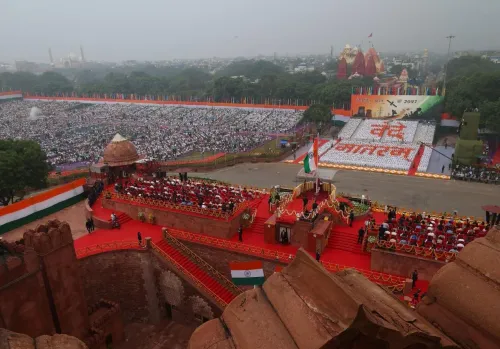
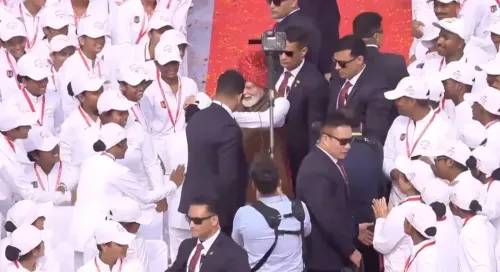
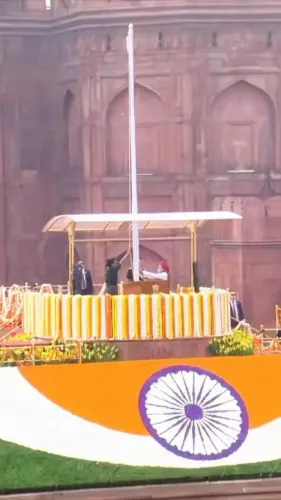
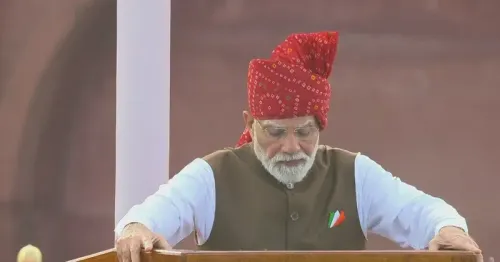
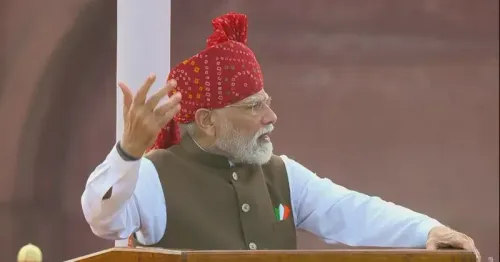
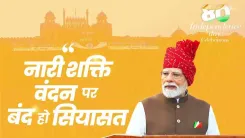
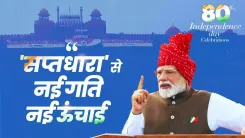
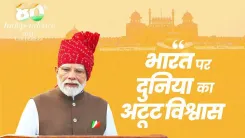
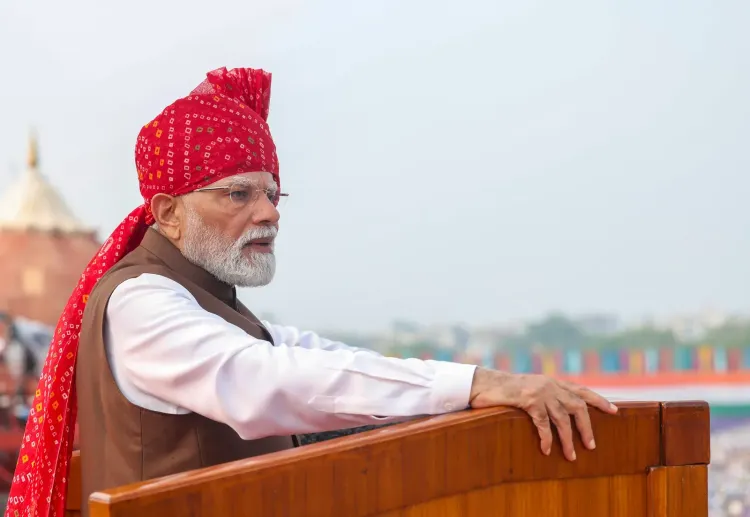
Prime Minister Narendra Modi marked the 80th Independence Day on 15 August 2025 from the ramparts of the Red Fort in a striking red tie-and-dye Bandhej turban — a design rooted in Rajasthani and Gujarati craft traditions — paired with a white kurta, chocolate-brown jacket, and three pocket squares in saffron, white, and green. The choice brought his 12-year Independence Day turban tradition full circle, closing a visual arc that began with an identical Bandhej design in 2014.
A Tradition That Began in 2014
When Modi first addressed the nation from the Red Fort on 15 August 2014, he wore a deep red Jodhpuri Bandhej turban — an understated but deliberate nod to India's craft heritage. What seemed like a personal style choice quickly became a closely watched annual statement, as distinctive in its own way as the speech delivered beneath it.
Notably, no other Prime Minister in recent memory has used Independence Day attire so consistently as a platform for regional textile representation, making Modi's turban choices a cultural institution in themselves.
Year-by-Year: The Turban Chronicle
Each year's selection has spotlighted a different thread of India's weaving and dyeing traditions. In 2015, a yellow and multi-coloured criss-cross turban took centre stage. 2016 brought a soft pink-and-yellow tie-and-dye design, while 2017 returned to a bold deep red and yellow contrast. Saffron dominated in 2018, with classic Indian colours continuing into 2019.
The 2020 pandemic year required adaptation: Modi wore a white scarf edged in saffron that also functioned as a face covering — the only year the format shifted under public health constraints. Cream and saffron returned in 2021, complemented by a half-sleeved kurta. In 2022, a saffron turban featuring red motifs and long hanging ends was paired with a blue jacket.
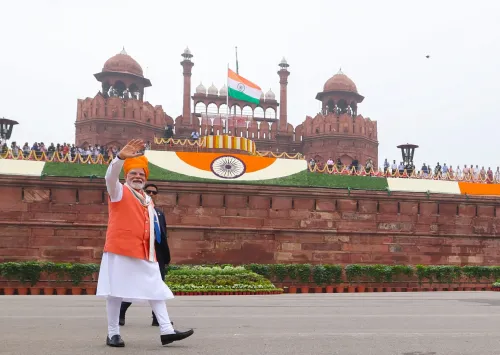
The 2023 edition featured a vibrant Bandhani print in yellow, green, and red. A colourful turban followed in 2024, and 2025 saw a bright Rajasthani Leheriya in orange, yellow, and green. This year's return to the rich red Bandhej design — echoing 2014 — was widely read as a deliberate full-circle moment.
What the Choices Represent
India's handloom and handicraft sector employs an estimated 35 lakh weavers and artisans, according to government data, making it one of the largest cottage industries in the country. Analysts of Indian fashion and soft diplomacy argue that high-visibility choices by national leaders — particularly on occasions with guaranteed global television coverage — carry measurable promotional value for these communities.
The turbans have drawn from at least three distinct regional traditions: Bandhej and Bandhani (tie-and-dye techniques from Rajasthan and Gujarat), Leheriya (wave-pattern dyeing from Rajasthan), and Jodhpuri draping styles. Each technique involves skilled hand-knotting or resist-dyeing processes that cannot be replicated by machine at equivalent quality.
Cultural Continuity as National Messaging
The annual turban has evolved beyond personal style into what observers describe as a quiet diplomatic tool — one that acknowledges India's regional diversity without requiring a single word. This year's Bandhej selection, arriving on the 80th Independence Day, reinforced that continuity while simultaneously underlining the craft's cross-regional resonance across Rajasthan and Gujarat.
As India's handloom sector navigates competition from power-loom and synthetic alternatives, the annual visibility from the Red Fort ramparts remains one of the most prominent platforms any Indian craft tradition can receive.
Point of View
High-visibility, and genuinely rooted in craft communities that rarely get prime-time attention. But the tradition also raises a quiet question: beyond the optics, have procurement and patronage for these specific craft clusters — Bandhej weavers in Jodhpur, Leheriya dyers in Jaipur — actually improved over the past decade? If the answer is unclear, the symbolism, however well-intentioned, risks becoming an annual photo opportunity rather than a policy signal. The 80th Independence Day was an opportunity to announce something substantive for the handloom sector alongside the visual tribute. That opportunity was not visibly taken.
NationPress
15 Aug 2026
Frequently Asked Questions
What turban did PM Modi wear on Independence Day 2025?
PM Modi wore a red tie-and-dye Bandhej turban on 15 August 2025, the 80th Independence Day, paired with a white kurta, chocolate-brown jacket, and pocket squares in saffron, white, and green. The design echoes the Jodhpuri Bandhej turban he first wore at the Red Fort in 2014.
What is Bandhej and where does it come from?
Bandhej — also known as Bandhani — is a traditional tie-and-dye textile technique practised primarily in Rajasthan and Gujarat. The process involves hand-knotting fabric before dyeing to create intricate patterns; it cannot be replicated by machine at equivalent quality and supports a large community of skilled artisans.
Has PM Modi always worn a turban on Independence Day?
Yes, Modi has worn a turban or equivalent headwear at every Independence Day address since 2014, with one adaptation in 2020 when a saffron-edged white scarf served as both headwear and a face covering during the pandemic. Each year's choice has spotlighted a different regional textile tradition.
Which regional textile traditions have Modi's turbans represented over the years?
Over 12 years, the turbans have drawn from Bandhej and Bandhani (Rajasthan and Gujarat), Leheriya wave-pattern dyeing (Rajasthan), and Jodhpuri draping styles, among others. The 2023 turban featured a Bandhani print; 2025 showcased a Rajasthani Leheriya in orange, yellow, and green before this year's return to Bandhej.
Why do PM Modi's Independence Day turbans attract attention?
The turbans have become a closely watched annual cultural statement because each design is understood as a deliberate nod to a specific regional craft tradition. With the Red Fort address guaranteed global television coverage, the choice gives visibility to India's handloom sector — which employs an estimated 35 lakh artisans — that few other platforms can match.