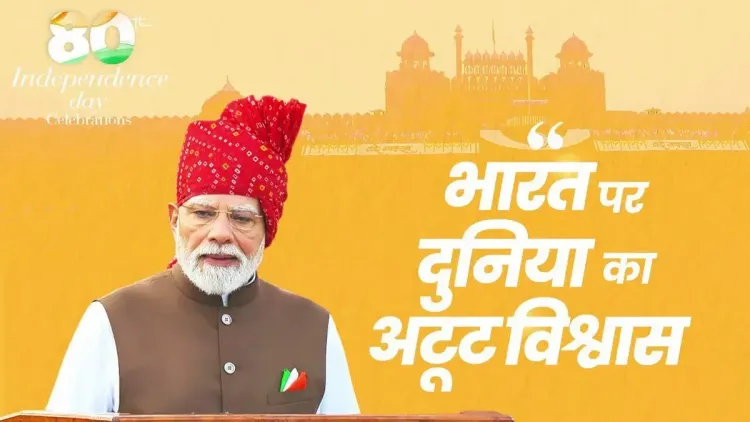
PM Modi on Independence Day: India's global respect rising on stable democracy
Synopsis
On Independence Day 2026, PM Modi posted that India's stable political mandate, vibrant democracy, strong judiciary, and Constitution are the reasons for the country's rapidly growing global respect — a recurring governance theme since 2014.
Key Takeaways
PM Narendra Modi posted on 15 August 2026 , India's Independence Day, crediting institutional stability for rising global respect.
He cited a stable political mandate , stable government , vibrant democracy , strong justice system , and the Constitution as India's core strengths.
The BJP-led NDA has held a clear Lok Sabha majority since the 2014 general election , which the party contrasts with prior coalition fragility.
The Constitution of India came into force on 26 January 1950 and is invoked here as a cross-partisan anchor for the stability argument.
The post extends Modi's consistent narrative linking domestic institutional strength to India's expanding diplomatic influence globally.
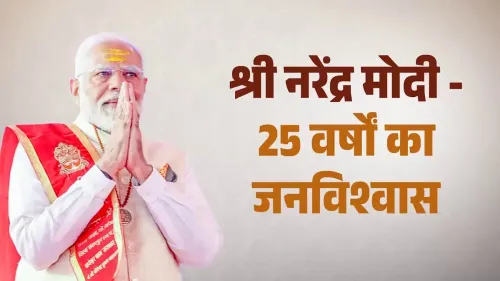
On Independence Day, 15 August 2026, Prime Minister Narendra Modi framed India's rising international standing not as a product of diplomacy alone, but as the direct consequence of something more foundational — a stable political mandate, a vibrant democracy, a robust judiciary, and a living Constitution that gives direction to over a billion people.
In a post on X, the Prime Minister wrote: 'आज भारत के पास स्थिर Political Mandate, स्थिर सरकार, वाइब्रेंट लोकतंत्र, मजबूत न्याय तंत्र और हम सबको दिशा देने वाला संविधान है।' — 'Today India has a stable political mandate, a stable government, a vibrant democracy, a strong justice system, and a Constitution that gives direction to all of us. That is why India's respect across the world is growing rapidly.'
Stability as the argument: from 2014 to now
The claim is rooted in a political arc that begins with the 2014 general election, when the BJP-led NDA secured a clear Lok Sabha majority — ending what the party has long characterised as an era of fragile coalition governments that diluted decision-making. Modi has consistently returned to this contrast: pre-2014 instability versus post-2014 coherence. On a national day, that contrast lands with particular force.
The invocation of the Constitution of India — which came into force on 26 January 1950 — is deliberate. It anchors a political narrative in an institution that transcends party lines, lending the argument a cross-partisan legitimacy that pure electoral messaging cannot.
Why 'global respect' is the punchline
The post's closing line — that India's global respect is 'growing rapidly' — is where domestic governance meets foreign-policy projection. India's expanding role in multilateral forums, its G20 presidency, and its positioning as a bridge between the Global South and developed economies have all been cited by the government as evidence of this rising stature. The argument Modi makes here is causal: institutional strength at home produces diplomatic weight abroad. Stable democracies, the logic runs, are taken seriously at the table.
For Indian citizens and international partners alike, the message is consistent with a brand India has been building — that of a large, predictable, constitutionally grounded democracy in an otherwise turbulent world. Whether the next parliamentary session or upcoming state elections sustain that narrative of mandate stability will be the real test of the argument.
Seventy-six years after the Constitution came into force, the Prime Minister's Independence Day message is ultimately a wager: that the world respects nations that respect their own institutions. India, he argues, is proving that wager right.
Point of View
Which in turn produces international credibility. By pairing 'stable mandate' with 'Constitution' in the same sentence, he attempts to fuse partisan achievement with constitutional legitimacy — a framing designed to be difficult to contest on purely institutional grounds. The 'global respect' claim does the heaviest political lifting, converting domestic governance into a foreign-policy dividend that voters can feel pride in. Ahead of any upcoming state elections, this kind of national-day messaging reinforces the stability-versus-chaos binary that has defined BJP's electoral communication since 2014.
NationPress
15 Aug 2026
Frequently Asked Questions
What did PM Modi say on Independence Day 2026?
PM Modi posted that India today has a stable political mandate, a stable government, a vibrant democracy, a strong justice system, and a guiding Constitution — and that these are the reasons India's global respect is growing rapidly.
Why does Modi link stable government to India's global respect?
Modi's argument is causal: strong domestic institutions — electoral stability, an independent judiciary, and a living Constitution — make India a predictable and credible partner on the world stage, boosting its diplomatic standing.
When did the Constitution of India come into force?
The Constitution of India came into force on 26 January 1950 , establishing the framework for parliamentary democracy and an independent judiciary that Modi referenced in his post.
What is the BJP's record of stable government that Modi refers to?
The BJP-led NDA has held a clear Lok Sabha majority since the 2014 general election , which the party consistently contrasts with the coalition-era governments that preceded it.
What does 'vibrant democracy' mean in Modi's Independence Day post?
In context, Modi uses 'vibrant democracy' to describe India's democratic system as active and functioning — part of a broader set of institutional pillars he credits for the country's rising international reputation.