PM Modi Renews Call to All Parties on Women's Reservation
Synopsis
On Independence Day 2026, Prime Minister Narendra Modi renewed his cross-party appeal to implement the Nari Shakti Vandan Adhiniyam — the 2023 law reserving one-third of Parliament seats for women — whose rollout remains tied to a pending census and delimitation exercise.
Key Takeaways
PM Narendra Modi on August 15, 2026 publicly appealed to all political parties to accelerate implementation of women's political reservation.
The Nari Shakti Vandan Adhiniyam , passed in September 2023 , reserves 33% of Lok Sabha and state assembly seats for women.
The law's activation is contingent on completion of a national census followed by a delimitation exercise — neither of which has been completed.
Modi has made similar public appeals on multiple occasions, consistently framing it as a matter requiring cross-party commitment.
The Independence Day platform amplifies the appeal's visibility, placing pressure on opposition parties to respond publicly.
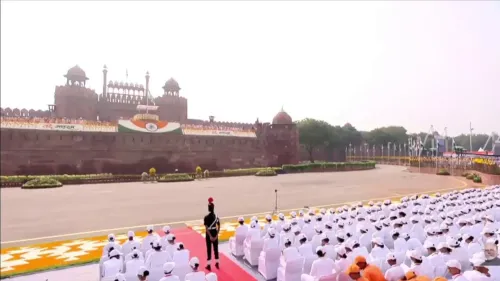
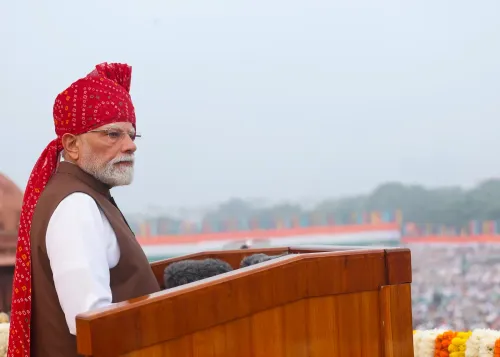
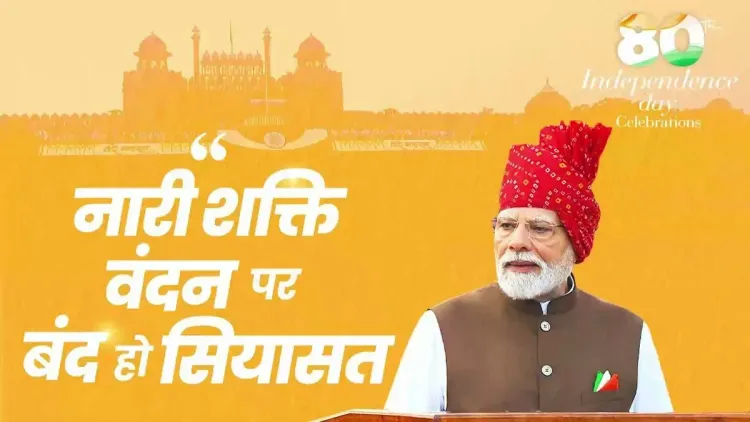
On Independence Day, August 15, 2026, Prime Minister Narendra Modi turned the nation's most-watched public occasion into a direct challenge to every political party in India — urging them, once again, to move swiftly toward implementing women's political reservation. The appeal, posted on X, carries unmistakable weight: it comes three years after Parliament made history by passing the landmark legislation.
In his post, Prime Minister Modi wrote: 'देश की मातृशक्ति को नमन करते हुए सभी राजनीतिक दलों से मैं एक बार फिर आग्रह करता हूं कि वे महिला आरक्षण को जल्द से जल्द लागू कराने के लिए आगे आएं।' — 'Saluting the Matri Shakti [mother power] of the nation, I once again appeal to all political parties to come forward and ensure women's reservation is implemented at the earliest.'
The Law That Passed — and the Clock That Has Not Yet Started
In September 2023, Parliament passed the Constitution (One Hundred and Twenty-eighth Amendment) Act — formally known as the Nari Shakti Vandan Adhiniyam — reserving one-third of seats in the Lok Sabha and state legislative assemblies for women. The vote was near-unanimous, a rare moment of cross-party solidarity. But the law contains a structural condition: the reservation kicks in only after a fresh delimitation exercise, which itself must follow the completion of a national census.
That sequencing is the bottleneck. No delimitation, no reservation. The census — delayed from its original cycle — has become the invisible gate between a historic law and its real-world effect. Every election that passes without the seats carved out is another cycle where the law exists on paper but not in Parliament's benches.
Why Modi Keeps Asking — and Who He Is Asking
This is not the first time the Prime Minister has made this appeal publicly, and the choice of platform matters. Independence Day is the one occasion when the entire political class, the media, and the public are paying attention simultaneously. By directing the call at 'all political parties' rather than at bureaucratic timelines, Modi frames the delay as a question of political will — not administrative process.
The move puts opposition parties in an uncomfortable position. Opposing women's reservation is politically untenable. But agreeing to accelerate the census and delimitation — processes the government controls — shifts the accountability question back toward the ruling side. The appeal is simultaneously a moral gesture and a political manoeuvre, and seasoned observers of Delhi's power corridors will read it as both.
Women aspirants across party lines, meanwhile, are watching for something more concrete: a government notification, a census roadmap, a delimitation timeline. Salutes to Matri Shakti are welcome. A date on the calendar would be more so.
Point of View
He deftly shifts the frame from administrative delay to political courage — a framing that is difficult for the opposition to contest without appearing to oppose women's empowerment itself. The appeal fits a broader BJP pattern of positioning the party as the architect of women's political inclusion while the implementation timeline remains, for now, in the government's own hands. Until the census roadmap is announced, the gesture — however sincere — will be read by critics as moral credit without operational commitment.
NationPress
15 Aug 2026
Frequently Asked Questions
What is the Nari Shakti Vandan Adhiniyam?
The Nari Shakti Vandan Adhiniyam, formally the Constitution (One Hundred and Twenty-eighth Amendment) Act of 2023, reserves one-third of seats in the Lok Sabha and state legislative assemblies for women. Parliament passed it in September 2023.
Why has the women's reservation law not been implemented yet?
The law's implementation is tied to the completion of a national census and a subsequent delimitation exercise to redraw constituency boundaries. Until both are completed, the reserved seats cannot be formally allocated.
What did PM Modi say about women's reservation on Independence Day 2026?
PM Modi appealed to all political parties to come forward and ensure women's reservation is implemented at the earliest, saluting what he called the 'Matri Shakti' — the mother power — of the nation.
Which parties voted for the women's reservation bill in 2023?
The bill was passed with near-unanimous support in both houses of Parliament during the special session in September 2023, with most major parties voting in favour.
When will women's reservation actually come into effect in India?
No official date has been confirmed. Implementation depends on the completion of a national census and a delimitation exercise; neither has been concluded as of the time of this report.