PM Modi Announces Landmark Initiative for Women's Empowerment in Parliament
Synopsis
As India gears up for a Special Session of Parliament focusing on amendments to the Nari Shakti Vandan Adhiniyam, PM Modi emphasizes the significance of this move in enhancing women's representation and empowerment. Discover the details behind this pivotal legislation.
Key Takeaways
Special Session of Parliament focused on women's empowerment.
Three amendment Bills to operationalize the Nari Shakti Vandan Adhiniyam.
33% reservation for women in Lok Sabha and State Assemblies.
Redefinition of population metrics for seat allocation.
Changes introduced to facilitate early implementation of the quota.
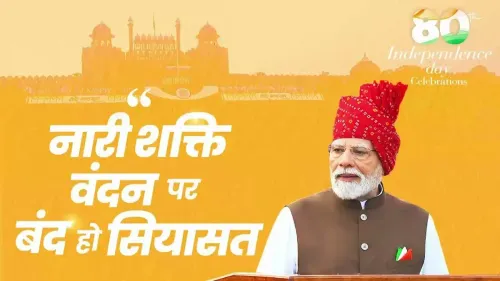
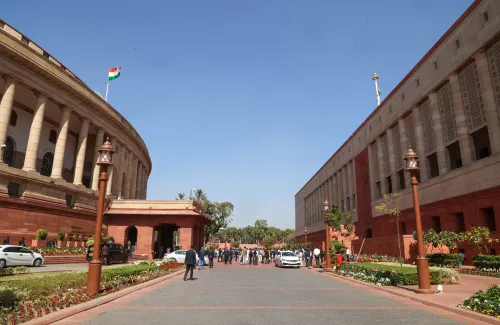
New Delhi, April 16 (NationPress) As the Special Session of Parliament is set to commence on Thursday to discuss amendments to the Nari Shakti Vandan Adhiniyam, Prime Minister Narendra Modi has termed this initiative a "historic milestone" for women's empowerment.
A three-day extraordinary session of the extended Budget session of Parliament kicks off today, focusing on proposed Constitutional amendments related to the Nari Shakti Vandan Adhiniyam.
In a statement on X, PM Modi expressed, "Today marks a significant moment in our journey towards empowering women. Respect for our mothers and sisters is synonymous with respect for our nation, and we are steadfastly advancing in this path."
The government plans to introduce three amendment Bills aimed at operationalizing legislation passed in 2023, which ensures a 33 percent reservation for women in both the Lok Sabha and State Assemblies.
This week, the Central government provided MPs with the draft of the Constitution (131 Amendment) Bill, 2026, which seeks to expand Lok Sabha seats to 850, incorporating representatives from States and Union Territories.
The Bill aims to establish a maximum of 815 members elected directly from constituencies in the States, while stating that "No more than 35 members will represent Union Territories, chosen in a manner prescribed by law."
Currently, there are 530 Lok Sabha members from States and 20 from Union Territories, although a delimitation commission had set the total at 543.
Additionally, the Bill proposes to redefine population metrics, granting Parliament authority to determine which census data will inform the expansion of seats.
The proposed modification to clause (3) of article 81 suggests, "In this article, 'population' refers to figures from the census as determined by law, with relevant data published."
Recently, the Union Cabinet approved the amendment Bill aimed at hastening the implementation of a 33 percent quota for women in Lok Sabha and Assemblies, alongside increasing the total number of seats in the lower house.
The amendment also seeks to revise article 82, replacing "Upon the completion of each census, the allocation of seats" with "The allocation of seats."
This change intends to dissociate the quota's implementation from the 2027 Census, utilizing 2011 Census data instead, paving the way for enactment ahead of the 2029 general elections.
Furthermore, the amendment Bill introduces a role for the Delimitation Commission under Article 82. It stipulates that in article 82 (c) of the Constitution, "for the words 'by such authority and in such manner', the words 'in such manner and on the basis of such census, by the Delimitation Commission' shall be substituted." The Bill also discusses the rotation of reserved seats in the Lok Sabha and Assemblies and includes provisions regarding the duration of women's reservation, subject to Parliamentary extension.
Prior to this special session, several political factions, including the Bharatiya Janata Party, Janata Dal (United), Lok Janshakti Party (Ram Vilas), and the Congress, have issued directives for their MPs to be present and align with party positions during the discussions.
Point of View
The proposed amendments to the Nari Shakti Vandan Adhiniyam represent a significant step towards enhancing women's representation in Indian politics. This initiative not only aims to empower women but also to align with the broader objectives of gender equality in governance.
NationPress
18 Sept 2026
Frequently Asked Questions
What is the Nari Shakti Vandan Adhiniyam?
The Nari Shakti Vandan Adhiniyam is a legislative framework aimed at reserving 33 percent of seats for women in the Lok Sabha and State Assemblies.
When was the Nari Shakti Vandan Adhiniyam passed?
The Nari Shakti Vandan Adhiniyam was passed in 2023.
What changes are proposed in the current amendments?
The amendments propose to increase the total number of Lok Sabha seats and redefine the criteria for determining representation based on population data.
How will the amendments impact women's representation?
The amendments are expected to facilitate the early implementation of the 33 percent reservation for women, enhancing their representation in Indian politics.
Why is this session considered historic?
This session is historic as it marks a pivotal moment in India's legislative journey towards ensuring greater empowerment and representation for women.