Congress and DMK Challenge Women's Reservation Bill Amendments
Synopsis
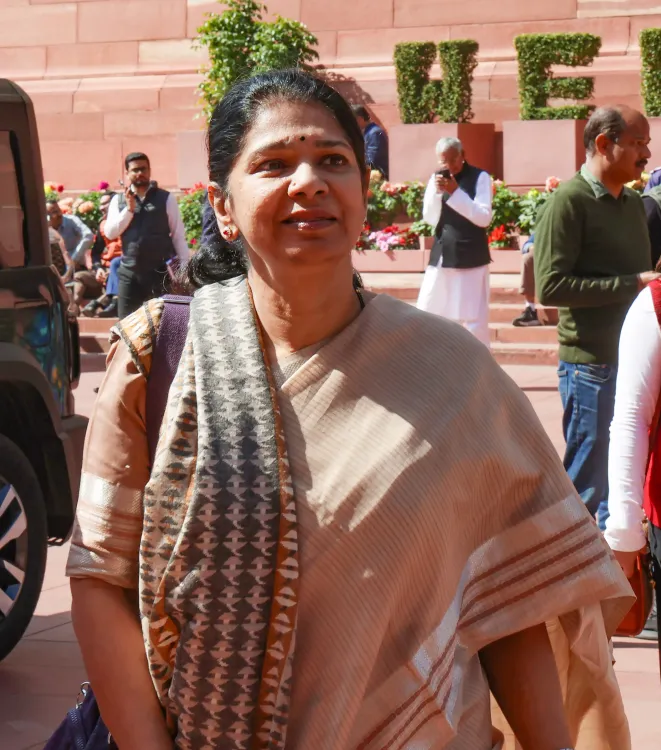
On April 16, Congress MP Hibi Eden and DMK leader Kanimozhi Karunanidhi moved motions opposing amendments to the Nari Shakti Vandan Adhiniyam in the Lok Sabha, amidst significant political discussions about women's reservation in India.
Key Takeaways
Congress and DMK oppose the amendments to the Nari Shakti Vandan Adhiniyam .
Three key amendment Bills are under discussion in Parliament.
Concerns raised by southern state leaders about representation.
The amendment aims to implement a 33% reservation for women faster.
Political parties are mobilizing their MPs for the special session.
New Delhi, April 16 (NationPress) Congress Lok Sabha MP Hibi Eden alongside DMK Parliamentary Party leader Kanimozhi Karunanidhi introduced motions on Thursday to challenge the amendments to the Nari Shakti Vandan Adhiniyam within the Lok Sabha.
This action coincides with the commencement of a three-day special session of the extended Budget session of Parliament, focusing on discussions regarding proposed Constitutional amendments related to the enforcement of the Nari Shakti Vandan Adhiniyam.
The three key amendments include the Constitution 131st Amendment Bill, 2026; Union Territories Laws (Amendment) Bill, 2026; and Delimitation Bill, 2026.
In the midst of the delimitation debate, Telangana Chief Minister Revanth Reddy is expected to arrive in Parliament later today.
He has also reached out to Prime Minister Narendra Modi via a letter, expressing his worries that the proposed delimitation could adversely affect southern states.
Furthermore, Reddy has urged the CMs of Karnataka, Tamil Nadu, Kerala, and Puducherry to unite in their opposition and advocate for equitable representation.
Anticipation surrounds the government’s introduction of three amendment Bills designed to activate legislation passed in 2023, which aims to secure a 33 percent reservation for women in both the Lok Sabha and State Assemblies.
Earlier this week, the Central government provided MPs with the text of the Constitution (131 Amendment) Bill, 2026, which seeks to increase the number of Lok Sabha seats to 850, including those from States and Union Territories.
The Bill proposes a limit of 815 members elected directly from State constituencies. For Union Territories, it states that "Not more than 35 members shall represent the Union Territories, elected in a manner determined by law by Parliament."
Currently, there are 530 Lok Sabha members from States and 20 from UTs, with a delimitation commission having set a total of 543.
Another significant amendment under consideration is the definition of population, which would empower Parliament to determine which census data will serve as the basis for the expansion of seats.
The Bill proposes to modify clause (3) of article 81 of the Constitution to read, "(3) In this article, the term 'population' refers to the population as calculated in the census determined by Parliament, with relevant figures published."
Recently, the Union Cabinet approved the Bill aimed at amending the Constitution for the swift implementation of the 33 percent quota for women in both the Lok Sabha and Assemblies, as well as increasing the number of seats in the lower house of Parliament.
The amendment Bill further proposes changes to article 82, replacing "Upon the completion of each census, the allocation of seats" with "The allocation of seats."
This proposed change aims to dissociate the quota's implementation from the 2027 Census and instead base it on the 2011 Census, facilitating rollout prior to the 2029 general elections.
Moreover, the amendment Bill aims to introduce a role for the Delimitation Commission in Article 82. It states that in article 82 (c), "for the words 'by such authority and in such manner', the words 'in such manner and based on such census, by the Delimitation Commission', shall be substituted." The Bill also discusses the reservation of seats on a rotational basis in the Lok Sabha and Assemblies, along with stipulations regarding the duration for which the women's reservation will remain valid, subject to parliamentary extension.
In anticipation of the special session, several political factions, including the Bharatiya Janata Party, Janata Dal (United), Lok Janshakti Party (Ram Vilas), and Congress, have issued a three-line whip instructing their MPs in both Houses to attend and align with the party's stance during the proceedings.
Point of View
The opposition to the amendments surrounding women's reservation highlights the ongoing debates over representation and equality in India. This situation reflects the broader struggle for women's rights in the political sphere, as various parties align themselves ahead of crucial legislative discussions.
NationPress
21 Oct 2026
Frequently Asked Questions
What is the Nari Shakti Vandan Adhiniyam?
The Nari Shakti Vandan Adhiniyam is legislation aimed at providing a 33% reservation for women in the Lok Sabha and State Assemblies.
What are the key amendments being proposed?
The proposed amendments include the Constitution 131st Amendment Bill, the Union Territories Laws (Amendment) Bill, and the Delimitation Bill.
Why are some politicians opposing these amendments?
Opponents, including Congress and DMK leaders, believe that the amendments may not adequately represent the interests of southern states and could alter the balance of political power.
What impact could these amendments have on future elections?
These amendments could change the number of Lok Sabha seats and the basis for representation, thus impacting the political landscape ahead of the 2029 general elections.
How are political parties responding to this issue?
Several political parties have issued directives for their MPs to support the party line during discussions on these amendments.